'>

Thursday, 22 January 2026

Fiash landings this week in Newlyn.

Dates: January 19th – January 22nd, 2026


It’s been a busy week at the market with over 100 tonnes of fresh catch passing through the doors. While the start of the week saw heavy volumes led by MSC Hake and Mediterranean Octopus, the latter half shifted towards high-value prime species like Dover Sole and Monkfish.

📈 Weekly Overview

Total Weight Landed: £100,596.17 

Total Market Value: ££510,806.77

Average Price: £5.08/

Top Species by Value:

MSC Hake: £113,315

Mediterranean Octopus: £85,780

Monkfish: £71,931

Dover Sole: £49,797

Bass: £37,760


🗓 Daily Breakdown

Monday, January 19th: Peak Volume

The week started with a massive landing, accounting for nearly 45% of the week's total volume.

Total Landed: 44,366

Market Value: £215,483

Key Highlights: MSC Hake dominated the day with over £11,000 landed. Pot-caught Mediterranean Octopus also saw strong numbers £36,585

Top 3 Species (by Value): MSC Hake, Mediterranean Octopus, and Monkfish.

Tuesday, January 20th: High Diversity

Tuesday saw the greatest variety of species throughout the week, with 62 different types of fish and shellfish hitting the market.

Total Landed: £30,622

Market Value: £159,951

Key Highlights: MSC Hake and Octopus remained the primary volume drivers, while Bass landings increased significantly, contributing over £16,000 to the day's total.

Top 3 Species (by Value): MSC Hake, Mediterranean Octopus, and Bass.

Wednesday, January 21st: Prime Fish in Focus

While volumes began to dip mid-week, the average value remained steady as prime species like Monkfish took the lead.

Total Landed: £19,972

Market Value: £99,240

Key Highlights: Monkfish became the highest-value species of the day, fetching over $£18,000.  We also saw a significant landing of Cuttlefish £2,848

Top 3 Species (by Value): Monkfish, MSC Hake, and Dover Sole.

Thursday, January 22nd: Quality Over Quantity

Thursday saw the highest average price per kilo ($£6.41/\text{kg}$) as the market shifted toward premium prime catches.

Total Landed: £5,633

Market Value: £36,13

Key Highlights: Dover Sole was the star of the show, making up nearly half of the day's total market value ($£17,287$).

Top 3 Species (by Value): Dover Sole, Monkfish, and Bass.


Market Note: The strong presence of MSC Hake throughout the week continues to demonstrate the consistent demand for sustainable, high-volume whitefish, while the late-week surge in Dover Sole prices highlights the premium market for local prime species.

Scottish Seiner Benefits from CatchCam Underwater Monitoring Systems

MFV Acionna GK44 - seine netter

Seine netting is among the most cost-efficient and sustainable commercial fishing methods, but it comes with its own set of challenges.

Managing such a large net over long distances is one of them. Especially when we’ve got strong tides to deal with, in the middle of the busiest waterways on the planet. This is exactly what the crew of the 24m Scottish vessel Acionna GK44 was facing. Factors like vessel speed, tide conditions, and chain weight – aside from the net itself – all influence how effectively fish are caught.

So, how can you tweak your setup to ensure a good haul? The compact CatchCam & SeaSensor systems might just be the answer.

Improving Catch Efficiency with Camera and Sensor Technology

In fishing, not knowing what’s happening underwater means costly guesswork. Traditionally, skippers rely on their experience, tides, and seasonality to predict good fishing conditions.

However, as any seasoned fisherman will tell you, fishing can make a fool of us all. Not seeing the full picture can mean the difference between coming back home empty-handed or with a great haul.

Underwater cameras like CatchCam provide a valuable look into the action, capturing visual evidence of how the gear and catch are behaving, but they don’t tell the whole story—especially in deeper or turbulent waters. This is where SeaSensor fills the gap. Mounted on the headline, it captures accurate data on net depth, movement, water temperature, and turbidity, providing a fuller picture of what’s happening underwater.


Net-Mounted CatchCam Systems

Seine netting might seem straightforward, but the reality is it requires an enormous amount of skill and concentration, much more so than demersal trawling, dare we say it! While both methods use similar nets, the way they operate is completely different. In seine netting, the vessel shoots a long rope in a wide circle around the fish, followed by the net itself. Then, as the rope is hauled in, it guides the fish into the net.

Variables such as tide conditions, seabed obstacles, vessel speed, and rope coiling all influence how well the net performs. Skippers must make constant calculations to ensure optimal net shape and positioning to maximise their catch while avoiding gear damage or loss.

On the Acionna, which targets prime demersal and non-quota species, our aim was to build an understanding around how every factor affected the fishing operation. For this commercial deployment, the team fitted:

  • Three CatchCam cameras strategically positioned around the net,
  • One SeaSensor, mounted at the centre of the headline to measure net height and movement, along with the water temperature and turbidity.

The trial took place over two days, first targeting squid in the East English Channel, then shifting to prime demersal fish much further west, off of Lyme Bay. As the vessel moved through different waters, the combined CatchCam footage and SeaSensor data helped track net drag, shape and even fish movement throughout the haul – and into the codend.

"It was interesting to get an exact insight as to what the net is doing, and therefore how the gear needs to be hauled for different target species and particularly different types of bottom." shared Aaron Brown, skipper of the 24m Seiner Acionna, in an interview with Fishing News.

Collecting Underwater Data aboard the Scottish Seiner

Each deployment provided more insights until, by the end of the trial, a clear picture of the net’s performance emerged:

Chain weight impacts performance: An 80kg chain attached to the bosom brought the gear to settle within 1 minute of shooting. However, the chain had drawbacks: it slowed the hauling speed, was prone to fraying against the bottom sheet causing wear, and caused the headline to dip – leading to catch loss. On the other hand, without the chain, the net took 8 minutes to sink, drifting far from the target area. Net shape varies throughout the tow: For most of the time, the net remains loose and undulating, only reaching full tension toward the end. This is also when fish start entering, and the codend begins to fill. The timing of this could have a significant impact on the catch rate for the haul.

Fish behaviour and catch timing: Data revealed that fish typically start entering the codend in the final 10 minutes of the tow, staying calm until the net is hauled onboard. That explains why the quality of the catch is so high. Speed influences net performance: As vessel and hauling speed fluctuated, the headline height changes, confirming the need to maintain a good steady speed towards the end of the haul. By integrating sensor data with video footage, the skipper was delighted to see that certain aspects of his gear were working well. Thus, he was now able to focus his attention on the areas that needed improvement, including gear positioning.


SeaSensor Data


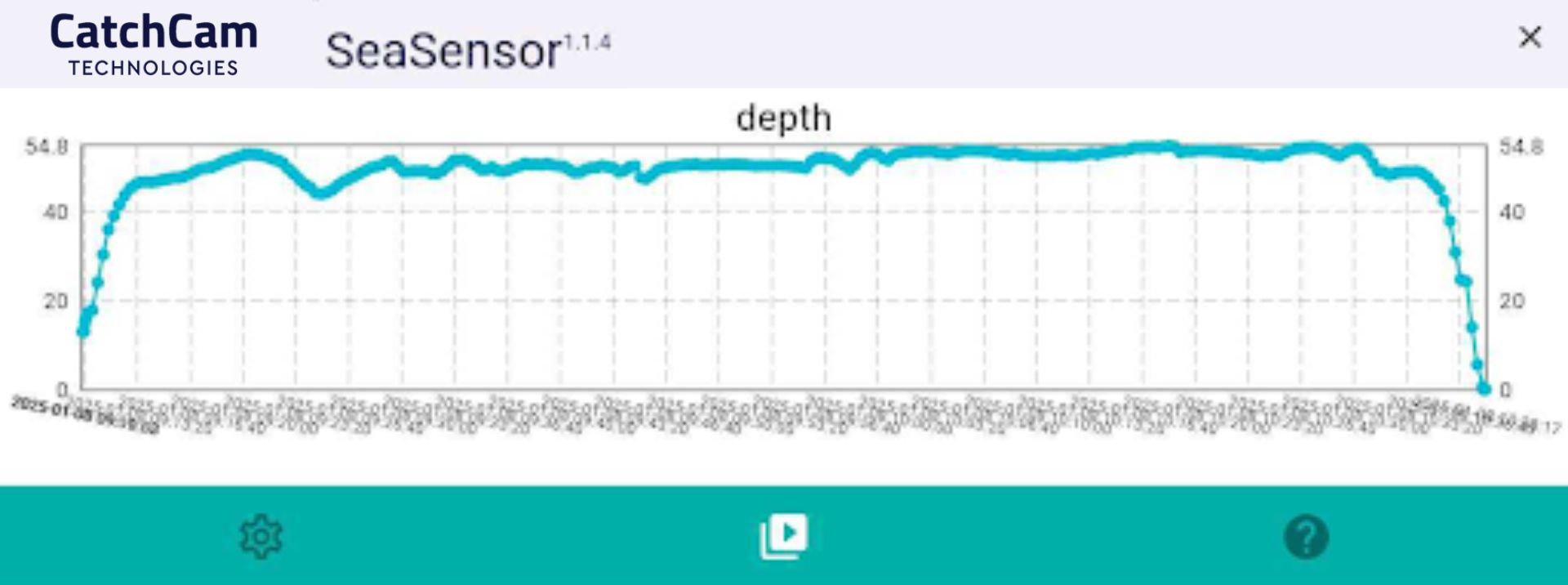
Attached to the headline of the 24m Scottish Seiner Acionna, SeaSensor collects depth readings - every 20 seconds - for a single tow. If we assume the bottom is flat, then the variation illustrates the headline rising and falling. Attached to the headline of the 24m Scottish Seiner Acionna, SeaSensor collects depth readings - every 20 seconds - for a single tow. If we assume the bottom is flat, then the variation illustrates the headline rising and falling. CatchCam Footage


CatchCam camera attached to the headline of MFV Acionna.

How CCTech Can Help Your Fishing Operations

This deployment once again reinforced the value of seeing how your gear behaves: whether you’re trawling, potting, or exploring methods like seine netting, understanding gear performance is key to efficiency and sustainability. By integrating visual and sensor data, we help you gather actionable insights that reduce uncertainty and improve your catch efficiency.

At CCTech, we don’t just provide technology—we also offer expert consultancy services to help fisheries optimise operations. Whether you’re looking to monitor net behaviour, reduce bycatch, or enhance gear efficiency, our team can tailor solutions to meet your needs.

Gain deeper understanding into your fishing operations schedule a call with CCTech.

Tuesday, 20 January 2026

Busy night in Newlyn, full-on landing sardines!


There was plenty of sardine action early on Monday evening with all the sardine boats making good landings, most were full up...


filling the western end of the fish market landing berths...


one inshore trawler picked up more than he bargained for, a huge length of nets...

master of the scales, Robert if all smiles with a market full of fish to grade.., 


a doggy landing from the Ajax...


and good to see the boys on the Cornishman taking the trouble to cut out monk cheeks and sae the livers...


and still the they keep coming, the Mayflower heading for the market as the rest of the sardine fleet land...


pump their fish ashore...


with some special visitors this evening from Japan and Indonesia...


here on a fact-finding visit with representatives form the MSC and Seafish coming together to learn from one another.

Monday, 19 January 2026

Well over 30 species of fish on Newlyn's Monday morning's market!


Still dark it may be, but getting lighter, earlier day by day...


while it may not be the season, there are still fish like these spiders being landed...


and making an impact again this week are bass...


and this rarely landed fish, one to ID, if you can...


hopefully the sardine boats will be landing again this evening as there is a visiting group of Japanese  MSC on their way to Newlyn from Edinburgh today...


sharks of all kinds graced the market...


and some cracking gurnards from the netter...


more sharks, though thankfully for the boat not spurdogs this time...


a good selection of black bream...


and yes, those Mediterranean octopi are sill moving across the grounds...


landing at first light...


the North Devon based twin-rigger...


Bideford registered, Our David George...


pollack seem plentiful enough...


as do bass, a good day's work for Mr Pascoe on the Huers...


the one beam trawler to land was the St Georges put ashore plenty of monk...


and quality flats...


and yet more bass from all of the netters like the Britannia V...


to go with their hake...


the same went for the Stelissa...


Silver Dawn...


and Ygraine...

Sunday, 18 January 2026

Two years of fisheries management plans: progress and what’s next


It’s been two years since the first fisheries management plans (FMPs) were published. With five more Defra-led plans published last week and Scottish Government consulting on their first 11, it is a good time to look back at what has been achieved so far. FMPs are central to how we manage our fisheries more sustainably, balancing the needs of communities and the environment.

What’s gone well

A truly collaborative process

Defra and delivery partners have worked closely with fishermen, and other stakeholders across the UK to develop and begin to implement our FMPs.

Collaborative working is at the heart of how we are developing and implementing FMPs. We would like to thank all of you that have been involved.

Engagement events, meetings and new stakeholder groups have brought together commercial and recreational fishermen, and environmental NGOs - often for the first time.

Discussions in these groups are essential to make sure each FMP is practical, innovative and responsive to real world needs.

Improving transparency

We introduced our blog as a trusted place to find updates and explanations on how FMPs are being delivered. It has become a key part of how we share updates and stay open with you. Engagement continues to grow with over 9000 visits to the site this year.

We recently launched the FMP directory on the blog. This was a big step to bring together information about each of Defra’s plans. You can find ways to get involved or stay updated with groups that are working on, or give updates on, FMPs.

Getting on with implementation

Both Defra and Marine Management Organisation (MMO) have led actions across the published FMPs.

New legislation was introduced to help manage flyseine effort in the English Channel. This legislation also increased the Minimum Conservation Reference Sizes (MCRS) for brill, lemon sole, turbot and crawfish to protect the juveniles of these species.

For bass we’ve reviewed both the shore based netting provision and the commercial authorisation system to identify improvements that could be made. We also launched the cuttlefish action plan which concluded a number of actions including a report on improving data found in markets.

Looking ahead, new minimum conservation reference sizes (MCRS) for brown crab in the South West and lobster in England will be brought in early next year. These steps follow the recommended measures in the FMPs.

In addition, we’re also designing new effort management systems for scallops, crab and lobster.

We have also started work with the European Commission to develop a joint UK/EU Multi Year Strategy on king scallop management. An expert group has been established involving UK and EU scientists to offer independent analysis and advice.

Building our evidence base

20 scientific research projects are underway to address key gaps in evidence related to FMPs. These projects are informed and prioritised by a Research and Development (R&D) steering group, with members that represent the views of various stakeholder groups.

These projects will improve our understanding of how to manage stocks in a sustainable way. For instance, new stock assessments for species with limited data, like crabs, lobsters, and scallops will give us a better understanding of stock status, and whether measures are needed to ensure these stocks are not over-exploited.

Our research will also inform how to reduce carbon emissions in the fishing sector, reduce bycatch, increase survival of discards, help us move towards an ecosystem-based approach to fisheries management, and more. These projects are being delivered by bodies including Cefas and MMO, with support from partners including IFCAs, academia and industry.

The aim of the R&D work is to deliver research to address current and emerging evidence gaps and support the implementation of FMP measures and goals in accordance with the objectives listed in the Fisheries Act 2020.

Preparing for emerging issues

As well as setting direction for long term development of fisheries, FMP implementation allows us to react to emerging issues.

When an octopus bloom appeared in the South West, we supported work to understand its immediate and long-term impacts, co-funding a research project with Plymouth City Council which looked to provide early indications of the nature and likely extent of population change. Working with MMO, we were able to quickly bring in octopus ID cards to help fishermen support both the plan and the future of the fishery.

The challenges


Bringing about change across diverse fisheries isn’t simple. Some elements need more time and attention than others.

FMPs are ambitious so we need to carefully prioritise what actions happen first, and what can happen in the future based on available resource.

Better data is crucial. We’re working to fill the gaps on some species, habitats and social economic impacts to improve decision making.

Balancing social, environmental and economic priorities is challenging. Not everyone agrees, but we continue to actively involve individuals and groups to deliver the best outcomes under the Fisheries Act.

Looking ahead


Putting the plans into action is key, as is monitoring results and refining as we learn.

Collaboration remains vital as we test and adapt the evidence base and management options, and groups will also play a central role in coordinating delivery and tracking effectiveness. We’re looking forward to continuing to work with you in 2026 and beyond.

Saturday, 17 January 2026

Down comes the scaffolding on the new Resource Centre!


Storm Goretti was not responsible for the scaffolding coming down from the new build in the harbour...


and now the building is beginning to look complete - from the outside! Fitting out the rooms is due to be completed over the next three months.

Friday, 16 January 2026

#FishyFriday's market full of fine fish!


First light in the Bay reveals the jack-up rig, Seafox 7 in the distance...


the market was dominated by quality fish this morning with fish like these cracking red mullet


probably best to avoid plaice though, however good those spots make them look, it's coming up to the end of their spawning season so save buying any till the summer when they will have done a bit of bodybuilding and regained their strength...


bass were everywhere on the market...


alongside this lonely red 'black' bream...


more bass.,,


the sardines keep coming...


oh, and dogs too...


the guys on the Ocean Pride will not have been impressed with this lot appearing in their nets as they came over the hauler...


newcomers to the market, tender tasty Mediterranean octopi have two rows of suckers...


unlike these, the type commonly landed by trawlers in Newlyn...


more bass...


more red mullet...


and a missing mug mystery...


the beamers, Enterprise and Billy Rowney both landed shots of monk...


and megrims sole...


a quality mixed inshore trawl trip...


no doubt these prime turbot will top the price rankings on this morning's auction sheets...


more bass...


hake from the Stelissa...


and yet more bass from the netter Britannia V...


to go with their hake...


and dogs... 

it was dark enough for the boats at rest this morning.