'>

Saturday, 25 October 2025

Play a leading role in shaping the future of Cornish fishing and seafood sector!


The Cornwall Fisheries Science Board (CFSB) is a pioneering partnership between the Cornish Fish Producers Organisation (CFPO), scientists, fisheries managers, and other experts, working together to deliver evidence-based, sustainable fisheries management for Cornwall.

The CFSB membership currently comprises of CFPO, Cornwall Inshore Fisheries and Conservation Authority (IFCA), Department of Environment, Food and Rural Affairs (DEFRA), Marine Management Organisation (MMO), Centre for Environment, Fisheries and Aquaculture Science (CEFAS), and International Council for the Exploration of the Sea (ICES).

The CFPO are now seeking a Fisheries Science & Policy Lead to coordinate the Board’s work, driving collaborative research, influencing policy, and ensuring Cornish science and fishing and seafood industry expertise help shape the future of Cornwalls fishing industry.

Click here for all the details and how to apply.

Friday, 24 October 2025

Boats battle back to Newlyn from storm Benjamin


The increasing tendency for the rise in house prices to force locals out of the housing market affects fishing in many ways; if you own a small or any boat in Newlyn you need to be on hand 24/7 to make sure all is well with your boat- especially when the weather conditions change for the worse - bailing out your punt is one such task with the incessant rain...


there are those who revel when a storm does pass through like these hardy surfers taking advantage of Newlyn's famous 'Graveyard wave'...


there are rocks and man-made rocks...


despite the weather new harbour building continues to grow...


thought the addition of the external wall cladding will no doubt  make life easier from now on...


they say there's gold at the end of every rainbow, though in Cod's case he's heading out in his red punt Butts for silver rather than gold, or maybe just mackerel after storm Benjamin left a big ground sea running in the Bay...


there's always one on the lookout on the prom for a cheeky snack from an unsuspecting tripper...


and we're off!...


early doors for #FishyFriday morning and all is quiet...


with only the Crystal Sea's fish on the market...


and a few dozen boxes from some hardy inshore boats who beat the stormy conditions to land some cracking shellfish...


monk tails...


red and black bream...


stiff as-you-like red mullet...


and the odd bass...


and a gurnard or two...


time for young Nathan to whisk the morning's catch away...


just some of Cod's post storm efforts from yesterday evening...


those crabbers always need bait from the bigger boats...


eventually, dawn breaks over the harbour...


and the merchants close the door on the van before heading back to base, or in this case, Port Isaac...


Benjamin was too much even for the bigger boats...


and the crabbers...


the classic lines of the Guiding Light and the other one.


Wednesday, 22 October 2025

Stop demonising fishing industry, SFF chief tells eNGOS


The leader of Scotland’s largest fisheries organisation last night urged environmental lobbyists to stop demonising the industry.

Chief executive of the Scottish Fishermen’s Federation Elspeth Macdonald said eNGOS were increasingly resorting to ideological purity and gross oversimplification of complex issues, misrepresenting fishermen to the wider public.

She told guests at the Federation’s annual dinner at The Scotsman Hotel in Edinburgh: “Complexity is the enemy of the punchy slogan and the online campaign.

“Distilling complexity down into only black and white, bad and good, doesn’t leave time, space or bandwidth for getting under the bonnet of these difficult issues.

“Food production, nature protection and restoration, climate change adaptation, scientific uncertainty, people, jobs and socio-economics – all are part of the rich tapestry of fisheries and where many factors have to be balanced and trade-offs made.

“But some environmental NGOs seem to have little interest in anything other than continual catastrophising – because that’s what keeps the grant funding flowing in. It appears they feel they have little to gain by being collaborative and working with others to find compromise and solutions.”

With Cabinet Secretary for Rural Affairs, Land Reform and Islands Mairi Gougeon in attendance for the last time before she stands down at May’s parliamentary election, Ms Macdonald spoke about the Scottish Government’s introduction of fisheries management measures in offshore Marine Protected Areas (MPAs).

“These measures were many years in the making, and are the culmination of a long process where the Scottish Government, the fishing industry, conservation bodies and NGOs worked collaboratively and constructively to find compromise and pragmatic solutions that will allow the conservation objectives of the sites to be met, whilst still permitting fishing activity over parts of the sites.

“This decision holds true to the government’s original premise on MPAs of more than a decade ago, and we commend them for holding true to this commitment.

“This was a fair decision, one that we were able to broadly support and one that showed the real benefit of working together in a trusted process, and co-designing solutions that work for nature and for business.

“We very much hope that the same pragmatic and balanced approach will prevail with the inshore MPAs and Priority Marine Features, which will be the subject of consultation before the end of this year, but when decisions are unlikely to be taken before the elections in May.

“Sadly it is unlikely that some of the environmental NGOs in this arena now would be so pragmatic. It seems increasingly to be the case that ideological purity has overtaken compromise and trade-offs, and gross oversimplification of complex issues must prevail.”

She pointed out that Fishing has been integral to Scotland’s society, culture, economy and indeed palate for hundreds of years.

“But as we enter the second quarter of the 21st century, our fishermen – and Scotland’s ability to produce renewable, healthy food from our seas - are under threat as never before.

“Scotland’s fishing sector has evolved over many generations to fish efficiently and effectively, making seafood affordable and accessible. It has long been a goal of successive governments to encourage and enable people in Scotland to eat more fish, for their own and for wider population health, to help reduce the burden of dietary related illness.

“Let’s debate the good, the bad and indeed the ugly, but let’s not demonise any one form of food production, when we have a growing global population with a growing demand for protein and an ever-increasing burden of ill-health related to poor diet.”

FUNDiNG AVAILABLE! Get your your Under 16.5m skipper's ticket here!

Fancy skippering one of these?


or this?


If you are looking for career and skills development ...


and are working in the Commercial Fishing Industry, then why not start down the path of gaining your Under 16.5m skipper's ticket?! 

CLICK HERE NOW!

Tuesday, 21 October 2025

Fishing and Coastal Growth Fund will boost regional economies


The new fund will modernise and revitalise the UK’s fishing fleet, with £56 million going to support Scottish, Welsh and Northern Irish fishing industries.

£56 million of new money will support Scottish, Welsh and Northern Irish fishing industries and boost local economies Investment in new technology and equipment, revitalise the UK’s fishing fleet, and training the next generation of fishers will drive growth across the industry Regional delivery will target investment to where it matters most across the UK, boosting the sector and local communities for the future Fishing businesses and coastal communities across the UK will benefit from £360 million of investment through a new Fishing and Coastal Growth fund, with £56 million of the new money going to support Scottish, Welsh and Northern Irish fishing industries.

Seafood Cornwall's new training centre being built in Newlyn.


Devolved governments in Scotland, Wales and Northern Ireland will be responsible for spending the money to best meet the specific needs of their fishing and coastal communities. This will allow the funding to be targeted to where it matters most, with devolved governments able to work in collaboration with their local fishing industries to prioritise regional needs and best support their coastal towns and villages.

The fund will invest in the UK’s fishing fleet’s technology and equipment, train the next generation of fishers by enhancing their skills, and support coastal communities by boosting tourism and trade. Targeting the funding will create more secure, sustainable, and economically successful fishing and aquaculture sectors across the UK, in turn supporting local communities. The Scottish Government (£28m), Welsh Government (£18m) and Northern Ireland Executive (£10m) have been allocated a share of funding based on the Barnett Formula.

Fisheries Minister Dame Angela Eagle said:

The grit and determination of fishers throughout the UK brings the best seafood to our dining tables and across the world. This fund will revitalise the fishing sector and coastal communities right across the UK, spurring growth as part of our Plan for Change. Supporting devolved governments with this new funding will help get the money to where it’s most needed, so the sector can thrive for generations to come.

UK Government Scotland Office Minister Kirsty McNeill said:

Scotland’s fisheries sector and our coastal communities are hugely important and this new £28 million UK Government investment will help deliver a bright, sustainable future for the fishing industry and those who live on our coast by improving infrastructure, creating jobs and boosting investment in skills. The UK Government is also slashing red tape for our seafood exporters and businesses as we work with partners to deliver a decade of renewal for the country through our Plan for Change.

National Federation of Fishermen’s Organisations Chief Executive Mike Cohen said:

There has been commercial fishing in the UK for more than a thousand years. Today, it remains integral to many coastal communities and continues to produce some of the best seafood in the world. We can be enormously proud of our heritage, and prouder still that fishing remains full of potential. Well managed, and with the right support, fishing can be an engine to drive sustainable growth all around our coastline. This funding is enormously welcome and, if properly targeted, will bring social and economic benefits that will be felt for a long time to come.

The UK government will work in close partnership with the devolved governments to ensure the funding supports both local needs and UK-wide ambitions for a thriving, sustainable fishing industry. Alongside the Fishing and Coastal Growth Fund, the UK government expects to start negotiations for a new Sanitary and Phytosanitary (SPS) Agreement with the EU this autumn.

The deal will slash red tape for UK seafood exporters and make it easier to sell UK fish to our largest trading partner, driving growth and removing barriers to trade.

Every Last Fish: Rose George Dives Into the Serious Business of the Fishing Industry

Rose George is a journalist renowned for plunging into the global systems and unseen industries that underpin modern life—from the surprising realities of human waste and sanitation (The Big Necessity) to the massive, hidden world of international shipping (Deep Sea and Foreign Going), and the essential, complex story of blood (Nine Pints). She is a master of revealing the serious, systemic issues lurking beneath the seemingly mundane.

Now, she turns her investigative focus to the world beneath the waves with her latest book, Every Last Fish.

This is more than a book about dinner; George takes us inside the colossal legal and illegal fishing industries, exploring the creatures themselves, the dangerous conditions faced by the people who catch them, and the communities striving to stay afloat. For those eager to understand the full cost of what lies on our plates, George’s work is essential reading.

You have a chance to hear Rose George discuss her intrepid reporting in person! She will be giving a talk about Every Last Fish at the beloved Edge of the World bookshop in Penzance on October 30th. Don't miss this opportunity to dive deep into one of the planet's most vital and overlooked industries. 


A fresh and fascinating take on fish, the fishing industry, and our shared future, from one of our most intrepid and entertaining nonfiction writers.

Slippery, wet, and strange: Fish can be easier to think of as food than as fellow animals. But what do we know about these creatures we meet on our dinner table and how they got there? For the first time in history, humans are eating more farmed fish than wild, and our fish consumption is predicted to increase. But with warming oceans, diminishing fish stocks, and questions about fish farming practices, where will the fish come from?

In Every Last Fish, Rose George dives into these questions by exploring the vast industries that support our appetite for fish sticks and salmon burgers, and the colossal illegal fishing trade whose practices and standards are unmonitored and often dangerous. Journeying to the bottom of the ocean and back, she examines the machinations of this $200 billion food system—one that’s growing rapidly even as fish populations disappear.

Along the way, George introduces us to the people on the front lines of fishes and fishing: fishermen, divers, marine biologists, fish fryers, and fishwives. She presents minnows who shout; discovers the underwater soap operas of wolffish; and, despite her constant seasickness, boards trawlers to see firsthand the impact of fishing on our emptying oceans. Her journey ends at the fish counter, with guidance for readers looking to make better choices, both for the ocean’s health and their own.

Ranging from Alaska to the United Kingdom to Senegal and beyond, Every Last Fish is an unforgettable trip through the ocean’s inhabitants and workers. With irresistible wit and an eye for the unusual, George reveals the unseen and endangered world behind what you buy at the seafood counter, while also bringing to life that dead fish on your plate.


Monday, 20 October 2025

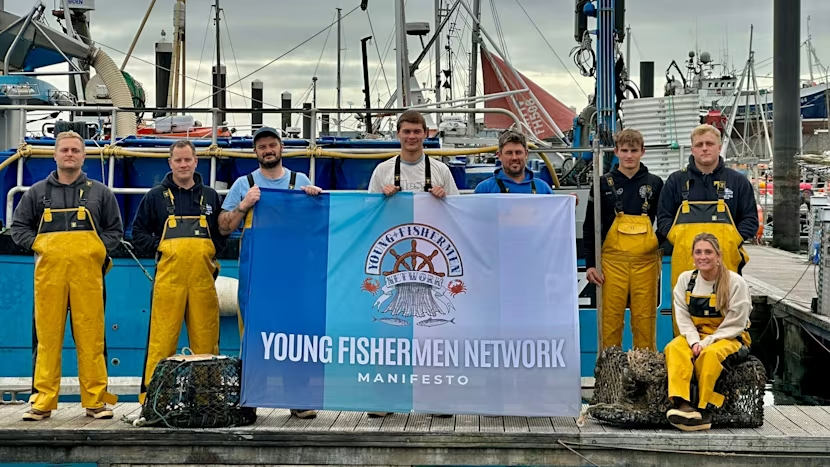
Young Fishermen Network Launches Manifesto


The Young Fishermen Network (YFN) has unveiled its first-ever manifesto at the World Food Forum in Rome, marking World Food Day with a call to action for the UK Government to back the next generation of fishermen. The YFN Manifesto sets out four key pillars calling for government support:

  • Step on Board – Provide accessible training opportunities for the next generation
  • Learn the Ropes – Knowledge transfer from experienced fishermen to new entrants
  • Help to Buy – Creation of a Help to Buy boat, licence, and quota scheme
  • Space to Fish – Create opportunities for all with improved management of inshore waters

The Young Fishermen Network is a UK-based organisation working to recruit, retain, and support the next generation of fishermen. Hosted by the Cornish Fish Producers Organisation. Funded by The Fishmongers Company, The Seafarer’s Charity and Ocean Fish.

YFN Representative, Will Jaycock, said: “Fishermen are a vital part of our coastal communities, for every one of us at sea in Cornwall, there are 15 more jobs across the supply chain. Our manifesto aims to drive change to ensure fishing remains a viable and inspiring career for young people, and we can keep putting healthy food on the table. With more new entrants recruited, supported by accessible training and help-to-buy schemes, young fishermen could play an even greater role in our food security.”

Launched in 2023, the Young Fishermen Network UK is an initiative led by young commercial fishermen to promote fishing as a viable career and amplify the voices of the next generation.

YFN Coordinator, Matilda Phillips, said: “Young fishermen play a critical role in global food security. Ten of our Cornwall YFN members accounted for 18% of Cornwall’s total fish landings in 2023. The message from us is simple: invest in young fishermen, invest in food security. Launching the manifesto on the world stage, we want to catch the attention of key decision makers in the UK and ensure we get some proper commitment and support.”

The World Food Forum (WFF) flagship event is a global platform driving action to transform food systems through youth, science, innovation, and investment. Hosted at the headquarters of the Food and Agriculture Organisation (FAO) of the United Nations in Rome, the 2025 event aligns with World Food Day on 16th October.