'>

Sunday, 21 May 2023

Catch crabs off Cornwall? Your chance to have your say to IFCA.


Cornwall IFCA has launched a Call for Evidence from 17 May to 14 June 2023 to collect detailed views about the management of potting for crabs and lobsters. This follows a questionnaire in 2021 in which active fishermen identified rising fishing effort as being the biggest threat to the long term future of this important fishery which supports over 270 commercial vessels in over 42 Cornish ports. This is supported by our fisheries data which is collected directly from inshore fishermen.

Similar concerns about increasing potting effort for edible crab and lobster were also shared with us during a consultation in December 2022 about the potential use of an emergency byelaw to restrict access to inshore waters by larger vessels. Whilst this byelaw didn’t go ahead, there has been continued support across Cornwall for effort to be controlled, particularly for edible crab.

A national fisheries management plan for crabs and lobster is under development and our work at a local level will link into that process as it emerges.

This Call for Evidence focuses on options which have been highlighted by inshore fishermen as being the most important ways to manage effort. These are listed on a flyer which we have circulated.

Click here to download the flyer.

For each of the options listed, we would like to know;

if there is support for it and if so; how could it be practically used inshore? If an option isn’t the best solution, why wouldn’t it work? It is likely that one option alone may not provide the solution and it may require a mixture of different approaches.

If you would like to submit a response please complete the form on this page.

Information and ideas received through this call for evidence will feed directly into the development of new management measures to support the future of these key fisheries.

Click here to see our Privacy Policy describing how we will handle your personal data. 

Saturday, 20 May 2023

MMO announces the results of I-VMS device testing


Industry update on the results of I-VMS device testing, as MMO confirms its ongoing commitment to support fishermen.

Fishers will continue to be supported by MMO following the outcome of the independent testing on Inshore Vessel Monitoring Systems (I-VMS) devices and are assured that upcoming legislation is on pause and will only come into effect once roll-out has been fully completed.

I-VMS devices are required to monitor inshore fishing activity to improve marine management and sustainability, ensure proper fishing practices and prevent illegal fishing to help protect and enhance the livelihoods of fishers.

Legislation in the form of a Statutory Instrument is due to come into force making it a legal requirement for all under-12 metre vessels - domestic and foreign - to have an I-VMS device installed and transmitting data to MMO, when they are at sea in English waters. Following the end of independent testing, there is no expectation that government will progress introduction of the legislation until issues with the roll-out of I-VMS devices have been resolved.

As England’s marine regulator, MMO has been leading preparations to support industry, through Type Approval, grant funding and a staged roll-out of I-VMS devices, so that every fisher can be compliant when legislation is eventually introduced.

Four devices were Type Approved in 2021 after suppliers provided evidence of their specification. However last year, following feedback, MMO acted and commissioned independent assurance testing on all four devices to provide assurance. Fishers were advised to wait until the results of this additional testing before choosing and purchasing their I-VMS device.

This independent testing is now complete, and two of the devices have failed the assurance process. Type Approval status will therefore be revoked from Maritime Systems Ltd MS44 device and from the Satlink Nano as they have been shown to not meet the original Type Approved specifications set out by MMO. This will be effective from 12:00pm Friday 19 May 2023, subject to final confirmation from MMO. The remaining two devices, Fulcrum Nemo and Succorfish SC2, will remain Type Approved following minor fixes and further review. MMO has therefore taken the decision to temporarily pause the I-VMS roll-out while it works with suppliers and fishers in resolving the issues raised. All fishers are being contacted directly to make them aware of how this affects them, and what steps are being taken to support them if any changes are now needed.

Tom McCormack, MMO Chief Executive, said:

  • We remain committed to supporting the industry and fishers, and the feedback received last year could not be ignored.

  • In response, MMO acted and commissioned independent testing. After receiving the testing results, we have now taken action to pause I-VMS roll-out and focus on supporting affected fishers.

  • I know this news is unsettling and I apologise for this. But we absolutely needed to take action in response to a supplier who has been selling I-VMS devices to fishers that have significant failures against the agreed device specifications.

  • I want to assure fishers our priority is to support affected fishers to secure replacement devices.

  • MMO can confirm that fishers will be financially supported to secure suitable, replacement devices.

  • Fishers will be contacted directly with more information and there is no requirement to take action at this stage.

  • Fishers are also being supported via our coastal teams and through a dedicated helpline.

A dedicated helpline has been set up to help with enquiries. Call 01900 508618 Monday to Thursday 9am to 5pm and Friday 9am to 4.30pm. It will also be operating on Saturday 20 and Sunday 21 May from 10am to 4pm.

Friday, 19 May 2023

Fish of the week 25 - mackerel

Mackerel has played a huge part in the modern history of Newlyn as a fishing port...


throughout the autumn and winter months from the 1970s into the 80s, every boat in the Newlyn fleet under 60ft, plus dozens more from as far afield as Weymouth to the east and Milford Haven to the north rigged themselves with hand-lines and gurdies - a mechanical winding machine with a 7lb lead weight and 24 'feathered' hooks - and fished for mackerel - mackerel shoals were so big they were measured in tens of fathoms deep and five miles or more across by the paper echo sounders of the day - so dense was one shoal that a large merchant ship limped into Falmouth Bay with her seawater-cooling inlet systems choked with mackerel...


eventually, even Newlyn's biggest boats couldn't ignore the fishery any longer and turned to mid-water trawling - seen here is the ports biggest ship at the time, the Silver Harvester and her pair partner Dew-Genen-Ny...


even a few of the port's trawlers like Bobby Laity's, Marina  tried their hand with pelagic gear...


as word of the huge shoals spread, ever larger boats came from far and wide, like the Lowestoft fleet and boats like the Boston Sea Harrier skippered by the legendary Alec Lincoln...


or the huge factory trawlers from Grimsby and Hull, though not everything went quite so well for them as the Conquest found out when she ran ashore near Mousehole on Boxing Day 1977...


or the Bounteous in 1980, where three lives were lost while she was hauling her net, she was one half of two pair trawling teams that came down from Buckie, Heather Sprig, Loranthus and Wave Crest...


at that time, the catches were huge and landings reached hundreds of thousands of tons, however it was not to last, over time, changes in the climate saw the fish head to the west of Ireland - in this 1981 photo, the entire Scottish pelagic fleet anchored in Mounts Bay having searched in line abreast from Plymouth over the previous 12 hours looking for mackerel marks to shoot on...


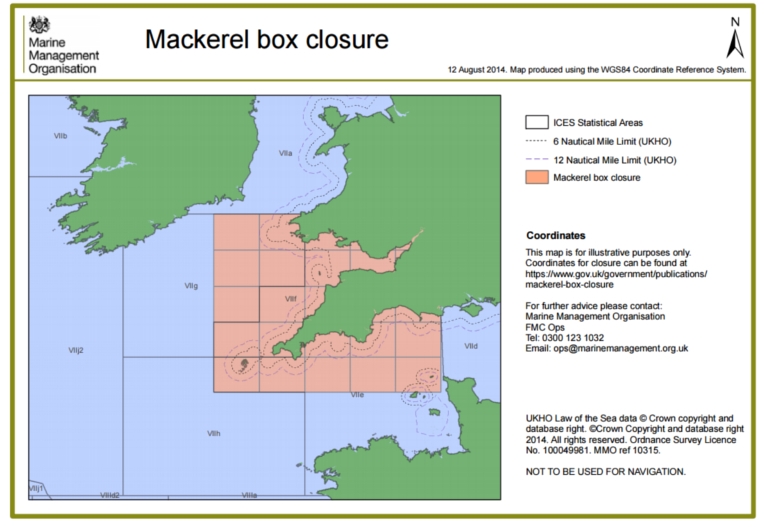
the year before the Mackerel Box was introduced which banned trawling for mackerel completely...

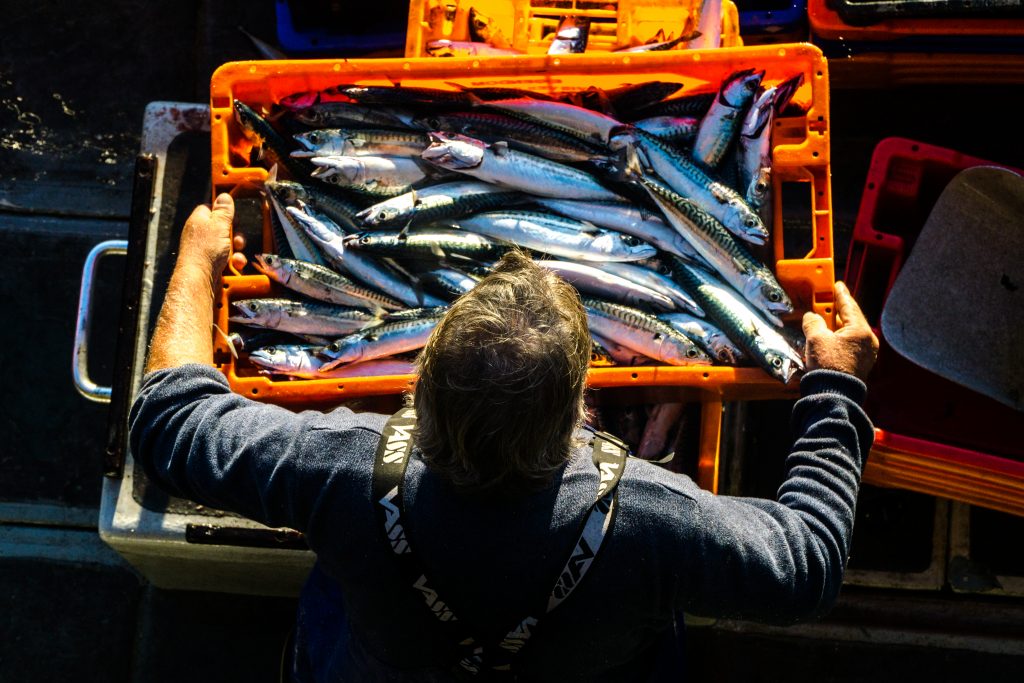
today most mackerel landed in Newlyn is caught by fishermen using handlines...


and landed, in ice, hours after it is caught. Mackerel is up there with the healthiest and tastiest of fish and can be eaten raw sashimi style, grilled, griddled, baked, soused whole or filleted - one of the best eating fish in the sea according to Michelin starred chef Richard Corrigan who has a mackerel signature dish. Nothing more than a squeeze of lemon on a freshly cooked fish will guarantee the chef gets the nod from all those stood around the barbecue
! When Bruce has it on the menu at The Shore in Penzance, you can't go wrong dining at the shore to taste what can be done with this fish that some, surprisingly, won't eat because of its reputation as a 'scavenger'!

French presence in Newlyn this #FishyFriday.


Not a rock trawled up but a lump of 'sea coal' from a wrecked merchant ship...


first time visit for prawn trawler Andromeda (ex-Valhalla)...


the new quay in Newlyn has never been so busy...


work continues on the ex-French netter 


won't be long before the sardine boats are in action again...


meanwhile there are trawls to be mended...


on the harbour...


on Friday morning it's a big mix of fish from congers...


to cuttles...


lemons...


ray wings...


and even whelks...


plenty of eight -leggers...


John Dory...


and brill...


all of which need wrapping...


along with the plaice...


and more of the marauding beasts...


finer weather brings out the angling boats...


and a broken ice machine saw the St Brieuc boat Stradale come in for four tons of ice with a few feet to spare under his keel...


Barry had a nice haul of spiders to land tis morning...


though this one wreaked is revenge seconds after this shot was taken - Barry uttered something like "ouch!"...


the big boats are back on the slip...


boxes from far and wide...


setting out his stall...


there are always plenty of French yachts willing to make it across 100 miles of open water for a tour of the west country...


the tug has arrived to take the Lisa Jacqueline and the James RH to be scrapped in Belgium...


spiders landed ashore and Barry heads back out through the gaps again.

Wednesday, 17 May 2023

How can UK fisheries achieve Net Zero by 2050?


With the Fifth Symposium on the Effects of Climate Change on the World’s Oceans (ECCWO5) underway this week in Norway, Cefas Scientist, Georg Engelhard tells us about his new report looking at the impact of the UK fishing industry on climate change and how technological, operational and policy changes are key to driving progress towards the UK Government’s Net Zero target.

It is now abundantly clear that, as a society, we need to reduce our greenhouse gas emissions if we are to tackle climate change. So, it was widely welcomed when the UK Government announced its commitment to reaching Net Zero by the year 2050. But how to get from where we are now, to where we would strive to be to achieve these ambitious targets?

For the UK fishing fleet, you could argue that this is a particularly challenging question. This is because fishing vessels typically use fossil fuels for propulsion, and for many other activities.

In our new report 'Carbon emissions in UK fisheries: recent trends, current levels, and pathways to Net Zero’, we found that total emissions by the UK fishing fleet are still substantial, estimated as 702 kt carbon dioxide-equivalent in 2020 (about 0.7% of UK domestic transport emissions, or very approximately 1.2 kg of emissions per kg of fish landed). However there has been progress, with significant reductions in total emission levels by the UK fleet of about 32% over a period of 15 years. Over the same period, total fisheries landings showed some fluctuations but generally remained stable.

So the key question recognised by the Department for Environment, Food and Rural Affairs (Defra) is – How can UK fishing fleets move towards Net Zero by 2050? –. Achieving the aim of reducing emissions to Net Zero carbon is likely to require major changes to the way that UK fisheries operate. Important changes in technology and management practices will be needed; some of these will be achievable in the short term but others will require mid to long term solutions.

Towards Net Zero Carbon Fisheries

In 2021, Georg Engelhard, Olivia Harrod and John Pinnegar of the Cefas Climate Change Team started work on a new Defra funded project, titled Towards Net Zero Carbon Fisheries, that was designed to specifically address this challenging question.

The team looked at both present and past trends in carbon emissions released by UK fishing fleets. Based on desk-based studies and interviews with many participants in the fishing industry, they also provided a forward look: proposing a set of potential pathways to aid reducing emissions from fisheries in future years.

This week, the findings will be presented at the “Fifth Symposium on the Effects of Climate Change on the World’s Oceans (ECCWO5) – one of the world’s most important conferences on marine climate change. Scientists, policy makers and NGOs from around the world will come together to discuss some of the most pressing problems facing our oceans. This year, there is greater emphasis on reducing emissions and climate change mitigation as many look towards how we can achieve Net Zero by the year 2050.


A pathway to progress

While recent trends in emission reductions do indicate that significant progress can be achieved, major changes will still be needed to fully reach Net Zero. The report provides several recommendations or a ‘roadmap’ of pathways for reducing emissions in fisheries. These include:

  • Technological changes. This includes looking at existing and more ‘mature’ technologies that could be implemented in the short term (e.g., switching to alternative fuel types, such as biofuels, or using hybrid diesel-electric propulsion methods); using emerging technologies that could be incorporated in the medium term (e.g., battery or solar powered vessels); and investing in new technologies that could have a significant impact in the long term (e.g. ammonia or hydrogen powered vessels). 

  • Operational changes. There are already significant opportunities to build on the operational and behaviour changes underway to adapt to the challenges of a rapidly changing industry and rising fuel costs. These include regular engine maintenance to ensure fuel efficiency; where possible reducing the speed and distances travelled; removing excess weight and avoiding going to sea in bad weather, all of which can increase fuel consumption. 

  • Policy changes. Several ‘quick wins’ were identified to achieving targeted reductions in emissions in the short term (but likely insufficient for fully achieving Net Zero), as well as long-term measures. These could include fuel policies, such as subsidies for low-emission fuel types and/or taxation of (or subsidies removed from) high-emission fuel types; or policies to encourage low emission gears, or low emission propulsion types. Schemes could also include incentives to reward or benefit low emission fisheries (e.g. an ‘eco-label’ offering a better price or market access if vessels have the right credentials). 

The report highlights the importance of the ‘Participatory approach’ to ensure that policy outcomes are developed in partnership between industry, science, and policy. The report has benefited from extensive engagement with industry where fisheries representatives shared their knowledge and provided examples of the existing initiatives and challenges in using new technologies. For example, the Thanet Fishermen's Association in Kent are operating a subsidiary fuel company, offering marine biodiesel (made from reused cooking oil) to their members, and in the southwest, a skipper has been trailing a lighter, more efficient wing trawl system (known as a ‘Sumwing beam trawl’) to help reduce fuel consumption.

“Our findings and messages, and the roadmap of adaptive pathways are not only relevant for the UK fishing fleet – they are equally important to fisheries and fleets around the world. It is only through close collaboration with all stakeholders involved, that we can successfully achieve carbon neutrality, whilst also maintaining sustainability and prosperity in the fishing fleet,” said lead scientist, Georg Engelhard.

The findings were presented to the Seafish Fisheries Management and Innovation Group, which is a regular meeting of stakeholders to discuss key challenges facing the UK fishing industry.

Georg Engelhard, Posted on:19 April 2023 - Categories:adaptation, Climate Change, Fisheries, Policy, Science, Technology

Tuesday, 16 May 2023

LETTER TO TRANSPORT AND SHIPPING MINISTER ON MCA MEDICAL CERTIFICATE FIASCO


The Maritime and Coastguard Agency (MCA) is responsible for the safety of shipping in the UK. In recent years, the MCA has introduced a number of new regulations aimed at improving safety. However, some of these regulations have been met with criticism from the fishing industry. 

One of the most controversial regulations is the new medical certificate requirement for fishermen. The MCA argues that the new requirements are necessary to ensure the safety of fishermen. However, the fishing industry argues that the requirements are far too stringent and will make it difficult for fishermen to get the necessary medical clearance. 

This presentation examines the MCA's new medical certificate requirements for fishermen. It discusses the arguments for and against the requirements, and  considers the devastating impact that the requirements are likely to have on the fishing industry.


Monday, 15 May 2023

Massive Monday morning market.

Sunday evening off Porthgwarra sees the netter Silver Dawn heading for Newlyn...


where she added her fish to a massive Monday morning market...


with an equally massive trip of ray from the Martha Mae...


two kinds of red fish...


and boxes of pristine white tangle-net turbot...


every netter's nightmare, spurdogs - having been banned from landing for so many years there are only a couple of merchants who buy them in quantity now - hopefully, there will be more buyers entering the market now the boats have an increased quota to land...


with floor space limited on the market some species were stacked like these megrim soles...


Ian must have been feeling somewhat hemmed in by it all...


surrounded by stacks if Dover soles...


and more megrims, good to see the Louisa N landing in Newlyn these days...


the Dorys are =getting fatter...


a one-claw lobster, known in the trade as a 'policeman'...


monk a-plenty...


yet more spurdogs...


and mullet of the red variety...


the Zone 2 was stacked out...


and with bait waiting to go...


so was Zone 3...


good to see young Gary on the market...


 measuring the carapace of lobsters...

the inshore boats made small landings of pollack which seem thin on the ground this year...


not the prettiest of fish - bull huss...


more stacks from the beamer...


and top quality turbot...


even the fridge was full...


with plenty of these beasts...


and more line caught pollack...


and the increasingly invasive eight-leggers...


 fine set of bass...


there's a good chance these guys might end up Hackney way by tomorrow...


not another one...


most of the fleet are at sea, some just landed...


tiz the season for yachts...


and bass poles...


the Joy of Ladram is now back in company colours...


and just having her numbers done...


the big one is back...


lobster farm...


rear view of the Joy...


the old harbour, or Gwavas Quay was built over 700 years ago by Bretons - there isn't a single repair to the outside wall in all tat time.