'>

Saturday, 24 January 2026

House of Commons debate on Fishing - Navigating Troubled Waters: The Future of the UK Fishing Industry

Navigating Troubled Waters: The Future of the UK Fishing Industry 


Storm Ingrid batters Newlyn during the debate!

In a Friday's high-stakes session in the House of Commons, MPs gathered to weigh in on the state of the UK’s fishing industry. From the rugged coasts of the Northern Isles to the bustling markets of Cornwall, the debate painted a picture of an industry that is as resilient as it is embattled.

The discussion, led by Mr Alistair Carmichael, moved beyond simple catch quotas to address a fundamental truth: fishing is not just a sector of the economy; it is a matter of national food security.

Key Features of the Debate

The £360 Million Question: Significant focus was placed on the administration of the Fishing and Coastal Growth Fund, with heated exchanges over whether the "Barnettization" of the fund unfairly penalized Scottish fishers.

The "Spatial Squeeze": A recurring alarm regarding the loss of traditional fishing grounds to offshore wind farms, marine protected areas, and subsea cables.

A Recruitment Crisis: Concerns were raised about a "visa cliff edge" in 2026, which threatens to leave the fleet without enough crew to operate.

Climate & Ecological Shifts: Extraordinary reports of "octopus blooms" in the south-west and the decline of species like the European eel.

Safety and Mental Health: Recognition of fishing as the UK's most dangerous peacetime occupation, requiring better mentoring and support systems.

The Post-Brexit Reality: Frustration over the 12-year extension of EU access and the "red tape" still strangling seafood exports to France.

A Not-So-Homogeneous Industry

Opening the debate, Mr Alistair Carmichael (LD) was quick to debunk the myth that fishing is a single entity. He noted that the issues facing "inshore crab boats are very different from those facing the larger white-fish boats." He argued that while fishing doesn't always move the needle on national GDP, it is the lifeblood of communities like Shetland, where it accounts for a third of the local economy.

However, the "spatial squeeze" remains a primary threat. Melanie Onn (Lab) pointed out that fishers often feel like an afterthought compared to "big wind development companies," a sentiment echoed by Charlie Dewhirst (Con), who warned that banning certain practices like bottom-trawling in marine protected areas could "destroy the industry overnight."

The Labor Shortage & The 2026 "Cliff Edge"

One of the most pressing concerns was the upcoming change to visa regulations. Jim Shannon (DUP) warned of a "last chance saloon," stating that Northern Ireland’s nephrops fleet relies on non-EU migrant crew for 70% of its labor. Without a bespoke visa route post-2026, he feared the fleet would be "tied up" within years.

Anna Gelderd (Lab) focused on the next generation, advocating for a "mentoring and training pathway" to make fishing a realistic career again. She was supported by Amanda Martin (Lab), who emphasized that sustaining the industry requires clear training routes for young people in coastal communities like Portsmouth.

The Battle of the "Lobster Capitals"

The debate wasn't without its lighter—and more competitive—moments. Charlie Dewhirst (Con) proudly declared Bridlington the "lobster capital of Europe," only to be challenged by John Cooper (Con), who suggested the title actually belongs to Port William.

Beyond the rivalry, Andrew George (LD) brought a modern perspective to animal welfare, noting that since "lobsters are sentient beings," the industry must stay informed on humane supply chain practices.

The Minister’s Response

Responding for the Government, Dame Angela Eagle (Minister for Food Security and Rural Affairs) acknowledged the "tough working conditions" and the "dangerous life" fishers lead. She pledged that the government is working to "slash red tape" through a new sanitary and phytosanitary (SPS) agreement with the EU, aimed for completion by late 2027.

Regarding the workforce, she confirmed a meeting with the Home Office to discuss the "visa cliff edge," promising that "the industry will be properly represented."

"Fishing families are hard-working and economically productive people. Take away their ability to earn a living at sea, and they will not just sit idle; they will move with heavy hearts... That will forever change the nature and character of our coastal and island communities." — Mr Alistair Carmichael

The consensus of the House was clear: while the tide is currently against them, with the right strategy and a genuine seat at the table, the UK's fishing communities can still navigate toward a sustainable and profitable future.

The debate was particularly rich in policy recommendations for how the £360 million should be targeted to provide more than just a "sticking plaster."


The debate was particularly rich in policy recommendations for how the £360 million should be targeted to provide more than just a "sticking plaster."

Here is a breakdown of the specific recommendations made by MPs and industry groups during the session:

1. Regional Autonomy: The "Cornish Pilot" Model

Anna Gelderd (Lab) made a strong case for a ring-fenced allocation specifically for Cornwall. She supported the Cornish Fish Producers’ Organisation's call for a £10 million delegated fund to deliver a "Cornish pilot fishing strategy."

  • The Logic: Instead of a top-down approach from London, local producers would manage smaller projects, ensuring money reaches the "places it might not reach" if managed centrally.

  • Support: Andrew George (LD) reinforced this, arguing that a delegated fund is the most efficient way to support small-scale, site-specific needs.

2. Investing in "New Blood" & Infrastructure

A major theme was that the fund must look beyond the current generation to ensure the industry's survival.

  • Fleet Modernization: Josh Newbury (Lab) and Anna Gelderd argued that previous funding focused too much on maintaining 60-year-old vessels. They proposed using the growth fund to help fishers buy new vessels with safer, modern living quarters and more carbon-efficient engines.

  • Help-to-Buy Schemes: To bridge the gap for young people, MPs recommended the fund support "help-to-buy" schemes for boats, licenses, and quotas, which currently act as a financial barrier to entry.

  • Mentoring Path: A call was made for a structured mentoring and training pathway to pass on traditional knowledge and safety guidelines to those entering the industry under age 16.

3. The "Barnett Formula" Controversy

The most contentious policy point was how the money is divided between the four nations.

  • The Conflict: Seamus Logan (SNP) and Mr Alistair Carmichael (LD) clashed over the fact that Scotland—which accounts for over 60% of the UK’s fishing effort—is receiving only £28 million (approx. 8%) of the fund.

  • The Recommendation: Torcuil Crichton (Lab) and others called for a "mechanism outside the Barnett formula" that reflects the actual size and value of the fishing industry in each region, rather than just human population.

4. Scientific Independence & Data Access

MPs argued that the fund should be used to empower fishers to lead their own research.

  • Industry-Led Science: Anna Gelderd highlighted the "Pollack FISP" as a model where fishermen work with scientists to provide real-time data. She recommended the fund be used for industry-led science projects so the benefits (and data) stay in local ports like Looe and Newlyn.

  • Modern Tools: Melanie Onn (Lab) suggested leveraging the fund to integrate Artificial Intelligence (AI) to better analyze the massive amounts of catch data already collected, turning regulatory "red tape" into a tool for better stock management.

5. Market Access and "Social Value" Quotas

  • Routes to Market: For isolated ports like Polperro that have seen local markets close, Anna Gelderd urged the Minister to use the fund to secure logistical routes to market, reducing the cost of transporting catch to larger hubs.

  • Social Quota Buying: Mr Alistair Carmichael suggested the fund could be used by local authorities to buy up fishing quota and distribute it to new entrants based on "social value" rather than purely to the highest bidder.


Summary of Funding Priorities

MP RecommendationProposed TargetKey Benefit
Anna GelderdCornish Pilot Fund (£10m)Regional autonomy and local decision-making.
Josh NewburyNew Vessel GrantsImproved safety, profitability, and crew comfort.
Melanie OnnPublic Sector ProcurementBoosting UK fish consumption in schools and the NHS.
Torcuil CrichtonRecruitment SupportAttracting young workers to combat an aging workforce.
Alistair CarmichaelQuota for New EntrantsBreaking the monopoly of "quota barons" for family businesses.


Thursday, 22 January 2026

Fiash landings this week in Newlyn.

Dates: January 19th – January 22nd, 2026


It’s been a busy week at the market with over 100 tonnes of fresh catch passing through the doors. While the start of the week saw heavy volumes led by MSC Hake and Mediterranean Octopus, the latter half shifted towards high-value prime species like Dover Sole and Monkfish.

📈 Weekly Overview

Total Weight Landed: £100,596.17 

Total Market Value: ££510,806.77

Average Price: £5.08/

Top Species by Value:

MSC Hake: £113,315

Mediterranean Octopus: £85,780

Monkfish: £71,931

Dover Sole: £49,797

Bass: £37,760


🗓 Daily Breakdown

Monday, January 19th: Peak Volume

The week started with a massive landing, accounting for nearly 45% of the week's total volume.

Total Landed: 44,366

Market Value: £215,483

Key Highlights: MSC Hake dominated the day with over £11,000 landed. Pot-caught Mediterranean Octopus also saw strong numbers £36,585

Top 3 Species (by Value): MSC Hake, Mediterranean Octopus, and Monkfish.

Tuesday, January 20th: High Diversity

Tuesday saw the greatest variety of species throughout the week, with 62 different types of fish and shellfish hitting the market.

Total Landed: £30,622

Market Value: £159,951

Key Highlights: MSC Hake and Octopus remained the primary volume drivers, while Bass landings increased significantly, contributing over £16,000 to the day's total.

Top 3 Species (by Value): MSC Hake, Mediterranean Octopus, and Bass.

Wednesday, January 21st: Prime Fish in Focus

While volumes began to dip mid-week, the average value remained steady as prime species like Monkfish took the lead.

Total Landed: £19,972

Market Value: £99,240

Key Highlights: Monkfish became the highest-value species of the day, fetching over $£18,000.  We also saw a significant landing of Cuttlefish £2,848

Top 3 Species (by Value): Monkfish, MSC Hake, and Dover Sole.

Thursday, January 22nd: Quality Over Quantity

Thursday saw the highest average price per kilo ($£6.41/\text{kg}$) as the market shifted toward premium prime catches.

Total Landed: £5,633

Market Value: £36,13

Key Highlights: Dover Sole was the star of the show, making up nearly half of the day's total market value ($£17,287$).

Top 3 Species (by Value): Dover Sole, Monkfish, and Bass.


Market Note: The strong presence of MSC Hake throughout the week continues to demonstrate the consistent demand for sustainable, high-volume whitefish, while the late-week surge in Dover Sole prices highlights the premium market for local prime species.

Scottish Seiner Benefits from CatchCam Underwater Monitoring Systems

MFV Acionna GK44 - seine netter

Seine netting is among the most cost-efficient and sustainable commercial fishing methods, but it comes with its own set of challenges.

Managing such a large net over long distances is one of them. Especially when we’ve got strong tides to deal with, in the middle of the busiest waterways on the planet. This is exactly what the crew of the 24m Scottish vessel Acionna GK44 was facing. Factors like vessel speed, tide conditions, and chain weight – aside from the net itself – all influence how effectively fish are caught.

So, how can you tweak your setup to ensure a good haul? The compact CatchCam & SeaSensor systems might just be the answer.

Improving Catch Efficiency with Camera and Sensor Technology

In fishing, not knowing what’s happening underwater means costly guesswork. Traditionally, skippers rely on their experience, tides, and seasonality to predict good fishing conditions.

However, as any seasoned fisherman will tell you, fishing can make a fool of us all. Not seeing the full picture can mean the difference between coming back home empty-handed or with a great haul.

Underwater cameras like CatchCam provide a valuable look into the action, capturing visual evidence of how the gear and catch are behaving, but they don’t tell the whole story—especially in deeper or turbulent waters. This is where SeaSensor fills the gap. Mounted on the headline, it captures accurate data on net depth, movement, water temperature, and turbidity, providing a fuller picture of what’s happening underwater.


Net-Mounted CatchCam Systems

Seine netting might seem straightforward, but the reality is it requires an enormous amount of skill and concentration, much more so than demersal trawling, dare we say it! While both methods use similar nets, the way they operate is completely different. In seine netting, the vessel shoots a long rope in a wide circle around the fish, followed by the net itself. Then, as the rope is hauled in, it guides the fish into the net.

Variables such as tide conditions, seabed obstacles, vessel speed, and rope coiling all influence how well the net performs. Skippers must make constant calculations to ensure optimal net shape and positioning to maximise their catch while avoiding gear damage or loss.

On the Acionna, which targets prime demersal and non-quota species, our aim was to build an understanding around how every factor affected the fishing operation. For this commercial deployment, the team fitted:

  • Three CatchCam cameras strategically positioned around the net,
  • One SeaSensor, mounted at the centre of the headline to measure net height and movement, along with the water temperature and turbidity.

The trial took place over two days, first targeting squid in the East English Channel, then shifting to prime demersal fish much further west, off of Lyme Bay. As the vessel moved through different waters, the combined CatchCam footage and SeaSensor data helped track net drag, shape and even fish movement throughout the haul – and into the codend.

"It was interesting to get an exact insight as to what the net is doing, and therefore how the gear needs to be hauled for different target species and particularly different types of bottom." shared Aaron Brown, skipper of the 24m Seiner Acionna, in an interview with Fishing News.

Collecting Underwater Data aboard the Scottish Seiner

Each deployment provided more insights until, by the end of the trial, a clear picture of the net’s performance emerged:

Chain weight impacts performance: An 80kg chain attached to the bosom brought the gear to settle within 1 minute of shooting. However, the chain had drawbacks: it slowed the hauling speed, was prone to fraying against the bottom sheet causing wear, and caused the headline to dip – leading to catch loss. On the other hand, without the chain, the net took 8 minutes to sink, drifting far from the target area. Net shape varies throughout the tow: For most of the time, the net remains loose and undulating, only reaching full tension toward the end. This is also when fish start entering, and the codend begins to fill. The timing of this could have a significant impact on the catch rate for the haul.

Fish behaviour and catch timing: Data revealed that fish typically start entering the codend in the final 10 minutes of the tow, staying calm until the net is hauled onboard. That explains why the quality of the catch is so high. Speed influences net performance: As vessel and hauling speed fluctuated, the headline height changes, confirming the need to maintain a good steady speed towards the end of the haul. By integrating sensor data with video footage, the skipper was delighted to see that certain aspects of his gear were working well. Thus, he was now able to focus his attention on the areas that needed improvement, including gear positioning.


SeaSensor Data


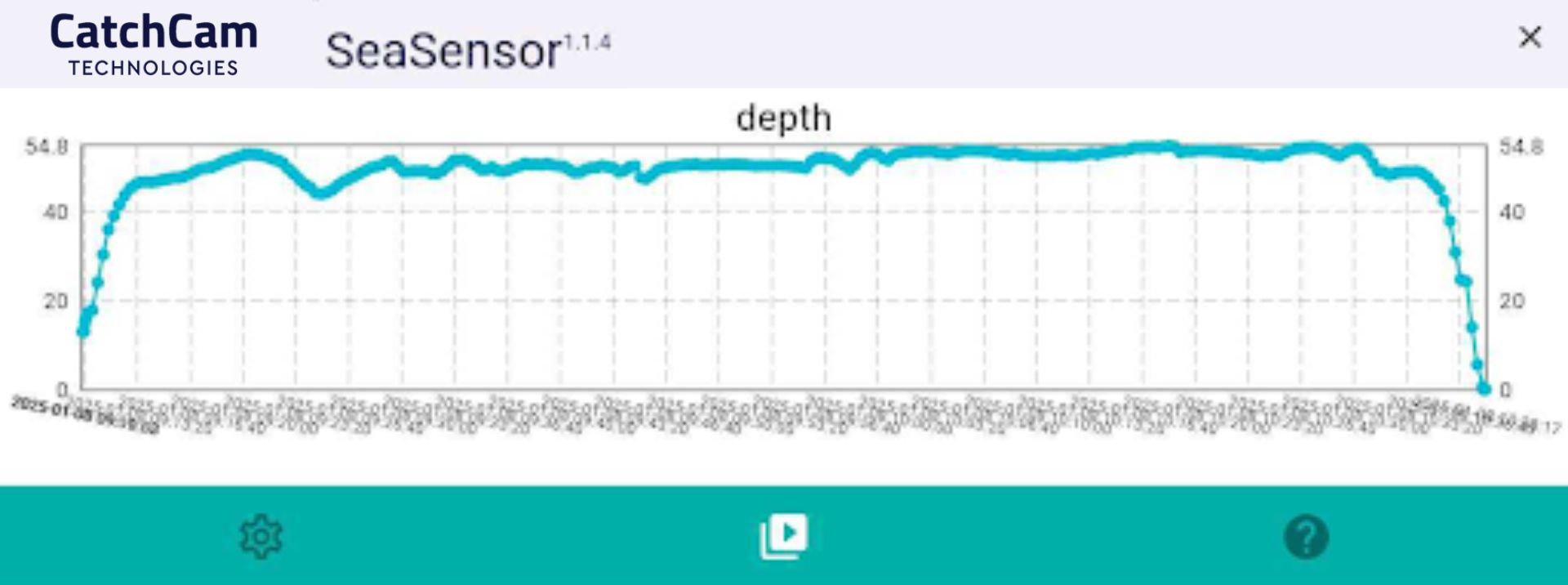
Attached to the headline of the 24m Scottish Seiner Acionna, SeaSensor collects depth readings - every 20 seconds - for a single tow. If we assume the bottom is flat, then the variation illustrates the headline rising and falling. Attached to the headline of the 24m Scottish Seiner Acionna, SeaSensor collects depth readings - every 20 seconds - for a single tow. If we assume the bottom is flat, then the variation illustrates the headline rising and falling. CatchCam Footage


CatchCam camera attached to the headline of MFV Acionna.

How CCTech Can Help Your Fishing Operations

This deployment once again reinforced the value of seeing how your gear behaves: whether you’re trawling, potting, or exploring methods like seine netting, understanding gear performance is key to efficiency and sustainability. By integrating visual and sensor data, we help you gather actionable insights that reduce uncertainty and improve your catch efficiency.

At CCTech, we don’t just provide technology—we also offer expert consultancy services to help fisheries optimise operations. Whether you’re looking to monitor net behaviour, reduce bycatch, or enhance gear efficiency, our team can tailor solutions to meet your needs.

Gain deeper understanding into your fishing operations schedule a call with CCTech.

Tuesday, 20 January 2026

Busy night in Newlyn, full-on landing sardines!


There was plenty of sardine action early on Monday evening with all the sardine boats making good landings, most were full up...


filling the western end of the fish market landing berths...


one inshore trawler picked up more than he bargained for, a huge length of nets...

master of the scales, Robert if all smiles with a market full of fish to grade.., 


a doggy landing from the Ajax...


and good to see the boys on the Cornishman taking the trouble to cut out monk cheeks and sae the livers...


and still the they keep coming, the Mayflower heading for the market as the rest of the sardine fleet land...


pump their fish ashore...


with some special visitors this evening from Japan and Indonesia...


here on a fact-finding visit with representatives form the MSC and Seafish coming together to learn from one another.