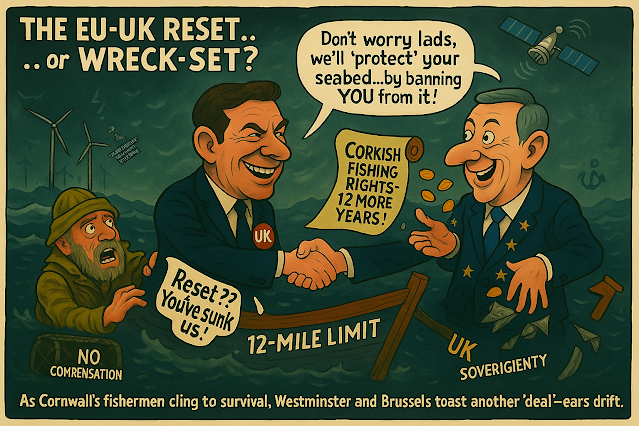
'>

Thursday, 12 June 2025

UN Ocean Conference - Emotive misinformation again!

 Clarifying the Confusion: Super-Trawlers vs. Bottom Trawling


The Super-Trawler Debate: Why Accurate Reporting Matters

Discussions about industrial fishing are often clouded by oversimplification, with complex issues reduced to dramatic headlines or emotive imagery. While legitimate concerns exist about overfishing, habitat destruction, and bycatch, the reality is far more nuanced—and many fisheries, particularly in the UK, have made significant progress in sustainability.

Take the MSC-certified Cornish sardine and hake fisheries, which have drastically reduced marine mammal bycatch through acoustic deterrents, modified nets, and strict monitoring. Such advances prove that responsible fishing is possible when science, regulation, and industry collaboration align.

Yet this BBC report at the Ocean Conference in Nice repeated a common but misleading conflation—lumping super-trawlers (large pelagic vessels) together with bottom trawling. Worse still, the segment featured footage of lush, vibrant seabeds—scenes completely unrepresentative of areas routinely worked by bottom trawlers. Such imagery misleads the public, implying that these habitats are typical of trawling zones when, in reality, heavily trawled seabeds are far more barren.

Why the Distinction Matters

  • Super-trawlers target mid-water fish like mackerel and herring. Their nets, though enormous, operate well above the seabed and do not cause seafloor damage or disturb carbon-storing sediments.

  • Bottom trawling is an entirely different practice, dragging heavy gear across the ocean floor. While some fisheries have adopted less damaging methods (e.g., lighter gear, area closures, selective nets and larger mesh sizes), the practice remains controversial—and should not be confused with pelagic fishing.

Similarly, claims about marine mammal bycatch often lack context. Dolphins and porpoises are primarily at risk in certain mid-water or coastal fisheries, not bottom trawling (where interactions are rare). Many pelagic fleets, including some super-trawlers, now use mitigation measures, though enforcement and improvement remain essential.

The Danger of Misrepresentation

Using misleading visuals and conflating different fishing methods does a disservice to the debate. It obscures the real progress made by sustainable fisheries while diverting attention from the worst offenders. If we want effective ocean conservation, we need clarity, not sensationalism—and reporting that reflects the true state of our seas, not just the most dramatic clips.

Wednesday, 11 June 2025

Cornish Fishing Under Attack: Betrayed by Westminster, Silenced by Extremists


"As Cornwall’s fishermen cling to survival, Westminster and Brussels toast another ‘deal’—twelve more years adrift."


Three weeks ago, the UK Government sold out Cornish fishing. At the so-called "EU UK reset summit," they handed EU fishing vessels unfettered access right up to our 6-mile limit - for another 12 years, with nothing in return for Cornish fishing. Now, the UK Government are back with another hammer blow: a proposed blanket ban on fishing in certain areas, all concentrated around Cornwall's coast.

This isn't policy. It's annihilation. It is clear that Labour cannot stand the thought of a Cornish fisherman producing seafood and are happy to wipe fishing and coastal communities off the face of the county. This new proposal ignores science, rhyme or reason and any thought for the leaps and bounds the fishing fleet have made when it comes to reducing its environmental impact. There is no thought for displacement of the fleet, driving effort into other fisheries, the total lack of sound science and evidence of how fishing methods actually interact with the seabed, as well as the whole raft on unintended environmental consequences that such radical blanket bans will create. And Labour have chosen this moment - when the industry is still on its knees from the so called EU reset - to stick the boot in.

Lets remember that this is the same government that merely six months ago gave the green light to create a space equating to 300,000 football pitches, or the entire size of Cornwall, worth of seabed around the Cornish coast to produce electricity from. In order to do this, they will be banging and crashing anchors, chains and electromagnetic cables in to the same space fishing is being banned from. All about saving the seabed and marine environment, is it? It's hard not to smell a rat.

Who's really calling the shots on this new ban of Cornish fishing? Not coastal communities. Certainly not fishermen. But extremist NGOs like Oceana UK and the Blue Marine Foundation - organisations hell-bent on wiping fishing and coastal communities off the map, with no regard for science, history, or consequences. Ministers are falling over themselves to listen to them, not to Cornish fishermen. And who funds these groups? Luxury fashion houses. Whiskey brands. Celebrities. All the non essentials for a healthy life. Last time of checking, fashion was second only to fossil fuels when it comes to global pollution. The hypocrisy stinks. 

Dressed up as eco warriors, they never called the fishermen, they never stepped foot on a working harbour, they never asked how these decisions would impact the 8,000 jobs it provides in Cornwall, or the countys ability to feed itself and the wider population with low-carbon, nutritious food produced just off our shore. They can not stand the thought of collaboration as that would risk leading to genuine solutions and no endless catastrophe for them to fundraise from. These organisations pretend they have a connection to the coast - but clearly it is not in their hearts.

And now, the Cornish fishing industry and its communities are expected to stand by while they attempt to erase the very industry that built our Cornish coves, harbours, and communities?

We won't.

Cornish fishing is more than an industry - it's a legacy. It's food security in an unstable world. It's who we are. It's our identity. And it's worth fighting for. We won't be silenced. We won't be sold out. And we certainly won't be pushed aside by out-of-touch elites.

Keep Cornwall Fishing.


Copy and paste this template email/letter to your MP


[Your Name] 

[Your Address] 

[Your Postcode] 

[Your Email/Phone Number]

[Date]


[Your MP's Full Name] House of Commons London SW1A 0AA


Subject: Urgent Concern for the Future of the Cornish Fishing Industry

Dear [Your MP's Name],

I am writing to you today as a concerned resident of [town] about what I believe is an existential threat to the Cornish fishing industry and our coastal communities. The recent proposal for a blanket ban on fishing in certain areas around Cornwall's coast is an attack on our heritage, our economy, and our identity.

Just weeks after the "EU UK reset summit" granted EU vessels unfettered access to our 6-mile limit for another 12 years with nothing in return for Cornwall, this new proposal feels like a final, devastating blow. This is not sound policy; it is the potential annihilation of a way of life.

The proposal seems to ignore the significant progress our fishing fleet has made in reducing its environmental impact. There appears to be a lack of sound science or consideration for the unintended consequences, such as the displacement of the fleet into other fisheries. It is particularly galling that this ban is proposed for the same areas where the government has approved massive seabed disruption for energy projects. This contradiction makes it hard to believe the primary concern is the marine environment.

Furthermore, it seems these decisions are being driven not by the needs of our community, but by extremist NGOs like Oceana UK and the Blue Marine Foundation. These organisations, seemingly funded by luxury brands and celebrities, are disconnected from the realities of our working harbours. They have not consulted our fishermen, nor do they seem to understand the impact their proposals will have on the 8,000 jobs the industry provides, or on our county's ability to produce low-carbon, nutritious food.

Cornish fishing is more than just an industry; it is our legacy and our food security in an unstable world. It is who we are. We will not be silenced, sold out, or pushed aside by out-of-touch elites.

As my elected representative, I urge you to oppose this radical blanket ban. I ask you to stand up for your constituents, to defend our fishing industry, and to ensure that the voices of Cornish communities are heard in Westminster. We need a future for Cornish fishing, not its erasure.

I look forward to your response and learning what action you will take on this critical issue.

Yours sincerely,

[Your Name]

Marine Protected Areas (MPA) Stage 3 Consultation: Have Your Say

MPAs off Cornwall

The UK government is seeking public input on the third stage of its Marine Protected Areas (MPA) consultation, aimed at further safeguarding marine biodiversity. This phase focuses on implementing byelaws and management measures to protect sensitive habitats and species in MPAs.  

Key Details of the Consultation

Objective: Strengthen protections for marine ecosystems, including seabed habitats and vulnerable species.  

Areas Covered: Multiple MPAs across UK waters, with proposed restrictions on damaging activities like bottom-towed fishing gear.  

Why It Matters: MPAs help conserve marine life, support sustainable fisheries, and combat biodiversity loss.  

How to Participate

The government invites stakeholders, including fishermen, conservation groups, and the public, to share their views.  


🔗 Read the full consultation documents and respond here**: [Marine Protected Areas Stage 3 Consultation] (https://www.gov.uk/government/collections/marine-protected-areas-stage-3-consultation)  

🗓 Deadline: Ensure submissions are made before the closing date (check the official page for updates).  

Your feedback will help shape policies that balance **marine conservation with sustainable use**. Don’t miss this opportunity to contribute to protecting the UK’s precious marine environments!  


Tuesday, 10 June 2025

Protecting Our Oceans debate

The Secretary of State for Environment, Food and Rural Affairs (Steve Reed) 09/06/2025

The Government are committed to protecting the ocean. Marine protected areas are pivotal to our ambitions to preserve and improve our seas. They are central to our international commitment to protect 30% of global seas by 2030. We have built a comprehensive network of 181 MPAs covering 40% of English waters. Now we are focusing on making sure they are properly protected.

MPAs are protected from the point of designation by the planning and marine licensing regimes that cover activities such as dredging for aggregates and construction of offshore wind farms. Some fishing methods, especially bottom trawling, can have a significant impact on our MPAs, and the Government are legally obliged to address this. Fishing is of course an important source of food, and is critical to our coastal communities. We want to support fishing, encourage it to become more sustainable, and ensure it does not damage protected species and habitats.

We use an evidence-led process to identify the specific measures needed to safeguard our MPAs. We have made good progress. Currently, 60% of English MPAs are protected by byelaws that limit the use of damaging fishing gear, but we need to do more.

The Marine Management Organisation is undertaking a programme to roll-out byelaws to protect all our offshore MPAs where needed. The first two stages of this programme have been completed, with byelaws covering 17 offshore MPAs. Today it is starting a consultation on the third stage, the largest by far.

The proposed byelaws are to protect coarse, sandy and muddy seabed habitats and the species that live on and in them. These include: ocean quahog—which can live up to 100 years old; fan mussel—one of Britain’s largest and most threatened molluscs; and sea pens—part of the soft coral family, which can look like large feathers sticking up out of muddy seabeds. This is a substantial package of proposed measures. It covers a further 42 MPAs and includes proposals to stop bottom trawling over approximately 30,000 sq km, approximately 13% of English waters.

We appreciate that these potential measures would impact fishing fleets, both domestic and European. We encourage them to respond to the consultation, and everyone else who cares about supporting our coastal communities and protecting our seas should also have their say. We recently announced a £360 million fishing and coastal growth fund, in part to help modernise Britain’s fishing fleet.


Where do you even begin with this?


The video also includes one of the lamest 'bottom' jokes ever aired.


The video, titled "The Bottom Line," has been roundly condemned by industry bodies, including the Scottish Fishermen's Federation (SFF) and the National Federation of Fishermen's Organisations (NFFO), for what they describe as a "simplistic and emotionally manipulative" attack on the commercial fishing fleet.

Federations have been quick to point out what they see as a complete lack of balance in the film, which lays the blame for marine ecosystem changes squarely at the feet of the fishing industry. Fishermen argue the film deliberately ignores a host of other significant factors, including the well-documented impacts of climate change, industrial and agricultural pollution, and the rapid expansion of offshore energy installations.

Elspeth Macdonald, chief executive of the SFF, stated that the film presents a "jaundiced and partial view" that fails to acknowledge the huge strides made by the industry in sustainability and conservation over the past two decades.

"To present commercial fishing as the sole cause of the ocean's problems is both disingenuous and fundamentally wrong," she commented. "Our members are on the water every day and are committed to a healthy marine environment. This film does a great disservice to the fishermen who work tirelessly to put food on our tables within a highly regulated and science-led framework."

A central point of contention is the film's depiction of bottom trawling. Industry leaders have branded the footage used as "misleading," arguing that it fails to differentiate between legal, regulated trawling and the illegal, unregulated fishing practices that the UK fleet has long campaigned against. They stress that modern trawling gear is designed to minimise seabed impact and that the fleet operates under strict spatial and temporal restrictions.

The NFFO has echoed these concerns, highlighting that the film's narrative conveniently overlooks the UK's position as a world leader in fisheries management. They argue that such "one-sided" campaigns risk severely damaging a vital domestic food production sector by misleading the public and pressuring retailers to boycott British-caught fish.

The unified message from the fishing industry is a call for a more balanced and evidence-based discussion, urging for an end to what they term "sensationalist" and "celebrity-led" campaigns that threaten the livelihoods of coastal communities across the nation.

Latest octopus bloom action from the MMO.


Southwest Octopus Bloom - Update 02 June 2025 Marine Management Organisation (MMO) is aware of an octopus bloom which is occurring in the southwest, most prominently in ICES division 7.e. Concerns have been raised by industry members regarding the impacts being observed in shellfish fisheries and effects on stocks in the surrounding areas.

MMO recently met with fisheries managers and scientists to discuss the bloom and the issues and opportunities it may bring and consider potential actions required.

Octopus is included in the Channel Demersal Non-Quota Species Fisheries Management Plan, due to their increasing abundance in the South West English Channel. Short term measures for Octopus are to monitor catches and designing a research plan for gathering data and considering management of the fishery. MMO have been collating landings information, and research into the viability of a UK Octopus fishery is being developed. To improve the evidence base MMO have produced species ID cards for Common, Horned and Curled octopus, to support better reporting of landings, these ID cards are available upon request at local MMO offices.

We are continuing conversations with industry representatives to explore ways to support those sections of industry affected by the octopus bloom. A meeting with industry representatives has been scheduled for 6 June and we will update stakeholders with the outcomes of our discussions.

Can crawfish keep crawling!

The 2024-2025 seasonal closure consultation with Defra has concluded 


Detail of outcome

Having considered the consultation responses, scientific and environmental evidence, socio-economic impacts and relevant legislation and policy, MMO will introduce a closure of the crawfish fishery for all UK and EU vessels in:

English waters of ICES area 7 from 16 December 2024 to 31 May 2025 (inclusive). This closure length will protect berried and juvenile crawfish whilst balancing socio-economic considerations and allowing the shellfish industry time to adapt business processes.

Further information on a summary of responses received and reasoning behind the decision is available in the decision document.

What happens next?

The closure will be enacted by a licence variation.

The variation included a prohibition to all vessels fishing, retaining on board, storing or landing crawfish from 16 December 2024 to 31 May 2025 (inclusive) in English waters of ICES area 7.

The full story behind the decirion making porcess can be followed here.