'>

Sunday, 19 January 2025

Fish and chip shops support Cornish fishermen


Recently, the National Federation of Fish Friers (NFFF) joined the Cornish Fish Producers Organisation (CFPO) in Cornwall to explore how local, sustainable seafood can play a bigger role in fish and chip shops across the UK. This visit was part of Seafood Cornwall’s work involving cross-supply chain focus groups. A groundbreaking initiative connecting fishermen, processors, and friers to promote underused Cornish fish species like spurdog aka Cornish Rock Salmon.

The day focused on showcasing Cornwall’s vibrant seafood industry, from the bustling docks of Newlyn Harbour to the efficient processing lines at Falfish, all with one goal: getting more British-caught fish onto menus nationwide.


A market full of fish including plenty of spurdogs.


Stop 1: Newlyn Fish Market

The day began at dawn with a visit to Newlyn market, where the fish market came alive with the freshest catch from the Celtic Sea. The friers witnessed first-hand how Cornish fishermen bring in a wide variety of fish and how these are carefully sorted and auctioned.


Stop 2: Newlyn Harbour Tour

Next, the group had a tour of Newlyn Harbour, meeting with key industry stakeholders and getting an exclusive insight into Cornwall’s seafood industry. The NFFF members learned about the different types of vessels and gear used to fish sustainably in the Celtic Sea. They also got a sense of the scale and diversity of Cornwall’s seafood industry and learnt about the fleet’s gear recycling schemes.


Stop 3: Aboard a Cornish Gill Netter – Sustainable Practices in Action

The friers then boarded a traditional Cornish gill netter, which primarily targets MSC-certified Atlantic Hake. They learnt about sustainable fishing methods and discovered more about bycatch fisheries, including spurdog a sustainable species the CFPO is championing as an affordable and alternative white fish option.


Stop 4: Falfish – Processing Perfection

After a short presentation on the species, the group were invited to Falfish, a leading wholesale processing facility. Here, they saw how advanced techniques ensure peak freshness and efficiency in processing.


Stop 5: Taste Testing – Spurdog on the Plate

The day wrapped up with a taste test of spurdog, a white fish with a pink hue prior to frying. Its mild, sweet, and meaty flavour impressed the friers, who agreed to try it on their menus and pledged to serve more Cornish fish in 2025.

Why spurdog? Thanks to positive fisheries management by the Cornish fleet, spurdog is increasingly abundant. Known historically as “rock salmon,” it’s a sustainable, affordable choice for fish and chip lovers across the UK.

Join the campaign!

Be part of the movement to support local fishermen and offer more home-caught fish on your menu. For more details, resources, and merchants offering Cornish Rock Salmon, please contact charlotte@cfpo.org.uk.

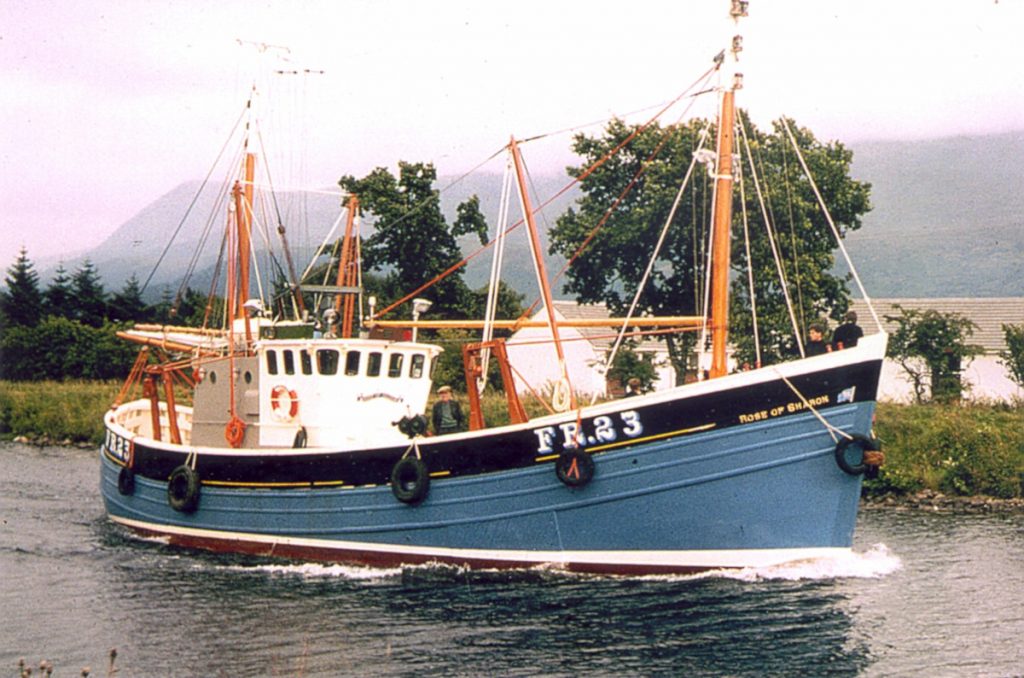
End of life for the Rose of Sharon.


Photo courtesy of Gilpin Demolition 

A poignant reminder of the fleeting nature of time, the once immaculate, Rose of Sharon lies in pieces on a River Dart slipway. Reduced to a pile of shattered timber, scrap metal, and a partially broken-up wheelhouse, this iconic trawler's demise marks the end of a chapter in Newlyn's maritime history.


In 1969, Forbes of Sandhaven were commissioned to build the 66ft trawler/longliner Rose of Sharon FR 23 for Ernest Stevens and his sons David, Paul and Peter. David Stevens Snr skippered the Rose of Sharon between 1971 and 1977. She was decommissioned in 2003 when she became a live aboard based on the River Dart.


The boat had been kept on a river mooring for many years but subsequently sank after being abandoned.

Photo courtesy of Gilpin Demolition 


Once salvaged, she was brought to a concrete slipway by a team from Gilpin Demolition and broken up on site. More pictures from the process can be seen here.


A versatile vessel, she spent most her early years long-lining for ling, ray and pollack...


though the heydays of gigantic mackerel shoals in the late '70s saw her rigged out for mid-watering...


which included doing pelagic trials with the Kilravock for the Hull Industrial Dev Unit and the White Fish Authority...


not so sure the MCA guys would approve of her being loaded like that these days though!


In the 1980s, she and a number of other similar sized boats, better known as, 'the clan', bottom trawled for whitefish, changing gear to fish for prawns on the Smalls in the summer months.


here, she can be seen overtaking another St Ives boat, the Keriolet, both boats steaming away from Newlyn after yet another winter gale had passed through...


though not every trip ended as it should, here she is well and truly mopped-up and about to be towed back to Newlyn.

A few words from Crystal Sea skipper David Stevens, whose grandfather Ernest had the Rose of Sharon built, recalls the role the she played in his life,

"Obviously she was a big part of Alec's (brother) and my childhood. Many hours we spent in Newlyn helping Dad, Peter and the crew land and mend nets. Alec and I would fill needles and keep the tea and coffee coming, even learnt to roll a fag for Dad and Aimie (Aimie Doom - a Belgian refugee from the WWII) 😆 🤣 
Both Alec and I went to sea on her from 9 years old in the summers for a few days. We'd mix it up rockhoppinp on the hard ground NW scillies to the Ship. Or, we'd shoot the clean ground net off to the southward. She really was a Swiss army knife of vessels. She did every job going and for many years did them well. She started off as a longliner come trawler. Then Dad fitted a net drum and paired up with Michael Hosking who had the Killravoc and Bobby Jewell with the Galilean?
They first went after pilchards for Shipphams then the mackerel boom started so she fished for mackerel. Uncle Paul ran her for a few years whilst Dad was beaming in Stevos He tried wreck nets, and lines, craw nets a little also. Then Dad took her again in 1983 and did mainly trawling, and later, when we bought the Crystal Sea we pair trawled for hake for a season. She was sold in 2001 for a house boat, which was a nice career end for her, kept her going for longer. She was a fine, beautiful versatile vessel."


In 2011, she re-appeared in Newlyn on passage...


now registered in Dartmouth...


and fitted out as a live aboard yacht...


the graceful lines of her canoe stern, once home to a baiting table and baskets of lines, still admired by those onlookers who came to see her. 

Always sad to see a boat so full of history and people's lives go the way of the breaker's yard.


Saturday, 18 January 2025

Exploring the Gaps in UK Seafood Supply: Whay we should eat more oily fish like Cornish sardines.


Let’s Talk Sardines: Why Eating More Cornish Sardines is a Smart Choice

Recent research from the University of Aberdeen has shed light on some surprising truths about the UK’s seafood supply and its implications for our health. The study reveals that while we’re exporting a lot of nutrient-rich fish, we’re missing out on essential nutrients ourselves. As Baukje de Roos, one of the authors, notes, “The UK undergoes large losses of omega-3 fatty acids, vitamin B12, and vitamin D through international trade, most notably through exports of oily fish such as salmon, herring, and mackerel.” This is where Cornish sardines come into the picture!


The Nutrient Dilemma

The study highlights a significant issue: the UK is losing out on vital nutrients like omega-3 fatty acids, vitamin B12, and vitamin D because we’re sending so much of our seafood abroad. These nutrients are crucial for our health, and many people in the UK are not getting enough of them. By keeping more of our nutrient-dense fish for ourselves, we could really boost our public health.

Why Cornish Sardines?

Cornish sardines are a fantastic option for anyone looking to improve their diet. Not only are they packed with omega-3s and other essential nutrients, but they’re also a sustainable choice that supports local fisheries. The Cornish Sardine Management Association (CSMA) is all about promoting these little fish, which have been a staple in Cornwall for generations.

But let’s not forget about other oily fish caught in the UK, such as mackerel, herring, and pilchards. These fish are also rich in omega-3 fatty acids and can contribute significantly to our nutrient intake. By choosing a variety of locally caught oily fish, we can help fill the nutrient gaps identified in the research while supporting our local fishing communities.

Supporting Local and Sustainable Practices

Eating Cornish sardines and other oily fish isn’t just good for you; it’s good for the planet too! By opting for locally caught seafood, we can reduce our reliance on imported fish and help create a more resilient food system. The CSMA emphasizes sustainable fishing practices, ensuring that we can enjoy sardines today and for years to come.

In Conclusion

So, what’s the takeaway? The recent research from the University of Aberdeen shows that we need to rethink our seafood choices. By incorporating more Cornish sardines and other oily fish like mackerel and herring into our diets, we can enjoy delicious, nutritious food while supporting local fisheries and improving our health. Let’s make a conscious effort to choose Cornish sardines and a variety of oily fish to help bridge the nutrient gap in our diets. Together, we can make a positive impact on our health and the sustainability of our seafood systems. Let’s get sardine-savvy!

The full paper from the Rowett research team at the University of Aberdeen can be found here.


Friday, 17 January 2025

Full fish market for another #FishyFriday in Newlyn.


Mid-week and the big fella is off for trials...


meanwhile, RNLI 14-15 Henry Heys-Duckworth replacement vessel is on passge...


don't think I have ever sen this many yachts in Newlyn at this time of year...


come Friday morning and the days will now start getting longer...


lenty of fish on the market this morning, the blk of it from beam trawlers and trawlers...


while it just seems to be one of those days for Mr Smart...


despite some superb fish up for action like this huge John Dory...


plenty of bass...


isn't this one of those things that took out that Aussie wildlife guy?...


Friday blues...


just the one netter to land, the Ajax...


plenty of colour this morning, red and black bream...


cuckoo wrasse...


and undulate ray...


it's a wrap...


for the megrims...


plaice...


Dovers...


and more...


those fish have to get off the market quick...


the twisty-turny fish that are congers...


a good shot of ray...


and big flats...


the usual sprinkling of cod...


and some quality red mullet...


and bass from the inshore boats...


it's all quiet down the quay...


and all go on the slip...


time for fuel...


as the sun begins to lighten the heavily clouded sky.