'>

Tuesday, 3 October 2023

First line caught bluefin tuna landed in the top port of Newlyn.


Four years in the planning and the wait is over, the 'A' Team, Andrew Pascoe and skipper Adam Harvey shove off the Prospector before heading out on...


their first licensed bluefin tuna trip. The license imposes strict fishing conditions and designated landing ports, they must only use rods and lures as seen here here held up by Andrew, as agreed between fishermen in the South West Handline Fishermen's Association, Defra and the MMO...


within the first few hours they had caught - and lost - their first fish working close to the western shore of Mounts Bay so the decision was taken to steam out of the bay and the Longships lighthouse off Lands End where they sighted around 30 bluefin feeding near the surface - while trolling from rods through the school a single bluefin was caught on the brightly coloured lures - these fish require very careful handling once caught so as to maintain the highest possible quality of fish - hence the protective bag - the fish was gilled, gutted and the cavity filled with ice to cool the core of the body before being covered in more ice and sealed up inside the specially made giant holdall type bag...


once alongside the fish market...


the 92" long fish estimated, according to the MMO chart provided...
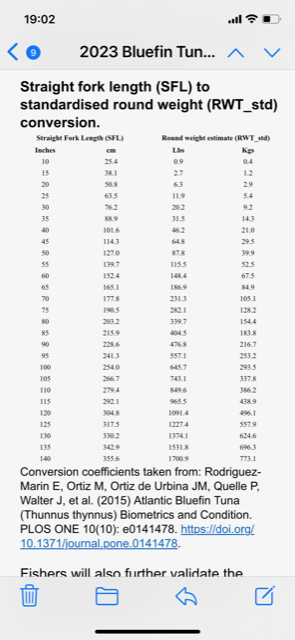

to weigh around 450-500lb...


traditionally, tuna are lifted from the boat to the quay using a strop around the huge tail fin...


providing skipper Adam (left) and crew Andrew with a record of their acheivment...


within minutes of being landed...


on to a pallet...


the fish was weighed in at 270kg...


and iced heavily in readiness for the fish auction. The fish actually weighed 245kg and made a sale price of £14.23 per kilo which works out at £3, 486. Two other SWHFA members were also successful, one landed a 195kg in Hayle and the other member landed in Looe with a modest 48kg fish. 

Tuna fishing globally is controlled by the International Commission for the Control of Atlantic Tuna (ICAAT). They control tuna quota internationally. Their science and stock assessment controls all Bluefin Tuna (BFT) Quota. A fisheries plan was submitted to them before license authorisation could be issued. The BFT have been increasing in UK waters for 8 years and the fishery has been opened because stock is so good. Bluefin tunas have been caught in the UK since the 1930's with the Tunny Club of Great Britain founded in Scarborough in 1933. There is also an MSC bluefin tuna fishery for Atlantic bluefin. Inshore boats catching with hook and line a small number of mature adult tuna on a very limited, well managed quota with a strict limit on licence numbers. As with other commercial fishing activities SWHFA and the CSMA promotes sustainable fisheries based around best scientific advice.


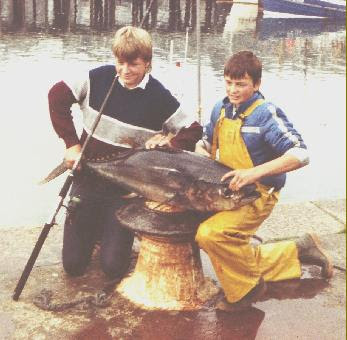
Top handline fisherman Andrew is no stranger to catching tuna, him and brother David, both schoolboys at the time, spent two days luring and eventually catching this big-eyed tuna in Newlyn harbour back in 1985...

 and, at 66lb it remains the UK record...


its seems the Pascoe fishing genes get about a bit, here is Donna Pascoe in NZ after landing her record breaking 907lb Pacific bluefin in 2020 off Auckland.

Owing to the late approval from Defra and the MMO, the ten licensed boats, four of them in the SWHFA have just over seven weeks until November the 30th to catch the 30.9 tons they have been allocated between them. The season was officially opened on August the 1st this year and will do so again next.


Monday, 2 October 2023

Misty Monday morning in Newlyn.

The harbour is tinged in a blue haze this morning with the cloud cover down to a hundred foot or so...


as can be seen from those punts handlining for mackerel off the partially obscured St Michaels Mount...


meanwhile, back on the market the landings this morning came form a handful of inshore boats willing to take on the biggest tide for the year...


fish like John Dory...


and bass all put a smile on the skipper's face when they fall out of the cod end...


the all hands on the Millennia must have been grinning ear-to-ear when this lot filled the pound on the deck...


while the beam trawler, Trevessa IV came in with plenty of flats like these plaice and monk tails...


Tom on the Guardian picked up a few JDs...


and a good box of bass...


good to see the sardines on the auction floor...


and these three boxes...


and these golden red mullet are examples of the finest handline fish which are landed in Newlyn almost every day of the year - all helping to contribute to the £38.5 million pounds worth of fish landed in the port last year, the top English port by volume...


only a handful of boats target cuttles...

low cloud at this time of year brings its own ambience to the harbour and a contrast to the workboat, Obervargh from Falmouth...


riding high on the big tide, the St Georges...


and the netters Karen of Ladram and the Ajax...


along with the St Georges springs doing their job and keeping her against the quay..


Paula Rose is almost ready to go back in the water...


Newlyn, leading the way as the UK's biggest fishing net recycling port...


plans are still in the process of being approved to re-instate and repair the Old Harbour, currently home to the lugger Barnabas seen here at high water...


along with other sail boats on the running moorings.


Sunday, 1 October 2023

ACT NOW – Just nine weeks left to claim I-VMS grant

Fishermen with under-12m vessels are being urged to ACT NOW to ensure they don’t lose out on grant funding for an I-VMS device.


Fishermen with under-12m vessels are being urged to ACT NOW to ensure they don’t lose out on grant funding for an I-VMS device ahead of the legal requirements coming into force next Spring.

As Marine Management Organisation (MMO) switches its main effort to supporting the vessels in the next phase of its roll-out, owners of larger vessels in the first phase, who are yet to act, are urged to buy a device and claim the grant without delay.

Peter Clark, MMO’s Director of Operations said:

“With just nine weeks to go before the deadline passes for grant funding for I-VMS, it’s vitally important for fishermen to act right now and order a device.

“I welcome the positive response from those vessels that we targeted with our initial support but there remain too many owners who are taking the risk of having to pick up the full cost because they’ve not ordered and paid for a device in time before the European Maritime and Fisheries Fund closes.”

Around 35% of the over-six-metre fleet has so far purchased a type-approved device. Over 85% of those making an order have already reclaimed their costs through the grants scheme with over £225,000 paid out since 4 September.

Mike Cohen, NFFO Chief Executive, said: 

"With the increasing spatial squeeze in UK waters, I-VMS is the best tool that the inshore fleet has for identifying and protecting their fishing grounds. “The evidence that it gives will be vital in demonstrating how important these areas are and defending our right to work them. “Funding is available for these devices, but there is a time limit. I would strongly encourage people to act now, to ensure that they have bought a device and made a claim for funding before the deadline.”

Guidance

Fishermen purchasing an I-VMS device can claim grant funding of up to £1,050 per vessel by the 30 November deadline, and before the European Maritime and Fisheries Fund closes.

Fishermen yet to organise an I-VMS device for their vessel should follow MMO’s guidance, booking installations during the time periods identified for around 80% of English ports.

Anyone who delays arranging installation outside of the dates for their port should expect to wait until later in the roll-out programme for their device to be installed.

MMO expects the Statutory Instrument to come into force in April 2024.

Take action

Choose your preferred device. The two type approved devices are Fulcrum NEMO or Succorfish SC2.

Purchase device from supplier. You’ll typically receive payment confirmation on the same day.

Apply for grant funding before 30 November 2023. You can start your grant claim as soon as you have paid for your device and received proof of purchase – you do not need to wait for installation of a device to submit a grant application.

Receive your grant payment. On receipt of all required information, grant applications will be processed by MMO and payment will be issued to you within three to five working days.

Install device. 

The installation date should be arranged directly with suppliers and/or their engineers.

MMO continues to contact fishermen by letter and email to make sure all fishermen are aware of their options, and fishermen may also receive a phone call or text.

Saturday, 30 September 2023

The way we manage UK fisheries is changing.


A bright new dawn?

Since leaving the European Union and the Common Fisheries Policy, the UK government has been developing a new framework for managing fish and shellfish stocks, known as Fisheries Management Plans or FMPs). 

There are 43 FMPs in development, each focusing on one or more species, with 6 frontrunners due to be published this year. The intention of these FMPs is to take an evidence-based approach to making management decisions that ensure stocks are fished at sustainable levels. 

The Future of Our Inshore Fisheries (FOIF), a joint project delivered by Seafish, Department for Environment, Food and Rural Affairs (DEFRA) and the Marine Management Organisation (MMO) released a newsletter in August providing an overview of how these FMPs are being developed, what they do and how to have your say on the development of them.


Friday, 29 September 2023

CFPO newsletter - great news, five young fishermen have completed their Class 2 Skippers training!


Fine #FishyFriday finish to September in Newlyn.

A quiet end to the week of fish landed...


which enabled harbour staff to get to grips pressure-washing the fish market and grader...


one seine net, bundled and ready to go...


despite the lack of wind, the sky has that watery look this this morning...


but for now, all is well with the Enterprise as she heads away from the gaps...


though the same cannot be said for the sardine boats Mayflower...


and the Vesta...


as they head straight back to their respective berths after a long and unsuccessful hunt for sardines...


one out, two in.


Thursday, 28 September 2023

Fishing industry 2022 statistics


Fishing industry in 2022 statistics published The Marine Management Organisation (MMO) has published its annual UK Sea Fisheries Statistics 2022.

The UK fishing fleet Its activity at sea Landings – how much fish they catch and land Effort – how long they spend at sea Trade

Key statistics include: 

Fleet

In 2022 there were 5,541 UK registered fishing vessels. This represents a 14% reduction in the last ten years, however Gross Tonnage (GT) has remained similar at 203 thousand tonnes. Approximately 21% of the UK fleet is represented by vessels over 10 metres in length, of which 44% are administered in Scotland. There are around 10,000 fishers working on UK registered vessels. This is a reduction of 2,100 fishers in the last ten years. Landings

In 2022, UK vessels landed 640 thousand tonnes of sea fish with a value of £1.04 billion. Compared to 2021, this is a decrease of 2% in quantity, however an increase in value of 13%. The increase in value is mainly driven by higher fish prices. Landings into the UK by foreign vessels in 2022 was 19 thousand tonnes, which compared to 2021 represents a 4% reduction. Landings abroad by UK vessels also decreased to 245 thousand tonnes, a reduction of 5%.

Effort Since 2004, fishing effort (kW days at sea) by the over 10m fleet has decreased by around 40%. Most of the reduction in effort is driven by a 1% decline in effort in the demersal trawl and seine segment. Fishing effort by the over 10m fleet decreased by 3% between 2021 and 2022.

Trade The UK is a net importer of fish. The UK’s crude trade gap in 2022 for sea fish is 316,000 tonnes. This is lower than 2021, where the gap was 322,000 tonnes. In 2022 the UK imported 647,000 tonnes of sea fish, with a value of £3.7 billion. It exported 330,000 tonnes, with a value of £1.7 billion.