Sunday, 15 January 2023
Critical report of current fisheries management measures implemented for the North Sea mixed demersal fisheries
Saturday, 14 January 2023
Future of Our Inshore Fisheries: What are Fisheries Management Plans?
This video produced for Future of Our Inshore Fisheries explains what Fisheries Management Plans (FMPs) are, why and how they are being developed.
For more information about Fisheries Management Plans visit: www.seafish.org/FisheriesManagementPlans
Future of Our Inshore Fisheries (FOIF) is an industry-led project with the long-term aim of transforming how inshore fisheries are managed.
Friday, 13 January 2023
Fish of the Day - week 9 - the cunning conger eel!
Conger eels come in many sizes, from the occasional beast over over 6ft long and weighing in at 10st (70kg) or more "Monstrum horrendum, informe, et ingens," ...
and those that live in the darker recesses inshore are often almost black rather than grey in colour.
![]() |
| Bill 'Rasper' Tonking waits for the next hooked fish to appear while Porthlevener, 'Kipper' guts fish in the side deck on the Bonny Mary. |
![]() |
| Mature congers, when gutted, reveal what is referred to as 'chittlings'. |
Thursday, 12 January 2023
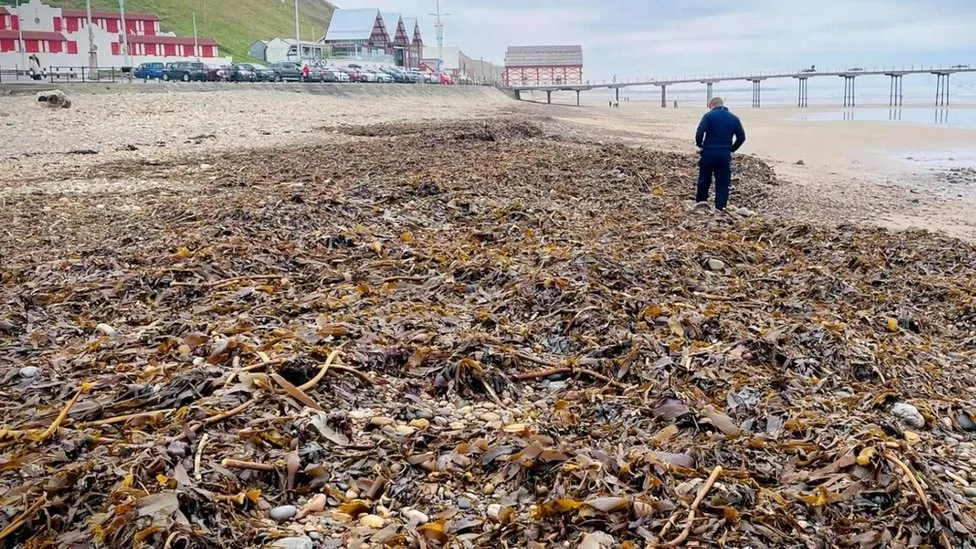
Political tensions rise over Teesside crab deaths
![]() |
| Hundreds of dead shellfish on the beach at Saltburn IMAGE SOURCE,JOE REDFERN |
But it also set off a row that shows little sign of dying off.
It ignited once again at Prime Ministers' Questions: Rishi Sunak had to defend the government's approach as local Labour MP Alex Cunningham, told it to "get serious" about what caused the deaths.
The row has also played out on the opinion pages of The Times this week. The newspaper accused the government of an inadequate response, while the Teesside Conservative MP and former Levelling Up Secretary Simon Clarke responded by saying "crude" political opposition was behind accusations of a cover-up.
At stake is not just the health of sea life, but also the future of a key part of the government's levelling up agenda - the creation of a freeport offering tax breaks to lure businesses to Teesside.
An investigation by the Department of Environment, Food and Rural Affairs said the most likely cause of the 2021 die-off was a naturally-occurring algal bloom. Devastating for fishing, but seemingly unpreventable.
It was a conclusion that many in the fishing industry did not believe. Instead, they suspected it was industrial toxins released during the dredging of the River Tees.
Fishermen have staged protests against the pollution They commissioned their own report from researchers at four northern universities. In September 2022, those academics concluded that the crabs were more likely to have been poisoned by pyridine - an industrial chemical that is present in the river's mud.
This is where the freeport and the thousands of jobs the Conservatives are promising there becomes an issue.
If poisons from the Tees were responsible, they can only have been stirred up by what's called maintenance dredging. This is work that has been carried out for decades to keep the river navigable for ships.
Nothing to do ostensibly with the freeport plan, as no dredging for that had taken place before the deaths of the crabs.
Crab deaths not caused by sewage or cables -
Preventing that could threaten the first economic fruits of the freeport. Government scientists, ministers, and the Tees Valley Mayor, Ben Houchen, then have held the line, insisting that the algal bloom was still the likely cause, and that the presence of pyridine was unsurprising as it naturally occurs in crustaceans.
The dredging began last autumn, with Mr Houchen keen to point out there has been no repeat yet of the 2021 die-off.
That did not settle the matter for the fishing industry, or many local Labour politicians. It all got personal when protesters last month turned up outside the freeport site wearing Ben Houchen masks, and calling again for dredging to halt.
In response Mr Houchen and Teesside's Tories have accused their opponents - and particularly Labour - of trying to wreck the freeport plan. In The Times, Simon Clarke referred to them as an "anti-growth coalition" who can't face the fact that it is Conservatives "restoring pride, identity and purpose" to the area.
It is hardly surprising that politics should play a part. Teesside will be a crucial battleground at the next election. The Conservatives have largely been beating Labour there since 2017, something Sir Keir Starmer needs to reverse. Tees freeport
Mr Houchen has said the freeport would add more than £3bn to the economy once fully developed. Labour though believe the Tories are big on rhetoric and short on results in their promise to transform the area. Denting the popularity of Ben Houchen is an aim, even if they are convinced their cause is a noble one.
A new chapter in this dispute though is about to begin. In October, the House of Commons environment committee spent a day reviewing the evidence. Although its members did not call for dredging to be halted, they did urge the government to re-examine the competing theories.
In response, the Environment Secretary Therese Coffey formed an independent panel of scientists which is now looking at whether the deaths are down to nature or industrial poison.
That report could come as soon as next week, but will it draw a line?
There has already been concern about transparency. Ms Coffey has not revealed who is sitting on the panel, or what its frame of reference was, even though she has been urged to do so by the Conservative environment committee chairman Sir Robert Goodwill.
There is every chance yet that its conclusions may not satisfy Labour MPs or the fishing industry that there is no attempt to cover up a scandal. Conservatives will continue to accuse opponents of playing politics.
It seems likely the legacy of those dead crabs will still be haunting the area when the next General Election comes.
Tuesday, 10 January 2023
Hard-won fishing trips as winter weather keeps all but the biggest boats in port.
so for the likes of the Enterprise...
and the Billy Rowney, every fish landed was down to the skipper and hard working crew aboard the boat
and with so few fish coming ashore anywhere in the UK prices should be higher than average...
especially for quality flats like these brill...
bass...
and hake...
a good run of red gurnard should help boost the landing too...
while this solitary ling will no doubt fill plenty of fish pies...
nearly 200 boxes worth of cuttles also came ashore...
while just a handful of inshore boats managed to find some lee to work a few lines and nets to help pay those bills...
the biggest of which is paying for fuel to keep the propellers turning of course!
Sunday, 8 January 2023
EU State Aid for Fishing
The aim of the scheme is to compensate owners of fishing capacity for voluntarily returning their off-register capacity (i.e. capacity held in the owner’s account but not assigned to a vessel). The scheme will run until 31 December 2023.
Under the scheme, the aid will be granted to Irish-registered capacity owners holding off-registered capacity in the form of direct grants to compensate them for returning their off-register capacity to the Irish Sea Fisheries Board. The aid amount will be calculated on the basis of the market value of the off-register capacity returned. Under the scheme, the returned off-register capacity will be permanently withdrawn.
Friday, 6 January 2023
Fish of the Day - week 8 - the mighty cod!
![]() |
| Just one of only a few dozen cod landed on Newlyn fish market this morning. |
While the people of the home nations still have an affinity for battered cod - even though many will not realise that much of the cod sold over the counter in fish 'n chips shops is not caught by UK boats - people are increasingly being offered alternatives to the nations favourite accompaniment to chips - many now offer hake - they continue being caught in increasingly significant quantities both in the South West and off Scotland.
The codfather of fish has shaped the world as we know it today - the surprising and fascinating story of which was superbly told in Mark Kurlansky's book, "Cod: A biography of the Fish that Changed the World" which puts cod up there with the wheel and the Romans in terms of global impact!
When anyone asks a chippy down here in Cornwall where they get their cod from it certainly won't have been landed on the market at Newlyn. There are two very good reasons for this seemingly illogical state of affairs.
Number one reason is that these days there is no 50-70ft trawl and longline fleet as there was back in the 60s-90s when heavy fishing on big white fish "up channel' was a thing in the Spring of every year. Today's netters tend to work well west of these grounds and the trawls used by the beam trawl fleet, when they do get in the Channel, are just not designed to catch such fish which tend to swim en-masse above the height of the any beam trawl.
Number two is that the grounds within reach of Newlyn never has been a major source of cod throughout the year. It is only in early Spring that cod appear on the ground in any significant numbers and even then the main fishing area is "up channel" - anywhere from off Pendeen all the way up to Lundy - basically, it's the spawning season. As far as I know, no tagged cod, caught and released in the South West, has ever been caught anywhere else other than in the South West and never far from where they were tagged in the first place.
However, such an iconic fish has always figured in the public eye. None more so when the Times ran a bizarre story in 2012 saying that there were fewer than 100 mature cod left in the North Sea. Fishermen were outraged at the blatant dis and mis-information ('fake news' being nothing new it seems) being so gleefully peddled by the media. I wrote a piece for the Great British Chefs website in order to try and put some perspective on the matter - very much needed as the full impact of Hugh Fearnley-Whittinstall's well intentioned but totally misguided Fish Fight campaign that was about to hit our screens was to bear witness!
Tragically, the same narrative is still being peddled by disingenuous NGOs today - their scaremongering serving largely to justify continued support from lobby group funders and organisations like PEW who largely funded HFW's Fish Fight TV series. Scottish white fish boats often seek to avoid areas where cod are in abundance in order to conserve quota. Crucially, poor catch data recorded and submitted by MAFF on behalf of South West boats saw a ludicrously small quota pf cod assigned to Area VII - something like 10% of the tonnage the French claimed for at the time. To be fair to them, they had a track record from nearly 200 boats that fished Area VII - many of them prawn trawlers that caught cod as a by-catch. The change in the fleet structure of South West boats meant a double whammy was dealt as the newer more efficient fleet of gill netters and remaining trawlers in the late 1990s and early 2000s struggled to avoid what cod there was given individual boats often had around 100kg of cod quota per month - when each boat was capable (and did) very often catch that amount in a single haul.
Brexit MPs before and after the Referendum endlessly peddled the, 'take back control' mantra - and the fleet are still waiting for a resolution of the quota imbalance for cod and other white fish like haddock.
Whatever the arguments, there is no denying cod is a fabulous fish to eat, Fish and chips aside, big, pristine white flakes of flesh when cooked well are sublime. I remember taking two ITN and Sky journalists to Bruce Rennie's, The Shore in Penzance. The guy from Sky savoured every mouthful of his asian-fusion cod fillet as if it were going to be his last.
There are more recipes for cod than I can count but there is one simple rule for cod in the kitchen - DON"T OVERCOOK IT!


