Do you want to buy seafood products directly from artisanal fishermen?
Thursday, 29 December 2022
Inshore lining for hake!
Do you want to buy seafood products directly from artisanal fishermen?

Wednesday, 28 December 2022
OUTCOMES FROM UK/EU CONSULTATIONS – 23/12/22

As per the Trade and Cooperation Agreement (TCA), delegations from the United Kingdom and the European Union met between November and December 2022 to consult on fishing opportunities for 2023, and for certain deep-sea stocks for 2023 and 2024. The Heads of Delegations agreed to recommend to their respective authorities the fishery arrangements.
Formal written record: Fisheries: consultations between the UK and the EU - GOV.UK (www.gov.uk)
Alternatively, paste the full URL https://www.gov.uk/government/
The written record includes agreed measures for 2023 relating to (but not limited to) the following;
- Bass.
- Spurdog.
- Reciprocal measures on access for Albacore.
- Non-Quota Stocks
- Agreed total catch limits and transfers of quota.
The Secretary of State determination under section 23 of the Fisheries Act 2020 is also due to be published today here - Fishing opportunities for British fishing boats - GOV.UK (www.gov.uk)
Further updates will continue to be communicated as several areas are worked through.
BASS MEASURES
The bass changes detailed below for 2023 will come into effect once the relevant SI (Sea Fisheries Regulations 2021) has been amended.
The changes consist of:
Commercial fisheries.
- The commercial trawl/seine flexibility will be amended from a 760kg limit per two months to a 3.8 tonnes limit per year,
- Trawl/seine bass bycatch landings will continue to be limited to 5% per trip.
- The commercial hooks and lines limits will be amended from 5.95 to 6.2 tonnes per vessel per year;
- The commercial fixed gillnet limits will be amended from 1.5 to 1.6 tonnes per vessel per year.
- The closed season remains in place for 1st February to 31st March inclusively.
We do not expect the delay in legislating for the changes to impact fishers’ ability to take advantage of the increased annual limits for nets and hook and line.
For trawl bycatch the 760kg two-month limit will apply until the new legislation is passed. This limit is rarely breached because of the more constraining 5% per trip. However, if this limit might be breached prior to the new annual limit coming into effect, we advise that fishers contact the MMO. The MMO will monitor uptake with a focus on the 5% per trip and the new annual overall limit.
Bass authorisations continue to be required vessels using hooks/lines and nets.
Recreational fisheries.
- The 2 fish per day bag limit remains in place.
- The closed season (catch and release only) for 2023 will remain in January and February. The December closed season will be removed.
- For 2024 the retained EU law will be amended to align the closed season with the commercial closed season – February and March.
The closure in December (Starting from Dec 2023 onwards) will be removed and thus provides an additional month for catching and retaining up to 2 fish per day.
For the recreational sector, this means that the existing catch-and-release season currently underway between December 2022 and February 2023 will remain until this is completed.

SPURDOG CHANGES
Following ICES advice that the Northeast Atlantic Spurdog stock is recovering and can support a significant level of landings for 2023 and 2024, the UK EU agreement allows for a Spurdog fishery to commence in UK and EU waters as soon as reasonably practicable in 2023.
Separate total allowable catches have been agreed for the North Sea (UK share 2,781 tonnes) and Western waters (UK share 4,825 tonnes). Quotas have yet to be allocated.
UK waters
- Prohibition remains in place until UK legislation amended (further info on timing to be announced).
- Until the prohibition is lifted all catches must be discarded.
- After the prohibition is lifted a full prohibition of retention of specimens over 100cm will apply to UK and EU vessels (to be enforced through UK legislation).
- The landing obligation will apply to specimens 100cm or less once the prohibition is lifted.
EU waters
- The prohibition will be lifted from January.
- Specimens over 100cm must not be sold for direct human consumption (this will be enforced through licence conditions for UK vessels and through EU legislation for EU vessels).
- The landing obligation will apply to all catches.
Quotas
- Allocation methodology for North Sea and western waters has yet to be determined.
- Catches taken in EU waters before quota allocations have been made will be deducted from quota once allocations are made.
- Quotas are expected to be allocated on a precautionary basis directed at bycatch.
- Until quotas are allocated fishers should continue to avoid catches where possible.
Catch Reporting
- As with all species separate reports (FARs) must be made for catches from respective EU and UK zones.
Non-Quota Stocks (NQS)
The information below outlines several measures for non-quota stocks (NQS).
For NQS, we agreed a roll-over of access arrangements for 2023 to ensure continued access to fish NQS in EU waters, worth around £25 million per year to the UK fleet. The agreement also provides increased data on both UK and EU non-quota landings.
A detailed summary of the agreement is as follows:
- The UK and EU have agreed not to apply the TCA access provisions for non-quota stocks. This is a continuation of the approach taken in 2021 and 2022. We will closely monitor landings of non-quota stocks.
- As per last year, if either the UK or EU reach 80% of the tonnages provided in the TCA, we will meet and consider any next steps.
- The UK and EU have agreed to continue the monthly data exchange of non-quota stock landings data. We also reiterated the need to ensure data transparency and robustness and will continue discussions in 2023 to update the first meeting of the Specialised Committee on Fisheries in 2023.
- Alongside these discussions, the UK and EU have published landings data for 2021 and provisional landings data for the period from 1 January 2022 to 30 September 2022 in Annex 3, outlining total landings for all non-quota species.
- The UK landed 12151 tonnes in 2021; 8607 tonnes as of September 2022 (provisional).
- The EU landed 19126 tonnes in 2021; 14452 tonnes as of September 2022 (provisional).
- The UK and EU agreed to update the data for 2022 to include October – December in 2023. The UK continues to publish its own landings data for UK vessels within EU waters on the MMO website Provisional Non-Quota uptake by UK vessels in EU waters - GOV.UK (www.gov.uk)

Undulate Ray TAC.
The UK and EU have agreed an increase in TAC for Undulate Ray in Area 7d/e.
For the UK this means an increase from 75 tonnes to 1051 tonnes. This means that Undulate Ray can now be targeted in 7d and 7e, although restrictions on the minimum and maximum landing sizes and the closed period (May to August) still apply.
The fishery will continue to be regulated via the UK licence schedule and further information on limits will follow.

Bluefin Tuna.
Separate to UK/EU negotiations, the UK has a share of 63 tonnes of Bluefin quota. The current position of one fish sold per trip remains in place as per the licence condition.
Further information will continue to be communicated in January.
If you have any queries, please direct them to Andrew Wills and Julian Roberts, and/or through your MMO RFG contacts included below.
RFG team
8 courtney.inch@ [07920 516092]
[07920 516092]8 eleanor.holford@
[07385 423958]8 emily.theobald@
[07468 752223]Regional Fisheries Groups - https://www.gov.uk/guidance/
Tuesday, 27 December 2022
Blue Marine: Wealthy, Well-Connected and Wrong!
Cod forgive us!

In fact, it is not true to claim, as Charles Clover did recently on the BBC, that the UK/Norway and the EU have set quotas at unsustainable levels, and that quotas are never set below scientific advice. In the case of North Sea haddock, a scientific recommendation to increase the quota by 160% was limited to a 30% increase to protect cod stocks because there is a recognised species interaction. For North Sea whiting, an even more precautionary approach was followed. The scientific advice for a 240% increase was also limited to only 30%. Similar precautionary restraint was in evidence on some Celtic Sea stocks, although most were set exactly in line with the ICES headline advice.
This year’s negotiations were notable for the number of stocks pointed in an upwards direction. This can’t always be the case because there is natural variation in the young coming into the fishery each year and that is governed largely by environmental factors.
So, it is just untrue to say that quotas are increased when the stocks go up but not when they go down. But the big picture is of stocks steadily moving in the right direction, always accepting that there will be some statistical outliers.
It is true to say that the other cod stocks in UK water are at a low ebb but two points, ignored by Blue Marine are salient. There are no directed (targeted) fisheries on these stocks, and so fishing pressure on them is very low. Quotas are set at the lowest possible level consistent with unavoidable bycatch in other important fisheries.
The second point is that the science suggests that there is a distributional shift under way, probably related to changing water temperatures. Cod in the North Sea is moving northwards by 12 km per year. What is the appropriate management response as cod moves out of southern waters and become abundant in northern waters? That is a genuine debate that the fishing industry, fisheries scientists and fisheries managers need to have in the New Year.
Without a catastrophe narrative, NGOs like Blue Marine would find it more difficult to obtain funding. They are wealthy and well-connected and wrong.
Since we right-sized our fleets around the turn of the century through decommissioning, fish stocks across the North-East Atlantic have not just recovered from the mismanagement of the 1980s and 1990s but in some stocks – like North Sea haddock and plaice and western hake, the biomass in higher than ever seen in the historic record.
That is not a story of mismanaged decline, but it is an inconvenient truth for the Johnny-come-latelys who pine for the bad old days when their existence might have been justified.
Sunday, 25 December 2022
Christmas at Sea

Skipper and crew of the Ocean Harvester enjoying a Christmas Dinner on the boat - L-R (out of shot) Charlie Richards, Nigel Richards, Mervyn Mountjoy and Brian Gruzelier
Born in Edinburgh in 1850, Robert Louis Stevenson was the son of a light-house engineer. He was a sickly child and a life-long invalid, but an inveterate traveller, living his final years in Samoa, where he was known as "Tusitala" – the Teller of Tales. While Queen Victoria's reign saw the steady rise of steam-powered ships, sailing vessels only slowly became obsolete, and ships often used a combination of steam and sail. Stevenson had very likely experienced first-hand, if only as a passenger, the drama of "Christmas at Sea."
The poem first appeared in the Scots Observer in 1888, several years after the publication of the enormously successful adventure novel Treasure Island. It's a confident performance, vividly depicting, from the point of view of a crew-member, the life-or-death struggle of steering a sailing-ship through winter storms, and contrasting this with a glowingly sentimental, spy-glass view of a Victorian family Christmas. The dash of novelistic irony in the poem is that the parlour scene the sailor witnesses is taking place in his own childhood home.
Immediately, the poem strikes the reader's tactile sense, with sails frozen so hard their edges "cut the naked hand." Then it troubles our sense of balance with those decks "like a slide, where a seaman scarce could stand." The 7-beat line is well-chosen. The metre is regular, on the whole, but the relentless rise and fall evokes a pitching movement and simultaneous lack of progress: the frequent slight mid-line caesura adds a momentary hesitation, as if the line had crested a wave and was about to topple. There's a brilliant effect when Stevenson adds an extra syllable in line 21, evoking the tumbled sound of church-bells rung "with a mighty jovial cheer." This, the sixth stanza, is where we learn that it's now Christmas morning.
Stevenson never fails to sustain the reader's interest in the story, or faith in the narrator. He finds an authentic-sounding voice, using judicious touches of dialect spliced with enough sailing jargon to make for a thoroughly convincing mariner's tale – to this landlubber, anyhow. At first, the protagonist speaks as a crew-member, but later shifts from the collective "we" as his experience becomes a personal one and separates him from the others.
Unfolding at a smooth, unhurried pace, the narrative maintains tension, and a happy ending for the ship and her crew seems by no means guaranteed. Stevenson's craft reminds me of something once said by the poet-priest Peter Levi: that a poet must hear every nuance of his poem just as an 18th century sailor would have been aware of every creak and squeak of his ship. Stevenson tacks and hoists the sails of the narrative with a timing that is truly elegant.
The domestic scene the speaker views with such uncanny clarity is clearly not meant to be a fantasy. The house he sees above the coastguard's is where his parents are still living, celebrating Christmas under the shadow of an absent son. He sees the old couple in some detail: they, of course, cannot see him. The ship is eventually manoeuvred into safety and now the speaker most sharply feels his separation from the collective: "And they heaved a mighty breath, every soul on board but me…" The danger is past and the vessel is "pointing handsome out to sea" but the speaker is stricken with guilt and a sense of mortality. He left home before, but without thinking about it. The voyage has been one of understanding: he has learnt that time passes, parents age and die. Now he is really leaving home.
Whether you're literally at sea, or only metaphorically "all at sea" this Christmas, here's wishing "Poem of the Week" readers a a cheery and storm-free passage through the festivities … "Fetch aft the rum, me hearties."
Christmas at Sea
The sheets were frozen hard, and they cut the naked hand;
The decks were like a slide, where a seaman scarce could stand;
The wind was a nor'wester, blowing squally off the sea;
And cliffs and spouting breakers were the only things a-lee.
They heard the surf a-roaring before the break of day;
They heard the surf a-roaring before the break of day;
But 'twas only with the peep of light we saw how ill we lay.
We tumbled every hand on deck instanter, with a shout,
And we gave her the maintops'l, and stood by to go about.
All day we tacked and tacked between the South Head and the North;
All day we tacked and tacked between the South Head and the North;
All day we hauled the frozen sheets, and got no further forth;
All day as cold as charity, in bitter pain and dread,
For very life and nature we tacked from head to head.
We gave the South a wider berth, for there the tide race roared;
We gave the South a wider berth, for there the tide race roared;
But every tack we made we brought the North Head close aboard:
So's we saw the cliffs and houses, and the breakers running high,
And the coastguard in his garden, with his glass against his eye.
The frost was on the village roofs as white as ocean foam;
The frost was on the village roofs as white as ocean foam;
The good red fires were burning bright in every 'long-shore home;
The windows sparkled clear, and the chimneys volleyed out;
And I vow we sniffed the victuals as the vessel went about.
The bells upon the church were rung with a mighty jovial cheer;
The bells upon the church were rung with a mighty jovial cheer;
For it's just that I should tell you how (of all days in the year)
This day of our adversity was blessèd Christmas morn,
And the house above the coastguard's was the house where I was born.
O well I saw the pleasant room, the pleasant faces there,
O well I saw the pleasant room, the pleasant faces there,
My mother's silver spectacles, my father's silver hair;
And well I saw the firelight, like a flight of homely elves,
Go dancing round the china plates that stand upon the shelves.
And well I knew the talk they had, the talk that was of me,
And well I knew the talk they had, the talk that was of me,
Of the shadow on the household and the son that went to sea;
And O the wicked fool I seemed, in every kind of way,
To be here and hauling frozen ropes on blessèd Christmas Day.
They lit the high sea-light, and the dark began to fall.
They lit the high sea-light, and the dark began to fall.
'All hands to loose top gallant sails,' I heard the captain call.
'By the Lord, she'll never stand it,' our first mate,
Jackson, cried.
… 'It's the one way or the other, Mr. Jackson,' he replied.
She staggered to her bearings, but the sails were new and good,
She staggered to her bearings, but the sails were new and good,
And the ship smelt up to windward just as though she understood.
As the winter's day was ending, in the entry of the night,
We cleared the weary headland, and passed below the light.
And they heaved a mighty breath, every soul on board but me,
And they heaved a mighty breath, every soul on board but me,
As they saw her nose again pointing handsome out to sea;
But all that I could think of, in the darkness and the cold,
Was just that I was leaving home and my folks were growing old.
R.L. Stevenson
Saturday, 24 December 2022

Friday, 23 December 2022
Fish of the Day - week 7 - Cuttlefish
It's not that many years ago that boxes of cuttlefish landed could be counted on one hand, a few kilos here and there...

then, around ten years ago word went round that the Brixham beam trawlers were landing not boxes but 400kg tubs of cuttlefish or 'black gold', it's the one single species of fish that has seen Brixham and its big beam trawl fleet gross more than Newlyn overall in recent years...

the his seemingly uninviting fish has some huge fans when it comes to cooking and eating, read on!..

When the creator of BBC1's Saturday Kitchen presented the concept to host chef James Martin five years ago there's no doubt that when Martin compiled his wish list of chefs to have on the show, top of that list would have been Pierre Koffman - five years later and a dream comes true - here's a chef with no pretentions - at the Berkley Hotel's restaurant, La Tante Claire his signature dish was pig's trotter - and on Saturday's show the three-starred Michelin chef (one of only a handful in the UK) set about demonstrating a simple dish using the humble cuttlefish.........

the thickest part of three cuttles were separated, cleaned, squeezed together and frozen.......

the rest, including tentacles were finely chopped........

and sautéed in shallots and butter before adding the Bolognese sauce .......

meanwhile, the frozen cuttlefish were sliced on a meat slicer - there's a good chance that you could replicate this at home with a peeler.......

the sliced cuttlefish was then plunged in boiling water for 20 seconds and served as the 'pasta'

with the sauce on top plus garnish - for full details of the recipe and a chance to watch it for the next few days, head on over to the Saturday Kitchen web site........

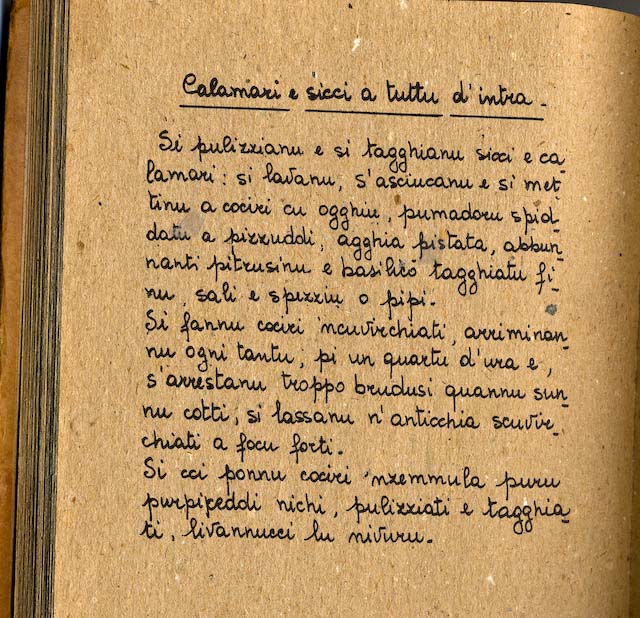
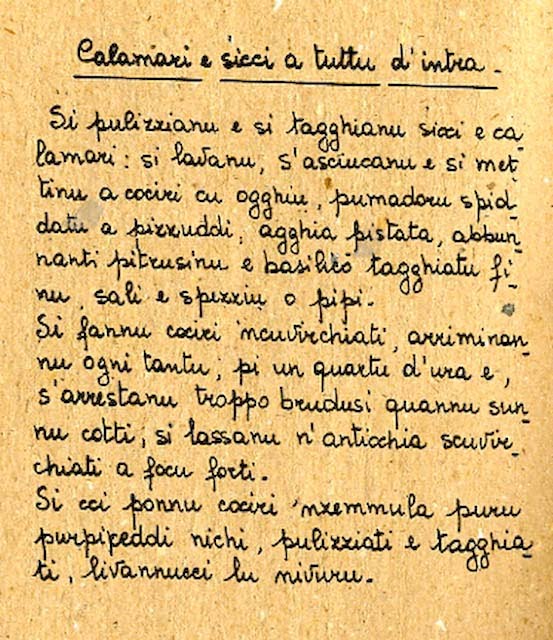
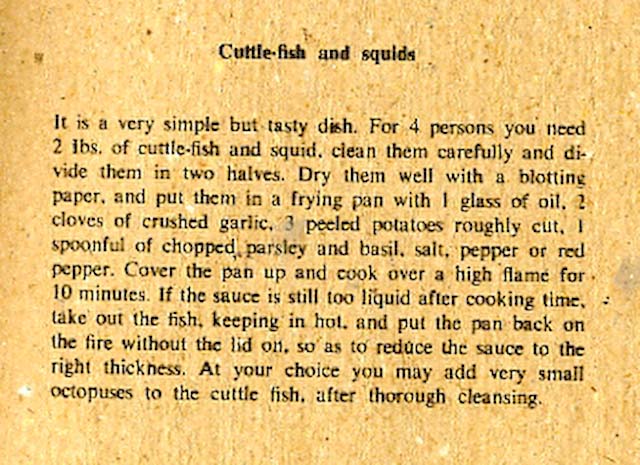
followed by an English translation - however, those of you with a limited knowledge of Italian (rather than Sicilian) may just spot a significant error in this recipe for squid and cuttlefish twixt the original and the English version!
Either way, the recipe is a delicious way of preparing the these delicate creatures at this time of year when they are in abundance (when the boats can get to sea).
Apart from the fact that cuttles are also fished by boats from the tiny port of Taormina the links don't stop there. Amongst many notable Englishmen living was Lord Bridport, the Duke of Bronte who entertained others like DH Lawrence. The Villa St Andrea was once owned by a Cornishman whose family came from Zennor then Ludgvan near Penzance. The Trewhella family, later railway engineer and mine owner Robert Trewhella lived in the villa, which was much later (in the 1950s) converted to the luxury hotel it is today. Another English connection with the port was the Nelson family - use Google translation for this page.
The story of the villa hotel has an incredibly tragic element. As with many parts of Sicily the coastline consists of sheer cliffs with tiny ports at the foot of these cliffs. The grounds of the villa above Taormina end at a steep cliff edge - access to the port itself is by funicular railway built by Robert Trewhella. On the 5th of April 1959 the wife of Alfred Percy Trewhella (search on the page), Gertrude Deidamia Sarauw stepped out of the way of a car in the villa grounds and fell, as she did so, her husband Alfred tried to catch hold of her and, tragically, the two of them fell to their deaths.
Maybe someone can help with the Trewhella family history being researched here by Harry Manley.
The UK's only 2 star Michelin fish chef is also a fan of the cuttle;
St Enodoc Hotel in Roc and recently awarded two Mchelin Stars to boot.
For the Cuttlefish
1kg cuttlefish cleaned, prepared and left whole, saving the ink
1 onion, roughly chopped
2 carrots, peeled and chopped
4 garlic cloves, crushed
6 ripe tomatoes cut into quarters
600ml fish stock
100ml dry white wine
Sweat off the vegetables for 5 minutes in a pan. Add the wine and reduce to nothing and then add the fish stock. Bring the stock to the simmer and add the cuttlefish. Simmer for 1 ½ hours or until tender. When the cuttlefish is ready remove from the stock and allow cooling. Strain off the stock for the vinaigrette and cool. When the cuttlefish is cold slice into 2cm strips and reserve until serving
For the purple sprouting
28 nice pieces of purple sprouting
Bring a large pan of salted water to the simmer and blanch the sprouting for 2 minutes. Refresh in ice water and drain off. If you’re doing in advance place in the fridge. If you’re serving straight away don’t refresh just serve immediately.
Ink vinaigrette
2 finely chopped shallots
75ml red wine vinegar
75ml cuttlefish stock
150ml extra virgin olive oil
1 tbsp cuttlefish ink
Add the shallots, vinegar and stock together and leave to stand for 30 minutes. Then add the ink and whisk in the oil. Season with salt and serve immediately.
Garnish
20g fine capers
4 sprigs of tarragon, picked
Squeeze of lemon
To serve
Warm the cuttlefish up in a bit of the vinaigrette, not to hot. Place the sprouting, capers and tarragon into a large bowl and then gently mix with the warm cuttlefish. Add a squeeze of lemon and season with sea salt and black pepper. Serve in bowl plate with a jug of vinaigrette on the side.

Put together the simple set of ingredients (plumped for tinned rather than fresh toms)........

one cuttle simmering slowly in the sauce........

sliced and ready to serve turned gently in with the purple sprouting (plus a few heads of broccoli)........

PS The starter was a failure - don't be tempted to pick mussels from Porthmeor Beach in St Ives, they are full of grit - the beach is way too sandy methinks!
CFPO news - Southwest fishing industry suffers a £2 million loss as a result of poor EU-UK negotiations
Despite the UK government announcing a £34 million increase in fishing opportunities based on this year's EU-UK annual negotiations, the reality for the southwest is a loss of over £2 million worth of fishing opportunities totalling 451 tonnes of key commercial stocks, as well as a massive blunder on Spurdog.
With annual negotiations results coming down to the wire again, the UK published the agreed Total Allowable Catches (TACs) and UK quota shares on Tuesday this week. Cornish fishermen have now raised serious concerns with the results and the continuous loss of fishing opportunities in the southwest. Cuts in Pollack, Sole, Plaice and Haddock will undoubtedly prove a challenge in what continue to be testing times since Brexit.
While respecting the scientific advice that goes some way to making these decisions, huge swings in TACs will see a 77% reduction for Plaice in the Bristol Channel and over a 20% reduction for Sole in the English Channel, all of which makes no logical sense given that these are annual negotiations. Surely there should be a focus on better managing our fish stocks to only need a maximum change of 20% either way? In other cases such as Pollack, commercial landings data have been down partly due to restricted access to the French markets, where traditionally, pre-Brexit, boats would have landed significant volumes. Limited overseas market opportunities have led to a reduction in catches, and as a result, our Government applied a use-it-or-lose-it scenario and cut the TAC by 20%, which is simply ridiculous. If stocks are not being caught, this shouldn't be a driver for making reductions.
Although not the crux of high-value species, one of this year's biggest blunders by the UK government is the failure to match the EU and open the Spurdog fishery as of the 1st of January 2023. Despite a number of Cornish Fish Producer Organisation member vessels being the only ones to work with the Government on recording and reporting precious data on Spurdog for the last decade, which has enhanced understanding of the stock and led to a positive shift in scientific evidence, it's now apparent that the EU will begin fishing in just ten days, whilst the UK will watch from the other side of the median line waiting for our Government go through a laborious red tape process for the next six months. Of course, this doesn't mean we won't still be catching Spurdog, it will remain part of the mixed fishery and an unavoidable bycatch, so we will simply have to carry on wastefully discarding perfectly good food whilst the French, Irish and Belgians take advantage of decades worth of hard graft and dedication from the Cornish fleet.
Monkfish, Hake and Megrim have seen more positive outcomes of this year's negotiations, all receiving slight TAC increases. In addition, an improvement in the scientific assessment of Bass stocks has led to a very slight increase in opportunity, which will come into effect later in the year as it is subject to a statutory instrument process.
Whilst this year's negotiations outcomes further compound what have been challenging times, it will not break the passion and dedication of Cornish fishermen who will make the best of any situation and will find a way forward. However, the UK Government must not be allowed to continue letting down fishing communities in the southwest and claim they are acting in the best interest of fishermen when that is clearly not true. Pre and post-Brexit warm words and empty promises have not been backed up by action and delivery for fishermen. The relationship between UK Government, DEFRA and fishermen in the southwest will continue to decline as political convenience and lack of understanding dominate decision-making.
Defra announces EU fishing deal to increase fishing opportunities to £750m
The deal will present UK fishing with opportunities worth over £280m in 2023
Defra has announced the UK fishing industry will benefit from 140,000 tonnes of fishing opportunities next year, following the conclusion of negotiations with the EU.
The deal, announced yesterday, represented a 30,000-tonne increase on pre-Brexit volumes and would present UK boats with opportunities worth over £280m in 2023 in EU waters.
This brought the total value of fishing opportunities secured for the UK fleet in 2023 in the three main negotiation forums to £750m, a £34m increase from last year, Defra said.
The UK and EU agreed catch levels for 69 fish stocks including North Sea nephrops (£54m), anglerfish (£31m) and western hake (£25m).
The agreement has also committed the UK and EU to working together to provide more sustainable fisheries management.
“Our agreement with the EU secures valuable fishing opportunities for the UK fishing industry while cementing our joint commitment to manage fisheries sustainably,” commented fisheries minister Mark Spencer. “These decisions are based on the latest scientific advice to help protect key fish stocks with the long-term health of the marine environment at the forefront of our minds.”
However, the agreements have been criticised by ClientEarth, an environmental law charity, which said both the EU and UK had “refused to follow scientific advice” that Irish Sea whiting, Celtic Sea cod and west of Scotland cod should not be caught at all.
“The EU-UK deal is a small step in the right direction, but nowhere near enough to bring depleted cod and whiting stocks back from the brink,” said Jenni Grossmann, ClientEarth fisheries science and policy advisor. “They are the collateral victims of unselective trawls that are sweeping up pretty much everything in their path while trying to catch species like Norway lobster and haddock.
“Despite all proclaimed ambitions at COP15 to protect biodiversity, today’s deal means that genuinely sustainable fishing across the board remains a pipe dream for both the EU and the UK,” she added.
The deal follows an agreement on 9 December between the UK, EU and Norway on six North Sea fish stocks including cod, haddock and herring, worth £202m to the UK fishing industry and a further £11m in stocks in other waters around the UK.
In the same week, the UK secured catch limits worth a further £256m with the North East Atlantic coastal states, while an agreement with Norway last month will enable the UK fishing industry to benefit from opportunities worth £5m in 2023.
“We are backing the fishing industry across the country to succeed, with a landmark £100m investment in infrastructure, skills and better scientific data so that our fishing industry thrives for generations to come,” Spencer added.
Read on for more reaction from the Cornish Fish Producers Organisation
Subscribe to:
Comments (Atom)