'>

Thursday, 24 November 2022

Prins Bernhard - Day 6 - environmental impact of industrial fishing


What are the environmental impacts of pelagic fishing as it is practiced on board our vessels? Selectivity, carbon footprint, degradation of the seabed: so many subjects on which France Pelagic is at the forefront.

Listen to Niels Hintzen, Director of Research at Wageningen University, stock valuation expert and member of the ICES Advisory Board, tell us about it, here and on the dedicated page of our website (https://lnkd.in/e8cBt_pS).

International Council for the Exploration of the Sea (ICES) 

For fishing boats with foreign crews: Labour and Skills Shortages

This is a transcript of the Labour and Skills Shortages HoC debate. 

To save time, the easy way to find fishing related references is to use a keyboard shortcut for 'find'.

Eg, On a PC Ctrl + F, on a Mac Command + F and 'fishing'


Devon & Severn Inshore Fisheries & Conservation Authority (D&S IFCA) use of enhanced Remote Electronic Monitoring (REM) equipment

The REM Project was presented to Members of the Authority and to the Inshore Potting Agreement Committee on 19th October 2022.

The owners and crew of a scallop dredging vessel assisted in the trial work which involved the installation and testing of a system of cameras and sensors to capture images and data when fishing gear was deployed and recovered from the sea. Similar systems are already widely used in the haulage sector and Marine Scotland will require all scallop dredging vessels operating in Scottish waters to have similar REM technologies on board by the end of 2022.

(Photo showing wheelhouse mounted camera)


What were the aims of the project?

  • To evaluate how technologies and can improve management through enhanced monitoring of fishing activities.
  • To demonstrate how technologies can improve access to fisheries by changing management measures.
  • To demonstrate how much data can be generated from on board technologies.
  • To demonstrate the cost and monitoring effectiveness of technologies compared to the current approach.
  • To demonstrate opportunities for vessel owners when their vessels are at sea.
How does the system work?

Two high-definition on-board cameras work in combination with sensors fixed to the fishing gear and linked to the vessel monitoring system (VMS). The VMS continuously records the vessel’s position, course, and speed; and sensors detect when fishing gear (scallop dredges were the gear type used in the trial) have been deployed. When the sensors detect the use of the fishing gear, three-minute videos of the activity on deck are uploaded from the cameras. 

(Photo right show sensors mounted to the towing plates on the scallop gear)

The videos are only uploaded if the vessel triggers an alert. In the case of the trial, the alerts, were either when the vessel was operating in an area simulating a Marine Protected Area or when it was operating in D&S IFCA’s District with towing bars that exceed the maximum permitted length of 5.18m metres under D&S IFCA’s Mobile Fishing Permit Byelaw (Category One Permit Conditions).

(Image below shows the VMS track of vessel, the speed profile of the vessel and information from the sensor on deck and the sensor in the water) 

(Photo below shows a still image - taken from a video - which demonstrates compliance with six dredges per side)

What about data protection and privacy?

Users can have different access permissions, so the owners of the fishing vessels can see everything that they want to and can add up to six additional cameras (engine room, full deck etc), but D&S IFCA would be restricted to only accessing the uploaded videos from the two cameras focussed on the fishing gear.

The uploaded data is stored securely by the company providing the cameras.  The camera company maintains an access log which records each time D&S IFCA accesses the video footage.  Under Data Protection Regulations, fishers (data subject) can request a copy of what information has been viewed by D&S IFCA.

The advantages of REM

There are significant benefits for vessel owners, masters, and regulators such as D&S IFCA.

The introduction of technologies can change the way regulators approach fisheries management providing benefits to the fishing sectors as demonstrated in the trial.

Vessel Owners can install additional cameras to improve the safety of the crew and vessels and use the data to improve traceability of their catches.

Currently less than half of D&S IFCA’s investigations into MPA incursions meet the evidential standard required to prosecute.  The REM technologies will strengthen the evidence available to both regulators and fishers and improve the regulators’ intelligence led approach to enforcement.  

REM is likely to increase compliance and reduce the likelihood of challenges to the regulators’ evidence.  The additional evidence will lead to improved reputation of the regulators and improve relationships with the fishing sector.

REM can be used to increase the effective protection of MPAs and will potentially reduce the financial losses incurred by the static gear fleet when illegal activity results in their pots and nets being towed away or damaged.

How much does the system cost and who is going to pay?

Each REM system will cost around £3,000 to purchase and install and will cost approximately £650 a year to maintain the equipment (under warranty) and support the automated monitoring of the onboard systems.

D&S IFCA is looking to secure funding to cover the cost of the purchase and installation of the REM technologies.  In addition, D&S IFCA is looking at how it can support the cost of maintaining the REM systems post installation and remove the cost burden on the vessel owners.  The cost of monitoring and maintaining REM on the current 57 scallop vessels active in the Authority’s District is comparable to the cost to the Authority of employing one enforcement officer.

Next steps

D&S IFCA intends to extend the REM project to continue to assess the reliability of the technologies.  If you would like to participate in the extended trial, then please get in touch.

More information about D&S IFCA

Our website includes a range of display pages and an interactive publication scheme (Resource Library). Contact Us or find out more About Us and Our Work.

Wednesday, 23 November 2022

Newlyn Fish Festival 2023?

After three years without a Fish Festival moves are afoot to reinstate one of Cornwall's most anticipated events. To that end, there will be a meeting at 5pm, December the 5th at the Argoe Restaurant, Newlyn Harbour. Anyone with an interest in seeing the festival up and running again is welcome. The agenda will include what sort of festival and who should benefit from any proceeds created - this will be a community led event.


1,000s of visitors

The festival, first opened to the public in1991, regularly attracted up to 20,000 visitors and raised hundreds of thousands of pounds for charity, namely the Fishermen's Mission. In the early days, the event hosted a trade show for the fishing industry - the fish market was full of companies keen to showcase their products and services to a rapidly changing fleet. By 2019 circumstances, including a major transformation of the fish market and the Covid lockdowns, forced the festival to be abandoned.

Much has changed since the early days. Like many large public gatherings, the impact of health and safety and insurance cover have restricted certain features and for many, the increasing presence of non-fishing contributors detracted from what should be a celebration of all things fish and fishing. With all that in mind, it is hoped that a new committee will be formed to once again put on a festival which truly reflects Newlyn's position as the fishing port that lands a greater variety of fish from the widest variety of fishing vessels in the UK.


Passionate about fish - fish-filleting maestro, Duncan Lucas tells all

For many, the very epitome of the fish festival was the huge fish display - for many years put together by Sue and Duncan Lucas.  Logistically, this was always a challenge as the display relied entirely on fish donated by boats in the days running up to the Bank Holiday Monday - and the weather did not always play ball often keeping many of the inshore fleet tied up beforehand! 

Top fish chefs like Paul Ainsworth demonstrated their fish cookery skills

Whatever final format the team develops, a new festival will have fish at the very heart of the event in order to celebrate every aspect of an industry that has existed since the Old Harbour was built as safe haven for fishing boats way back in the 15th century. Nowadays, the harbour plays host to a modern fleet of beam trawlers, trawlers, scallopers, netters, potters and hand-line fishermen who between them regularly land over 50 species of fish to a fish auction that supplies a good percentage of its fish to European markets - though that percentage continues to fall from the 90% it once was.


Today's feature rich wheelhouse - almost needs a degree in electronics!

One thing is for sure, Newlyn is at the very heart of a modern, sustainable fish industry - many innovative ideas to conserve or protect fish and other species have been thought of, trialled and developed with the direct involvement of Newlyn fishermen. Harbour based Seafood Cornwall Training play a key role in training, advising and developing local skippers and crews and now run the new Fishing Apprenticeship - and a quick scan of the job description reveals just how demanding the work really is. Crucially, the industry now needs to attract young people to protect the future of the industry rather than rely so heavily on overseas crews as it does at present. Celebrating the wide range of career options in fishing - one that can, and does, provide an income well above the average in Cornwall - should be a key feature of any new festival.  For example, Hunting the Catch, the most recent fishing BBC TV series focussed on the the thoughts and decision taken by skippers of crabbers, trawlers, beam trawlers and a pelagic boat - the qualifications needed just to take a boat to sea - irrespective of the knowledge, skills and experience they have to manage a boat and crew and find enough fish to make it pay - are actually at degree and post-graduate level. Fishing is not the brawn, bravado and a few beers back in the harbour-side bar as so often depicted in the media.


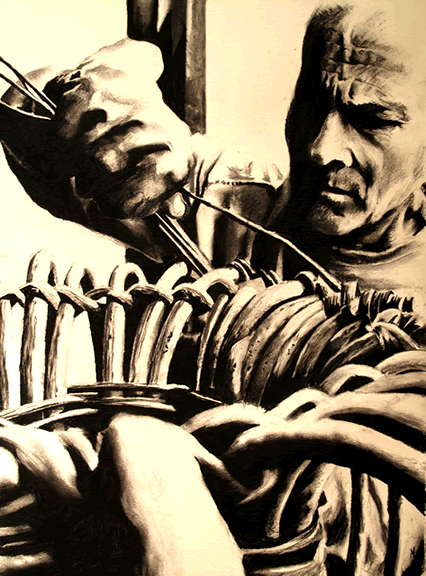
Dick Ede - and the art of pot making - by Nick Henshaw.

The attraction and reasons for visiting a real life working fishing port are many - the chance to see up close work still seen as a way of life rather than a 'job',  the sights, sounds and smells around the harbour, demonstrations of skills like pot and net-making that date back thousands of years, well before even the building of Newlyn's Old Harbour, chefs, fishmongers and merchants with fish fresh from the sea on display, being prepared and cooked in a myriad of ways for the table, boats, some well over 100 years old and new, to go aboard and see first hand - the list is endless. 

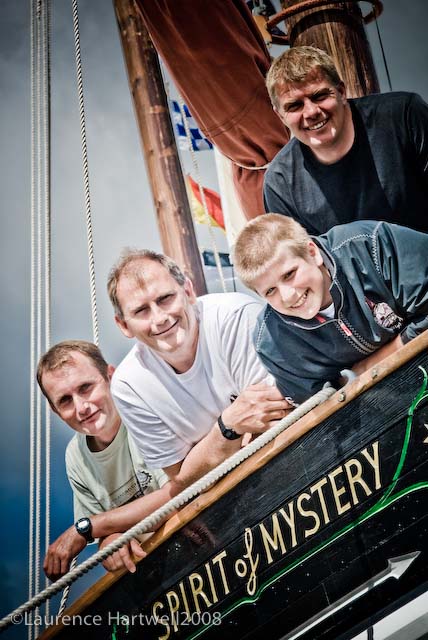
Pete Goss re-created the incredible Mystery voyage.

In addition to all that the fleet has has to offer, the harbour and town of Newlyn have seen history made and recorded for centuries - from the Mayflower stopping off to top up on fresh water on its way to the Americas, the start of the amazing world's first trans-oceanic sailing boat voyage in 1854 by the lugger Mystery, the Newlyn Riots, hosting Belgian and Breton fishermen during WWII and the almost impossible to calculate significance that the Tidal Observatory has played in creating every nautical chart in use by shipping the world over - the list is endless. Newlyn is also unique for having seen the creation of its own School of Art to rival French Impressionism - a tradition still very much alive today given the number of thriving artists studios and galleries in and around the harbour.

Ultimately, and at the very heart of this unique community, is fish. It is to fish we should turn for the inspiration to make a new festival happen. So, last but not least, listen to what TV chef Angela Hartnett in conversation with fish buyers and chefs like Nathan Outlaw and Mitch Tonks has to say on just how important it is to promote the eating of fish!


So, whatever your interest, skill or just plain curiosity, here is an opportunity to see that we celebrate fish and fishing in a new way as the harbour faces its fishing future.


Fish Festival Meeting

Where? Argoe Restaurant, Newlyn Harbour

When? 5pm Monday 5th December 2022.

Refreshment drinks will be available

If you cannot make the meeting but have any thoughts, ideas and suggestions, please email them here.


Directions: 


Prins Bernhard - Day 6 - herring on board.


"Don't be idle. Fish should be frozen as soon as possible. For quality, this is essential.

The herring has just arrived in the chilled water tanks: kick-off for the factory. Production can begin. Sorting, calibrating, freezing, freezing: the rate of the 6 sailors stationed on the production line is adjusted to that of the freezers. The same gestures are repeated, assured, precise, as long as there is fish coming from the deck. As long as it lasts, it put a smile back on the faces of the whole crew.

Embark. 

Discover the images of the Prins Bernhard factory on our LinkedIn page and on the dedicated page of our website (https://lnkd.in/e8cBt_pS).

Tuesday, 22 November 2022

EU fishing news: Fly-shooting ban lifted and news on access inside 12 miles.


Dutch claim victory in EU Parliament over flyshooting ban in the Channel.

The European Parliament has voted not to ban flyshooting from the English Channel in a vote today, Tuesday 22 November 2022.

The vote ended with 608 in favour of retaining the fishing method, nine against it, and 13 in abstentions. Supporters of the fishing method believe that this win sends a strong message to those opposing it, that flyshooting is here to stay in EU waters, at least.

French environmental NGOs, BLOOM and Association Pleine Mer, along with inshore fishermen on the French side of the English Channel have been severely critical of the method they say are wiping out traditional French fishing grounds. Artisanal fishermen say they have been hit hardest as whole areas takes weeks to recover after it has been visited by a flyshooter.

the fishing daily advertise with us At the end of September, the controversial method of fishing, also known as demersal seine-netting survived a trialogue between the Council of Europe, the European Commission and the European Parliament.

After an intense debate the outcome of the trialogue was announced by the EU Parliament who said:

“Parliament and Commission take note of the situation of fisheries in the Channel, where local and regional stakeholders and fishers raised concerns about bottom trawl fishing methods used by numerous vessels. They therefore invite EU governments to come up with joint recommendations in this regard, which the Commission could use to propose practical measures. The Commission will ensure that funding for related scientific research is available.”

The news was welcomed by Dutch fishing but eNGO, BLOOM called it a “Black Friday for coastal fishermen”. BLOOM had carried out a survey amongst French coastal fishermen with 98% polling against the industrial fishing technique.

Earlier in July, the European Parliament’s Committee on Fisheries (PECH) voted in favour of banning the fishing method altogether.

In England, a consultation was undertaken by the UK Government regarding the future of flyshooting on the British side of the Channel. The consultation which closed on 17 November last included the following proposals:

Introducing an ‘entitlement’ which would restrict the number of vessels with flyshooting gear (0-200 nautical mile zone); and/or

Restricting engine power for demersal seine gears to 221kW or 600kw in 0-12 nm zone; and/or

Removing an exemption that currently allows a 40mm mesh size in a directed squid fishery (0-200nm); and/or

Restricting vessels’ rope diameter used in flyseine gear to 30-40mm (0-200nm); and/or

Restricting vessels’ rope length used in flyseine gear to 1500m if in 0-12nm and/or 3000-3200m if in 12-200nm.


Reacting to the decision of the European Parliament today, Dutch MEP and member of the PECH Committee Bert-Jan Ruissen who is an advocate of the fishing method said, “The French attempt to keep Dutch fishermen out of the Channel using fly-shoot technology has been definitively averted. Our agreement received almost unanimous support from the European Parliament on Tuesday: 608 in favour, 9 against and 13 abstentions. Strong decision!”


Also in he European Parliament today = a plenary on Extension of EU rules on access to coastal waters - 12 mile limit news!


Monday, 21 November 2022

Prins Bernhard - Day 5 - it's all about the science and the seasons


Prins Bernhard's AIS track for the last 24 hours courtesy of Vessel Tracker...


 fishing for herring in the English Channel.


Niels Hintzen, Director of Research at Wageningen University gives his view of the fishery.

Our vessels fish for herring in winter in the English Channel, but also in summer in the North Sea. What do we know about this seasonal migration?

"Herring spawn in 4 different areas: one in the English Channel, and the other 3 along the English coast, as far as Scotland (...) In summer, herring migrate from these 4 areas to the central part of the North Sea, to feed and fatten."

Find the scientific perspective of Niels Hintzen, Director of Research at Wageningen University, expert in stock assessment, member of the ICES Advisory Board, here and on the dedicated page of our website (https://lnkd.in/e8cBt_pS).


The fleets' vessels catch five different pelagic species (herring, mackerel, horse mackerel, blue whiting, sardines) throughout the year, between the west of Ireland, the north of the Shetlands and the North Sea, on the high seas most of the time.

The fishing area is determined by the season and the target species. The herring season in the English Channel lasts a few weeks each year, between November and December.

Get on board: for a month, infographics to discover and understand the herring fishery in the Channel, here and on the dedicated page of our website (https://lnkd.in/e8cBt_pS).