Asthore on the hard, it's final few weeks of the sardine season and these guys will be laid up until July when the first signs of the new season's fish will no doubt present themselves around the same time as glit appears on the fine meshes of the netters...
big hake from the Ygraine, just one of the big netters to put the first fish ashore in Newlyn for nearly a week...
a little treat for some lucky customers up the line, some cracking bream...
more hake...
Silver Dawn added a few dogs to the mix of fish landed...
along with pollack...
and hake...
wile the Ocean Pride added a good shot of ling, once the mainstay of the longlining fleet back in the 60s and 70s......
even a few red gurnard found their way into the netters big mesh gear...
all whisked away...
with no trawl fish at all on the market supplies of monk tails...
ray...
Dover soles...
and megrim were even more thin on the ground...
fresh weekend winds kept all but a handful of handliners on their moorings so fish like mackerel were few and far between...
red and...
black bream proved just as elusive for the men with hook and line...
with just a handful being landed...
more ice next time for these tails...
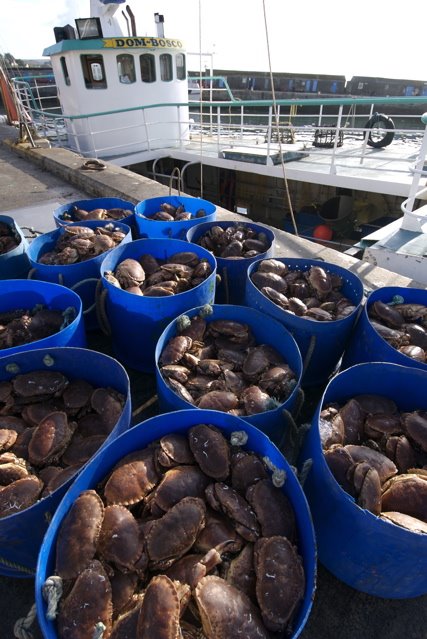
fine weather sees just the two crabbers and the netter Amanda of Ladram in port today.
The Fishmongers’ Company has joined Fisheries Innovation Scotland (FIS), the partnership exploring new ideas for greater prosperity and sustainability in Scottish seafood. The Company takes its place alongside high-profile members from catching, processing, retail and fisheries management.
Welcoming this new collaboration, FIS Chairman John Goodlad said: “FIS is known for connecting the supply chain to release untapped potential in our seafood industry. FIS’ take on innovation is about genuine collaboration to add value to businesses and communities – a goal already shared by the Fishmongers’ Company, and we’re delighted to have the support of this ancient and esteemed industry leader.”
The Fishmongers’ Company will be represented on the FIS Board by Alison Freeman, who manages the Company’s Marine Fisheries programmes. Alison has experience of innovative projects across the breadth of the UK fisheries sector. She developed the Company’s COVID-19 ‘Rapid Response Grant Programme’, and a network and funding structure to enable industry-led science.
Alison said: “Fishmongers’ are thrilled to be joining the FIS membership. We have always admired FIS’ targeted approach to working with industry to pilot and champion innovative practices that improve the sustainability of the sector. Their mantra of ‘no fishing sector left behind’ firmly resonates with us and our own work programmes. We hope that this partnership will enable us to scale up projects and share practices for the benefit of the wider sector.”
FIS projects are designed by its members, responding to the most pressing innovation needs for Scottish seafood. Current projects include piloting digital technology to improve traceability and verification, and understanding what alternative vessel fuels might be realistic in a Scottish context. FIS’ Smartrawl project puts Scotland at the forefront of the innovative response to eliminating discards, allowing skippers to retain commercially valuable catch. FIS supports the next generation of industry leaders through travel and study bursaries, and will host the Scottish Fishing Conference in Autumn 2022.
Denis ROBERT and C.LE GALL denounce these predatory billionaires against the states
In her book “The Ocean Imposture”, the investigator Catherine Le Gall points out the real threats to the oceans: pollution and climate change, of course. But also the appetite of multinationals.
Haro on the Breton fishermen-sailors! Endangered species – half as numerous as twenty-five years ago – now they are being refused access to British waters. More serious: for the past twenty years, two NGOs have accused this artisanal fishing of all evils and harassed the owners of trawlers. Are they shining the spotlight on the right place?
This is not the opinion of Catherine Le Gall, an investigator until then specializing in financial matters (Les Prédateurs. Billionaires contre les Etats, éd. Le Cherche midi, with Denis Robert), but who left Paris to join his native land, the bigouden country, for a long time the first fishing territory in Brittany. In L'Imposture Oceanique, she points out the real threats that she believes weigh on the oceans: to climate change and generalized pollution is now added the appetite of multinationals who see in the "blue economy » a new territory of conquest. And they act under the shelter of their foundations and NGOs...
What is your view of the Franco-British conflict over fishing?
Once again, fishermen are faced with issues beyond their control. Prime Minister Boris Johnson is questioning the Brexit agreements, which provided for the annual granting of licenses for those who already fished in British waters. He creates this conflict to hide the disastrous economic situation of his country. The British make it almost impossible to renew licenses because small coastal boats, which have limited technical means, are unable to prove that they were fishing in these waters.
This crisis, which I did not address in my book, nevertheless illustrates my point: once again, fishermen find themselves in the crosshairs and are instrumentalized…
That is to say?
I am a girl from Bigouden country. Born in Pont-l'Abbé, I grew up in Nantes but I spent all my holidays with my paternal grandparents, both from the world of fishing, and, as a teenager, I rode my bike every day to attend the landing fishing in Guilvinec. After fifteen years in Paris, my relationship to the country and to fishing was distended, then I read Pénélope Bagieu's comic strip [a page entitled Prends cinq minutes, et signe, ami and published on her blog in 2013, editor's note] and I was then permeable to his environmental discourse: fishermen were the main responsible for the disappearance of species.
Two NGOs, Bloom and Sea Shepherd, off Finistère, were carrying out harassment campaigns against them and making their lives impossible. The fishermen of Guilvinec, those heroes of my childhood, had become assassins…
“In Brittany, the dumping of nitrates
leads to a proliferation of toxic algae
which deprives the plankton on which the marine animals feed of oxygen.”
It is nevertheless undeniable that Claire Nouvian and her NGO Bloom played an important role in Europe's ban on deep-sea trawling...
I do not deny the ravages of overfishing, nor the need for fishermen to evolve their practices.
My main criticism of these NGOs is that they only focus their gaze on fishermen, and make people believe that they are the main threat to the oceans. However, living in this territory, I know that overfishing has had an impact on fish stocks, but also that the fishery resources, according to Ifremer [French Research Institute for the Exploitation of the Sea], are today today in much better condition than in the past. The image of the fishermen is deeply damaged, they are bitter because they were the first worried to see the resources dwindling, and they know full well that many other dangers weigh on the oceans.
Which ?
They are multiple. The greatest threat is obviously greenhouse gases: the warming they cause is 90% absorbed by the oceans, which have also incorporated 20 to 30% of the CO2 emissions emitted by humans since 1980. of course the price of water acidification. The other big threat is pollution from land. In Brittany, the dumping of nitrates from pig farms leads to a proliferation of toxic algae, which suck up oxygen and deprive the good plankton, the diatoms, which marine animals feed on. If the big fish have nothing left to eat, they can no longer reproduce and the stock collapses. Add the pesticides used for sixty years and chemical pollution of all kinds, and the loop is complete.
But we prefer to focus on fishing.
You also point out the negative effects of tourism…
Global tourism, a monster out of control, is responsible for 8% of the planet's greenhouse gases. Without even mentioning the caricature of the mega-cruise ships – which represent only 1% of the merchant fleet but 25% of the waste it produces – the simple influx of population towards the coasts degrades the coastlines. If Finistère has preserved an identity despite tourism, it is because a fishing activity continues to sustain the region. Let's make this profession disappear, as Bloom wishes, and the entire historical, cultural and economic ecosystem of the region is called into question. I'm not sure that replacing the fishing industry with tourism will be very beneficial for the environment.
Starting from a local investigation, I came to question the fate of the oceans on a much larger scale and to question the harmful role of multinationals.
“By funding NGOs whose discourse
is compatible with their liberal paradigms,
multinationals have a prescriptive action on
environmental discourse.”
How do multinationals act?
Through foundations and NGOs. The great American families who have made a fortune in high technology, mass distribution or oil have all set up foundations, according to the codes of Anglo-Saxon culture, to defend causes of general interest, but keeping in mind their paradigms. liberals. These foundations finance NGOs whose discourse is compatible with their market culture. By financing these NGOs, they have a prescriptive action on environmental discourse. It's not a conspiracy theory, I'm not saying that it's all calculated, except in the sense that they are indeed rational actions, linked to a culture, to the habits of the business world.
Here, I am not talking about Bloom or Sea Shepherd, although they too have been financed by American foundations and, being part of a galaxy, they are useful to this ideology. I am talking about large NGOs, like The Nature Conservancy or WWF, which implement this economic project. WWF, in conjunction with AXA, has for example calculated the economic value of the oceans! Instead of considering the environment and nature as a common good of which we are a part, these NGOs objectify it, giving it a value. All that remains is to propose commercial solutions to “improve” the environment.
Catherine Le Gall underlines the harmful effects of the lobbying of multinationals on the environmental issue, through the powerful NGOs they finance, such as WWF.
Do the NGOs you quote defend this vision?
They defend the principle and the application of carbon credits [the payment of a tax or an investment intended to offset one's CO2 emissions]. And they implement them. An example: by replanting mangroves, as has been done in Senegal, they validate the fact that carbon offsetting is a good thing, while contributing to the eviction of women who extracted oysters and fed on the mangroves. In terms of CO2 capture, the numbers are ridiculous.
Since the Paris agreements, the most polluting large industries, cement works, oil companies, must offset their CO2 emissions, so they are applying for carbon credits to achieve their neutrality. But even people who adhere to this vision recognize that carbon neutrality through the prism of offsetting is not achievable. In fact, this principle just allows the most polluting industries to continue to pollute.
While it would be desirable that they no longer produce or adapt their production drastically.
“Marine protected areas seem attractive, except that they only protect marine activities, while 80% of pollution at sea comes from land.”
You are also very upset against the concept of the “blue economy'
In the early 1990s, the 200 most polluting multinationals on the planet created the World Business Council for Sustainable Development (WBCSD). Their three rules: trust the markets, let leaders show what they are capable of, give value to nature. Ecology is seen as a challenge, as an economic opportunity, not as a vital emergency. The new eldorado of the digital industries are the precious natural metallic concretions, called polymetallic nodules, which line the bottom of the oceans and which they need to ensure their expansion.
We are still at the stage of exploration, not exploitation. But at recent climate meetings in Marseille, NGOs including the International Union for Conservation of Nature called for a moratorium on the mining of marine resources, and France abstained. There are big economic issues at stake.
Can the development of "marine protected areas" (MPA) be a solution to protect the oceans?
MPAs may seem attractive, except that they only protect marine activities, whereas 80% of pollution at sea comes from land. In addition, the oceans are disturbed by acidification and eutrophication – an excessive proliferation of vegetation – which will not be stopped by protected areas.
Water quality cannot be decreed. Even people who are in favor of these marine protected areas and the NGOs involved in their management explain that there are not enough financial and human resources to manage them properly. Emmanuel Macron would like to increase to 30% MPAs in French territorial waters.
I cite the example of the Clarion-Clipperton region, in the Pacific: it includes an MPA of 2,500 square kilometers, created by France in 2016 to protect endangered species, while an area of 4.5 million square kilometers is dedicated to the exploration and then the exploitation of polymetallic nodules. If MPAs have a function, it is this: by sanctuarizing small parts of our oceans, they save us from asking ourselves what way of life to adopt in order to protect all of them. We will not save the oceans by leaving them in the hands of the merchants.
Cefas, on behalf of Defra, is currently investigating the health of edible crab populations around the English coast.
Cefas’ Weymouth laboratory have started doing health screening on crabs around the coast and, in conjunction with Cefas’ Shellfish Team, are asking for some feedback which will help target our sampling in the future. We would be grateful if you (the skipper or vessel owner) could answer the following questions as best you can. Your experience and knowledge of the fishery will give us a valuable insight into edible crab stocks around the country. This work is part of a three-year Defra project to research crab health around the English coast. It is not related to the separate on-going Defra-led investigation into crustacean mortalities in the North East.
Individual responses will not be shared with any other organisations. Research findings will not be used for purposes other than those they were collected for. Personal data will be stored securely and will only be kept for as long as they are needed for this project (maximum of four years). After four years personal data will be deleted securely and anonymous data will be retained. Any data that are published will be aggregated and anonymised.