Monday, 31 January 2022
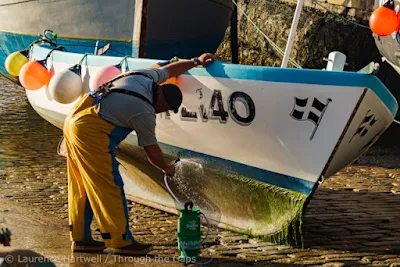
Boom! Star ship Enterprise lands a record-breaking £87,353 trip.
Saturday, 29 January 2022
Newlyn Coastal Research & Development Project.
Newlyn Coastal Research & Development Project - FAQs Why isn’t a full rock breakwater improvement scheme being done in Newlyn?
Originally in 2019, we planned to increase the height and length of the rock armour breakwater, using eco- engineered blocks at Newlyn, to provide the community with extra coastal erosion and flood risk protection
from the sea. We created a wave model, explored different types of options and decided on a final breakwater design. Unfortunately, an unforeseen increase in costs, exacerbated by an increase in the costs of building materials has led to this design not being affordable at present.
The funding for this project is based on the government funding mechanism for securing Flood Defence Grant in Aid (FDGiA): FCERM appraisal guidance - GOV.UK (www.gov.uk).
Please be assured that our long term intent is to still deliver the full breakwater upgrade, but this will involve securing funding from other contributors/ grants, and is dependent on the results of the current research and development project.
What is a 'nature-based solution'?
Nature-based solutions involve working with natural processes to deliver flood risk management rather than solely relying on traditional rock and concrete methods. Nature-based solutions can also provide benefits for local ecology, carbon reduction, water quality, recreation, etc. It is a multi-benefit solution, which means we can protect communities from flooding whilst also improving the surrounding environment. For the coast, examples include: beach nourishment, creating space for salt marshes and offshore artificial reefs.
I've seen the term 'eco-reef' referred to for this project before, why is it not called this now?
The Environment Agency commissioned wave modelling in Newlyn, which was completed in 2019. This modelling looked at different coastal flood and erosion risk management options for Newlyn. The modelling showed that an upgrade of the existing breakwater would be the most cost-effective option to alleviate this risk. Therefore, the intention has been to do works in this location from the scheme inception. As the project
has downsized due to funding limits and due to the new research objectives of this project, the term 'eco- reef' is no longer appropriate.
Why Newlyn?
The existing breakwater at Newlyn provides an ideal location to implement the eco-blocks. It is also home to a wonderfully diverse rocky shore which we hope to enhance and will allow us to directly investigate if this technology works in this location (and therefore may be able to speed the process of delivering the larger breakwater to benefit Flood & Coastal Erosion Risk Management).
What does the planned work involve, and what are the benefits for Newlyn?
The Research and Development (R&D) project is looking at installing approximately 400 – 500* low-carbon armour units on and around the existing breakwater at Newlyn. The units will be a maximum size of 5T. These units will have been designed not only to function as coastal armour but also to encourage colonisation of their surface by marine life. The R&D works will enable us to monitor the success of this ecological function on a variety of different units. We anticipate the project will provide additional intertidal marine habitat at Newlyn, creating a greener aspect to the existing, traditional rock armour breakwater. The R&D findings at this site will also inform our approach to lowering carbon and building in new habitat to future coastal projects, including a proposed extension to Newlyn breakwater which would offer increased protection from coastal erosion and storm wave overtopping at Jack Lane Bridge. The current R&D project will also feed into the potential works that are being planned for all of Mounts Bay providing foreshore protection and adapting to climate change.
Will this affect flood and erosion risk in Newlyn?
Our project team has investigated the theoretical effects of the block placement in Newlyn. Calculations show that this project will not increase the coastal flood or erosion risk in Newlyn. Also, the works are not expected to provide improved FCERM protection due to the R&D nature of the project. When is the work scheduled, and what is the expected duration of works?
The work is currently due to start in July and continue to September 2022. Ourselves and Kier expect to be on site for approximately 6-8 weeks. Timing of the work has been scheduled during these months due to time-limited funding for the project and delays in the earlier stages of the project due to COVID-19 disruption.
What information will I receive about the works in the future?
Prior to works, we will provide notices, newsletters and are planning a public drop-in event for the community, details of which are currently being finalised before we can advertise it. We will provide information boards prior to starting and throughout the works and will include contact details for anyone wishing to enquire further about the project.
No. This project has no link to any development of the Newlyn Harbour.
Will these works affect recreational water activities in Newlyn?
Our intention is to not negatively affect the use of the water for recreational activities. Blocks will be placed within 10m of the existing rock breakwater, with locations of blocks determined by stability calculations. We are interested to hear more about how the area is used for recreation - please let us know using contact details below
Contact details
Have we not answered your question? If you would like further details about the Newlyn Coastal Research & Development Project, please contact Stephen Bentall, the Environment Agency's Project Manager via the Devon, Cornwall and Isles of Scilly enquiries team:
Email: DCISenquiries@environment-agency.gov.uk Phone: 020847 47914
Friday, 28 January 2022
You're fried! Final #FishyFriday in January
Thursday, 27 January 2022
Spend a few minutes and help contribute to the Marine Plan monitoring survey for the South West.
The Marine Management Organisation (MMO) is required to monitor marine plans under Section 61 of the Marine and Coastal Access Act (2009).
Wednesday, 26 January 2022
New! Out-of-water inspections of small fishing vessels.
The regulatory body wants fishermen to take advantage of the advice and guidance on offer ahead of their next inspection, so they are prepared for the changed requirements.
The updated ‘Code of Practice for the Safety of Small Fishing Vessels of Less than 15m LOA (Length Overall)’ came into force on 6 September, 2021, and strengthened the minimum safety requirements that vessels are expected to meet to obtain a small fishing vessel certificate.
The new requirements are part of a concerted effort to boost safety standards in the industry – following the news that 10 UK commercial fishermen lost their lives in accidents at sea last year.
The requirements include minimum safety rules on construction, watertight and weathertight integrity, stability, machinery and electrical equipment, fire protection, crew protection and life-saving appliances. In addition, an inspection is now in two parts, with a surveyor required to inspect a vessel both in and out of the water.
“The biggest change is the out-of-water inspection (as well as the in-water inspection) of a vessel for the safety certification.
“Failure to prepare or present a vessel will mean the surveyor is unable to complete the safety checks. “There have been a few examples where it is clear the new rules have not been looked at, and surveyors are finding that not everyone is fully compliant with the requirements of the updated code. “It is a more comprehensive safety inspection than ever before. The checks may take longer than they used to, but they can also be completed on two days, to accommodate the out-of- water inspection. “And fishermen have up to a year after their in-water inspection to get the out-of-water done. “An inspection remains free.”
Paul Scotter warned, however, that fishermen’s certificates will not be valid if they don’t get their out-of-water inspection done in the timeframe stipulated.
“The first port of call is to look at the guidance online for applying the code, to ensure you are familiar with the requirements – but if there are any questions, talk to your local Marine Office,” he added. “We are doing what we can to help, answering queries and providing advice. Once an inspection is arranged, we’re sending out links to further guidance. “We don’t want to have to fail a vessel at inspection, and we don’t want to stop fishermen from doing their jobs. “We are here to make sure the vessels – and the fishermen onboard – return to shore safe and well. Our inspections are vital to ensuring a basic level of safety, something most of the industry is behind and supportive of.”
Paul Scotter said that the majority of fishermen are already ‘up to code’, and have been for years.
He added: “This is as much about the MCA reflecting the growing standards in the industry as that the overall benchmark for safety has gone up.”
Guidance on the new code can be found here.
Tuesday, 25 January 2022
Who wants the disappearance of fishermen?
On the occasion of this 22nd World Fishermen's Day (JMP) initiated on November 21, 1997 in New Delhi, in the presence of representatives of French artisanal fishing, the Fishing and Development Collective is sounding the alarm.
In recent months, worrying signs have multiplied indicating a desire, sometimes obvious, to make fishermen disappear or, very often, to marginalise them to make way for more lucrative activities in the blue economy.
- The European Union, in its strategy for the blue economy, excludes fishing, which has been denounced [ 1 ] by several organizations, including the Collective on the occasion of the JMP in November 2019. It has just planned a considerable extension offshore wind farms without a clear answer to the problem of cohabitation with fishing [ 2 ] over the thousands of km2 concerned (3% of European marine areas, but mainly in the coastal zone, therefore in the busiest fishing areas).
- In May 2019, a famous British journalist from the Guardian, George Monbiot, called for an end to fishing, the only way he believed to protect the oceans [ 3 ] , while vegans (L 214) called fishermen slaughterers and celebrated at the end of March the day for the end of fishing, with good relays in the press.
- At this very moment, the WTO is preparing the end of the discussions on fisheries subsidies within the framework of the mandate entrusted to it by the United Nations for the implementation of Goal 14 of the Sustainable Development Goals on the oceans. The representatives of small-scale fishermen have never really been involved in these discussions, which will nevertheless have a considerable impact on their activity [ 4 ] .
In France, the Citizen's Climate Convention has proposed "to avoid fishing fish in their natural environment" and replace it with sustainable aquaculture [ 5 ] . Aquaculture is however an old moon which has already shown its limits.
IUCN is actively preparing for January 2021, in Marseille, its congress which will be largely devoted to the protection of the oceans by extending Marine Protected Areas to 30% of the oceans, including 10% in integral reserves. All this will find its translation in the Convention on Biodiversity in a valuation of ecosystem services: "The net benefits of protection of up to 30% range from a minimum estimate of $490 billion and 150,000 full-time jobs in MPA management at the most optimistic of $920 billion and over 180,000 jobs by 2050" [ 6 ]. A reserve of 30% of the oceans is therefore clearly envisaged. It should be added that some scientists are calling for a ban on fishing in international waters, ie 60% of the oceans. Fishermen's representatives are not involved in these decisions.
Since September this year, the organisation Sea Shepherd has been harassing fishermen day and night in the Bay of Biscay denouncing a "massacre of dolphins" based on a few videos of dead dolphins in nets. These images immediately led to a reaction from the European Commissioner in charge of fisheries in response to the request from environmental NGOs for a 4-month fishing stoppage in the Bay of Biscay. The impact of these images, not contextualised, is devastating because today's society does not accept the death of cetaceans. A single photo of dolphins in driftnets for tuna and a campaign by Greenpeace in the 1990s quickly led to a decision by the United Nations to ban the use of driftnets; an aberration for all anglers. Sea Shepherd is in fact fighting for an end to all fishing and with these images will not stop harassing fishermen to put pressure on elected officials who feel unable to resist due to the emotion felt by the general public. Already, after a few weeks of harassment, fishermen have cracked, some have made inexcusable remarks while some, in the Bigouden country, have already decided to put their boat up for sale. They sense that the battle for public opinion is lost and feel misunderstood by a society increasingly cut off from the realities of fishing.
- It is worrying to see the European Commission rushing to react to the injunctions of ENGOs when it knows perfectly well that this problem has always been part of the realities of fishing and that dolphins are in no way threatened as a species; their number is estimated at 634,000 individuals in the NE Atlantic. Like seals, the more numerous they are, the more complicated coexistence becomes.
Like Le Collectif Pêche & Développement, geographers, historians, economists and anthropologists, some international NGOs and world forums of artisanal fishermen denounce these abuses and this contempt for fishermen.
We are witnessing at sea, with the stranglehold of environmental NGOs on MPAs, the same phenomenon denounced by the historian Guillaume Blanc, in his book "Green Colonialism": the grabbing of land in Africa, in particular by the stranglehold of NGOs environmentalists on National Parks, and which provides a pretext for the expulsion of indigenous peoples, considered incapable of managing their ecosystem. However, these reserves for more than a century have not been enough to solve the biodiversity crisis on land.
This is the case with the evolution of the marine world towards a "Blue colonialism" which is shamelessly displayed, multiplying MPAs prohibited to fishing, a subsistence and eminently sustainable practice of many oceanic peoples, and which, in Europe and elsewhere , only rarely involves small-scale fishermen in decisions about the oceans, of which they are nevertheless secular managers.
Our elected officials must react:
Faced with this accumulation of threats to the very existence of fishing, the Fishing and Development Collective asks elected officials to commit to:
- Recognize the collective ability of fishermen to co-manage their resources and protect the environment provided their rights and responsibilities are recognized, as shown by the restoration of the red lobster stock.
- Recognize the need to fish to feed the population with quality products, important for health (omega3) and with low environmental impact compared to farmed products.
- Involve fishermen and their representatives at all decision-making levels from local to global.
- Recognize the specificity of their culture and the richness of their knowledge, essential to safeguarding the oceans.
- To bear witness to these commitments on the occasion of each World Fisherman's Day by organising in all the communities concerned with fishing and shellfish farming (municipalities, departments, regions) an event recalling that fishermen carry out an essential activity in difficult conditions the good of all. That the State finally formalises this Day, as is the case in many countries of the world.
Under these conditions, there will always be men and women ready to invest themselves in this fascinating profession and to confront the risks of the sea. They will also be able to commit to meeting the expectations of society and to pursuing their commitments. for sustainable fishing, based on the voluntary guidelines of the FAO and its charter of good fishing practices.
Fisheries and Development Collective 183, Fisheries and Development Bulletin n°183, December 2020 | Blue Economy World Fisherman's Day
November 21, 2020
[ 1 ] Appeal to the European Commission: an inclusive ocean strategy is needed to ensure sustainable fishing communities https://peche-dev.org/spip.php?article276
[ 2 ] https://lemarin.ouest-france.fr/secteurs-activites/energies-marines/37737-la-commission-europeenne-vise-340-gw-denergies-marines-en 2050
[ 3 ] Alain LE SANN. Stop fishing to save the oceans? https://peche-dev.org/ecrire/?exec=article&id_article=250
[ 4 ] WFFP, WFF. Declaration on the Sustainable Development Goals (SDGs) and on the UN Ocean Conference https://peche-dev.org/ecrire/?exec=article&id_article=157 , see also https://peche-dev .org/write/?exec=article&id_article=319
[ 5 ] Alain LE SANN. Does the Citizens' Convention call for an end to fishing? https://peche-dev.org/spip.php?article309
[ 6 ] IUCN. Large-scale Marine Protected Areas, Guidelines. 2017
[ 7 ] Llamado a la Comisión Europea: se necesita una estrategia inclusiva para los Océanos para garantier comunidades pesqueras sustenibles https://peche-dev.org/spip.php?article276
[ 8 ] https://lemarin.ouest-france.fr/sectors-activites/energies-marines/37737-la-commission-europeenne-vise-340-gw-denergies-marines-en-2050 _
[ 9 ] Alain LE SANN. ¿Dejar de pescar para salvar los oceanos? https://peche-dev.org/ecettre/?exec=article&id_article=250
[ 10 ] WFFP, WFF. Declaration on the Objectivos de Desarrollo Sostenible (ODS) and on the Conferencia Oceanica de la ONU https://peche-dev.org/ec Escribir/? Exec=article&id_article=157, ver también https: // peche-dev .org / write /? exec=article&article_id=319
[ 11 ] Alain LE SANN. ¿La Convención Ciudadana pide el fin de la pesca? https://peche-dev.org/spip.php?article309
[ 12 ] IUCN. Protected marina areas in gran escala, Guidelines. 2017