'>

Wednesday, 10 November 2021

Newlyn's sardine fleet sails for the night.

Taking advantage of a big tide and more time dried out the John Dory king has a little maintenance to do alongside the market...


the big ship is back in port...


a sign of the times, times, a completed safety folder gets the once-over - it seems the industry is being swamped in officialdom, paperwork where the safety rules for much larger vessels with far more complex working and vessel operations have been crudely adapted to police very small fishing vessels with little regard for the skills, competence and fishing operations they live by - increasingly seems we live in a world where we attempt to mitigate against any and every kind of problem - every new set of rules simply creates a need for audits which in turn creates easy money for the auditors but ongoing costs and additional work and paperwork for those being audited...

Cornish sardines look out! - the fleet is leaving the harbour, first off the Asthore...


followed by the Plymouth based, Charlotte Clare...


and the Lyonesse...


one of them there St Ives men heads down the steps...


and waits for Dan to get the Golden Harvest moving...


as the rest of the fleet join in the hunt...


with one hand on the tiller...

his thoughts might just go back to the time his hands were sheeting the mains'l during the 1994 Defi des Ports de Pêche - next year will be the 33rd such event - five days of intensive yacht racing with crews made up entirely of fishermen makes for some pretty intense competitions between fishing ports from all over Europe - maybe it's time the guys put together such a team again?..


not too sure what to make of this, maybe its so they can have two on watch?...

first sight of the new Rowse crabber just arrived from France...


she's an ex-netter...


so won't need quit so much work to convert to trawling...


mackerel man Mr Morley emulates one of Ralph Bramley's most accomplished watercolours, Eyes and No Eyes, which can be seen in the Penlee gallery in nearby Penzance...


though the presence of the young eyes in his case is missing...


all quiet on the lifeboat front tonight.


Monday, 8 November 2021

Sunday through to Monday in pictures.

The lengths people go to...


 to get the shot they want...


or you just have to be patient or get up early...


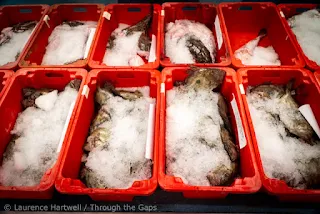
Monday morning's market was full of day boat fish after a weekend of fine weather enable the saller boats to get to sea in numbers...


though the beam trawler Algrie made the only big-boat contribution to the first auction of the week...


for young Roger on the Immy squid are till almost non-existent - in some years they can be landed by the ton...


while he made a good landing of ray...


a few bass...


and more ray...


both squid...

and cuttles release large quantities of ink when caught...


and despite the best efforts of the guys a few fish bear the scars - not that the ink in any way detracts from the flavour...


flatfish tails like these on plaice...


turbot...

and Dover sole serve to adjust the height of the fish over the ground as they swim - some think they raise the tail and use the tide to push them along and conserve energy...


not so many reds at this time of year...


a good box of witches...


while Tom got lucky with this nice landing of monk tails...


leaving a few bigger ones for the Algrie...


there were still a few JDs on the ground too...


these pristine reds were hauled up the beach at Cadgwith...


not much of a conger line...


while the bass boys were in action again...


some chose to make the most of good mackerel marks...


like the Sea Spray...


the big one will be sailing later today...


Crystal Sea heads in through the gaps to land...


fishermen have an old saying, name the three most useless things you can have on a fishing boat, and this is one of them, along with a step ladder and a soldier...


bait taking time...


taking the springer...


as a few more early-morning line caught bass come ashore...


the Kaen N was unlucky enough to pick up a length of 80mm mesh floating on the surface which meant an 8 hour tow job from sister-ship, Louisa N...


just another day's trials and tribulations for rugby player Jack Nowell's fisherman father Mike and brother Steven!..


a short time-laps of the morning's events.


Saturday, 6 November 2021

Loss of the Bugaled Breizh - British justice concludes it was a "fishing accident",

Bugaled Breizh entering her home port of Loctudy.

British justice concludes a "fishing accident", seventeen years after the sinking of the French trawler off England The hypothesis of an accident with a submarine, favoured by the families of the victims, has been ruled out.

The end of the mystery in the " Bugaled Breizh " affair? Five years after the final dismissal in France, the British justice concluded, Friday, November 5, that the sinking of the French trawler, which had five dead off England in 2004, was a "fishing accident". The hypothesis of an accident with a submarine, favoured by the families of the victims, has been ruled out.

Over the course of three weeks of hearings in October, witnesses succeeded in this proceeding which attempts to shed light on the circumstances in which the ship suddenly sank off Cornwall (south-west England) on the 15th January 2004.

"I'm capsizing, come quickly!" , had launched the boss of Bugaled Breizh Yves Gloaguen, in a distress call to one of his colleagues at midday that day. On board the trawler, which was fishing in rather good conditions, were five experienced sailors, "riding on safety", according to their relatives.

The submarine hypothesis ruled out of the five victims, only the bodies of Patrick Gloaguen, Yves Gloaguen and Pascal Le Floch were found, the first in the wreckage during its re-floating, the other two in British waters. It is on the deaths of the latter two that the British proceedings are focused. Georges Lemétayer and Eric Guillamet were reported missing at sea.

If the British procedure cannot lead to the pronouncement of sentences, the families of the victims hoped that it could raise new elements likely to nourish a request for reopening of the investigation in France. The dismissal pronounced by the French justice became final in 2016 after the rejection of their last appeal.

But over the hearings before the High Court in London, the hypothesis of the collision with a military submarine, favoured by the families of the victims, moved away in favour of that of a fishing accident that would be due equipment on the ship which may have gripped the bottom. This hypothesis was confirmed by the judges.

Article written by franceinfo

France and the U.K. are feuding over fish. What is this war of words really about?


France and the U.K. are feuding over fish.  What is this war of words really about?  The dispute centres on French fishing licences.

French President Emmanuel Macron, left, and British Prime Minister Boris Johnson are seen during a lighthearted photo op in Cornwall, England, earlier this year. Their respective words over fishing rights, however, have been anything but collegial. It's war!

Well, it's a fish war.

And like past fish wars, the words are ferocious, the stakes are tiny, gunboats make an appearance, but the shots fired are almost always verbal.

This conflict pits France against Britain — and not for the first time. Think of the Napoleonic wars in the 1800s, the Seven Years' War in the 1700s (when Canada was a prize) and, of course, the big one: the Hundred Years' War. That was some time ago. It ended in 1453.

At stake in the current conflict are — wait for it — a couple hundred fishing licences for small French boats. These were introduced after the Brexit vote in 2016, when Britain took back control of its coastal waters. They allow the French boats, as agreed in the Brexit accord, to fish off the English coast and the coasts of the Channel islands of Jersey and Guernsey — as they have for decades.

But the French say the British are deliberately refusing many licences to their boats. In retaliation, the French seized one English trawler and took it to the port of Le Havre and fined a second skipper on Oct. 27.

The rhetoric is fierce, and coming from the top. "Now we need to speak the language of force," France's Europe Minister Clément Beaune told French television. "Unfortunately, it's the only language the British government understands."

The British trawler the Cornelis-Gert Jan Dumfries is docked in the northern French port of Le Havre last month as it waited to be given permission to leave.  British Prime Minister Boris Johnson replied in kind, saying France's actions may mean it's "already in breach" of the trade agreement on Brexit. "That's a matter we have to pursue."

And this is Round 2. In April, the British dispatched two Navy gunboats off the coast of the island of Jersey to face down a French fishing boat protest. One French boat was reported to have tried to ram a Jersey fishing vessel. No shots were fired.

Jersey fisherman says regular folks are caught in the crossfire of post-Brexit fishing row Britain to send patrol boats to Jersey amid fishing-related tensions with France What is it about fish?

A Canadian lesson

In 1995, the Canadian fisheries minister, Brian Tobin, ordered the seizure of a large Spanish trawler for overfishing in waters off the Canadian coast. The Coast Guard fired across the fleeing trawler's bow. Tobin later displayed the nets on a barge in the East River, just outside the United Nations headquarters, to show that they infringed international fishing rules.

The Spanish retaliated by sending a military patrol boat to protect its vessels.

The European commissioner for fisheries, Emma Bonino, called the seizure "an act of organized piracy." Threatened European Union sanctions were vetoed by Britain, after intense lobbying by Canada's high commissioner to London, Royce Frith.

Tobin then travelled to the Cornwall fishing port of Newlyn, where he was greeted as a hero in a sea of Canadian flags by English fishers who loathed the Spanish fishing fleets in their waters as well.

"I've never had such a glorious reception in all my political life," Tobin told me at the time.

Back in the mid-'90s, Canadian fisheries minister Brian Tobin had a row with the Spanish over fishing rights off Canada's east coast. The "war" was settled quietly about six weeks later. Canada returned a $600,000 Cdn bond Spain had posted to free the seized Spanish vessel. And both countries agreed to revised international fishing rules off the coast.

The French-British conflict is nastier, wider and personal.

Fake fury?

British government sources have been whispering that the French fury is faked. President Emmanuel Macron faces a tough presidential re-election campaign in the next few months and they say some high-profile Brit-bashing could help galvanize the voters, particularly in France's increasingly restive right-wing camp.

True, but that misreads the real anger in the French government toward the Johnson government. Much of it has to do with Brexit. Macron believes that Johnson can't be trusted.

The two men met at the G7 summit in June. Macron told Johnson there needed to be a reset in British-French relations. Just so everyone understood, a presidential adviser then dictated Macron's exact words — which he had delivered in English to Johnson — to the media.

It included this key sentence: "[A reset] can happen provided he keeps his word with the Europeans."

In other words, stop lying.

Instead, in September the British signed up for something called AUKUS, an American-Australian-British alliance against China that brutally — and with no notice — jostled France out of a long-standing submarine deal with Australia in favour of the U.S.

The French were incandescent. The foreign minister called it a "stab in the back." Paris recalled its ambassadors from Canberra and Washington, but not from London.

Jean-Yves Le Drian, the French foreign minister, rudely dismissed the Johnson government as "the fifth wheel on the carriage" in this plot.

Johnson, as usual, played it for laughs. "Donnez-moi un break," he said in deliberately fractured French. The French were not amused.

'Not a big sign of your credibility' Indeed, the British, and this British government in particular, know how to infuriate their neighbours across the Channel.

"We won't let Great Britain wipe its feet on the Brexit accords." That was the French government spokesman and cabinet minister Gabriel Attal on Oct. 26.

The French government believes Britain hasn't respected its commitments on fishing or on customs checks in Northern Ireland. London has even threatened to ditch the Northern Ireland protocol.

On Oct. 28, the French prime minister, Jean Castex, sent a letter to European Union Commission President Ursula von der Leyen calling for sanctions against London. It had to be shown that Brexit costs.

"It is essential to make clear to European public opinion that … leaving the Union is more damaging than remaining in it," Castex said.

French Prime Minister Jean Castex wrote a letter to European Union Commission president Ursula von der Leyen calling for sanctions against the U.K., saying, "It is essential to make clear to European public opinion that … leaving the Union is more damaging than remaining in it." (Charles Platiau/Pool Photo via The Associated Press) France, he wrote, could start applying its own sanctions on fish catches as of Nov. 2.

The next day, British cabinet minister George Eustice said, "two can play at that game."

Macron himself drove the French message home in an interview with the Financial Times of London on Oct. 29.

"Make no mistake," he said, "when you spend years negotiating a treaty and then a few months later you do the opposite of what was decided on the aspects that suit you the least, it is not a big sign of your credibility."

A call for calm

This really does feel like war, if only diplomatic. In economic terms, the catch is tiny. Fishing represents less than half of one per cent of gross domestic product in both countries, according to the World Bank.

The French problem is that the EU is far less bellicose toward Britain. It would like a negotiated end to the wrangling, not wet fish at 20 paces.

On Oct. 31, Macron and Johnson met again at the G20 meeting in Rome, and apparently couldn't agree to end the dispute. Instead, Macron lobbed another warning. According to the French presidential palace readout, "the French president told his counterpart about the need to respect commitments taken jointly by the U.K. and the EU in the Brexit agreement."

In return, Johnson told Macron to "withdraw his threats" over sanctions. By Monday night, Macron seemed ready to talk further, rather than block English fishing boats unloading their catches at French ports.

Meanwhile, the president of the French ports of Calais and Boulogne-sur-Mer, Jean-Marc Puissesseau, tried to rein in his own government by injecting a note of common sense into the heated debate.

He told the BBC on Oct. 29 that if sanctions were imposed by France, "it will be terrible for both sides of the Channel — for you, for us, for the ports, for the fishermen in your country, for the fishermen in our country. And that's only for a few little boats that are not allowed to fish in your country."

But who wants to listen to common sense in a fish war?

Don Murray · CBC News · Posted: Nov 02, 2021 4:00 AM ET | Last Updated: November 2

Friday, 5 November 2021

Fishing licences issued by the UK and the Crown Dependencies since the TCA was signed.


This statement sets out, for clarity, the numbers of fishing licences issued by the UK and the Crown Dependencies since the Trade and Cooperation Agreement (TCA) was signed. The information is correct as of 9am on 3 November 2021.

The position does change as applications can be made or withdrawn at any time. Requests to withdraw licences by the European Commission can also be made at any time and therefore the number of active licences will be slightly different.

UK waters

Under the Fisheries Act 2020, all foreign vessels fishing in UK waters are required to have a licence. Article 2(1) of Annex 38 to the TCA sets out the level of access which applies during the adjustment period (until 30 June 2026). This includes both the Exclusive Economic Zone (EEZ) and also particular zones in the territorial sea (6 to 12 nautical miles from the shore in ICES divisions 4c and 7d-g). Access to the territorial sea is limited to “qualifying” vessels, i.e. those that fished in those zones in at least four of the years between 2012 and 2016, or their direct replacements. The TCA also places some limitations on access in terms of which stocks can be targeted, where and by which Member States.

In the UK 6 to 12 nautical mile zone, our approach has been to license vessels once sufficient evidence has been provided that they have fished in UK waters on at least one day in four of the years between 2012 and 2016.

The number of licences that have been issued to EU vessels to fish in UK waters are as follows.

Overall total:

UK

Applications received

Licences issued

Licences pending further information from the Commission/Member State

1831[i]

1793

38

In short, almost 98% of all licences received by the UK have been granted.

UK 12-200nm zone

The majority of these licenses were granted on 31 December 2020 with 1,285 EU vessels licensed.

Applications received: 1,673

Vessels licensed: 1,673

By member State:

Member State

Applications received

Licences issued

Applications pending

Belgium

65

65

0

Demark

121

121

0

France

736

736

0

Germany

49

49

0

Republic of Ireland

358

358

0

Lithuania

2
2

0

Netherlands

192

192

0

Poland

2

2

0

Portugal

49

49

0

Spain

90

90

0

Sweden

9

9

0


UK 6-12nm zone

Vessels over 12m

Applications received: 109

Vessels licensed: 102

By member State:

Member State

Applications received

Licences issued

Applications pending

Belgium

21

17

4

France

88

85

3


Vessels under 12m

Applications received: 50

Vessels licensed: 19

By member State:

Member State

Applications received

Licences issued

Applications pending

France

50

19

31

  • 1 licensed vessel was withdrawn at the EU’s request.


Crown Dependency waters

The TCA provides for different arrangements for the Crown Dependencies of Jersey, Guernsey and the Isle of Man, all of which are responsible for issuing their own licences. Article 502(1) of the TCA provides that:

“Each Party shall grant vessels of the other Party access to fish in its waters reflecting the actual extent and nature of fishing activity that it can be demonstrated was carried out during the period beginning on 1 February 2017 and ending on 31 January 2020 by qualifying vessels of the other Party in the waters and under any treaty arrangements that existed on 31 January 2020.” A “qualifying vessel” is one which fished in the relevant CD waters on more than 10 days in one of the periods defined by the TCA.

Both Jersey and Guernsey have extended transitional arrangements to enable EU vessels to continue to fish in their waters, while evidence of relevant fishing activity during the reference period is collected and they move to a full licensing regime.

Licensing figures for the Crown Dependencies are as follows:

Jersey

Total live applications

Permanent licences issued

Temporary licences granted. Valid until 31/1/22. Further information from the Commission/Member State required for them to be made permanent

Lapsed on 30/10 due to lack of evidence

217

113

49

55

Jersey have also received 11 applications for replacement vessels, which are pending the finalisation of a methodology for such vessels.

Guernsey

Guernsey’s transitional arrangement which allows access for 167 French vessels will continue until 31 January 2022.

Full licences will be issued to eligible vessels on 1 December 2021. 58 applications have been received.

Isle of Man: no applications received.

[i] Additionally, a further 37 applications for direct replacement vessels have been received from France. Processing of these will be carried out once a methodology has been finalised for such vessels

Thursday, 4 November 2021

A talent drain puts the future of Spanish fishing at risk.

This is an interesting article recently published in Spanish for a marine site. Why the exodus to Uk or other EU member state flagged vessels? - it would seem that thee are tax advantages for those that crew the offshore fleet that are not available to those that crew Spanish vessels. There is a degree of familiarity to other issues raised in the article also being experienced here in the UK 


UK flagged Spanish trawler.

The Spanish fleet faces a flight of talent among its crew to ships from other countries, especially command posts and machines, which aggravates the problem of generational change in the sector, while on land the Fishmongers also accuse lack of quarry.

The exodus of sailors to ships of other flags adds to the difficulties of the Spanish shipowners to find personnel and even slows the departure of distant-water Spanish ships to sea.

This flight to French-flagged ships is frequent, according to shipowners and trade unions, although the sailors who star in it also enlist in vessels flying the flag of the United Kingdom or Ireland.

Representatives of the Government, employers and unions have reactivated this month a consultative committee for fisheries social dialogue to study solutions to the lack of personnel and generational change.

Among the departures, sources from all over the sector insist, in statements to Efe, on the need to change professional training; They also ask to modify the laws on recognition of titles to attract foreign workers.

OWNERS ASK FOR HELP FROM HACIENDA

The general secretary of the Cepesca shipowners' association, Javier Garat, explains that the flight of talent has been detected for years in fleet segments such as tuna or longliners; but at the moment it is more accused in the fleet of the Gran Sol (Great Sole), that operates around British waters and of Ireland or France.

Fishing associations from Galicia, Cantabria, the Basque Country and Asturias have warned, in a letter sent to the Ministry of Finance, of the difficulties faced by Spanish shipowners who fish in the waters of the northeast Atlantic because their certified sailors prefer to work aboard ships of other EU countries.

They attribute this choice to the fact that within Spanish taxation there are exemptions in personal income tax for working days in a foreign company, with a ceiling of 60,100 euros per year, in countries with which there are agreements, according to the letter, provided to Efe.

The businessmen have requested that the Treasury apply a similar measure for all Spanish sailors who fish in the northeast Atlantic, to equalize the rules of the game, because in the end, whether the boats are French, Spanish or British, they all unload the same fish and compete in the same ports.

AN EDUCATIONAL REFORM AND FLEXIBILITY IN DEGREES

Cepesca, the unions and the Fedepesca fish retailer employers agree that it is necessary to reform Vocational Training in Spain and apply a more practical dual system to guarantee the preparation of seafarers.

Labor support measures are foreseen in the program of the new European Maritime Fund for Fisheries and Aquaculture (FEMPA), but until they become reality it will take two years.

The head of CCOO fisheries, Juan Manuel Trujillo, points out that "good skippers" are highly valued and, apart from that, collective bargaining should also be improved and attractive remunerations should be promoted to incorporate women on board.

But in general, Trujillo believes that in fishing a lot is worked "on the side," according to profit from the catches, and that tradition discourages many young people from joining the profession, because they are not willing to be uncertain.

In the advisory committee, the Government and the sector are also debating a revision of the regulations on Spanish qualifications to make it more flexible and facilitate the use of sailors of other nationalities such as Indonesia, with whose administration there are talks.

Another modification under study consists of giving the skippers more skills (expanding their navigation further).

MISSING QUARRY IN THE FISHERY

The director of the Fedepesca fishmongers association, María Luisa Álvarez, explains that traditional commerce experienced its particular escape in the past decade, because businessmen over 50 years old left their business to work as an employee in a supermarket and have less sacrificed hours .

Álvarez indicates that at present there is more demand than supply in the fishmongers and that it is difficult to find young people who want to join the counters in these small businesses: "Lack of quarry."

Even in family businesses, the trend is for fishmongers to guide their children to other career opportunities, so the fishmonger will close when they retire.

Álvarez also considers that the solution lies in professional training, because in the food trade "it does not exist", in contrast to the wide range of modules linked to sectors such as the hospitality industry.

Original story in Spanish by Mercedes Salas