'>

Wednesday, 18 December 2019

2020 fishing opportunities in the Atlantic, North and the Mediterranean Seas: Council secures agreement

The Fisheries Council closed off its annual quota allocation talks in the early hours of this morning - and the biggest cut was for North Sea cod, down by almost 50%. The full FC press statement is available here:

2019 Quota allocation talks finished in the early hours.

The Agriculture and Fisheries Council reached today a political agreement on a regulation concerning the 2020 catch limits for the main commercial fish stocks in the Atlantic, the North Sea and international fisheries in which EU vessels participate.


The quota-setting exercise is never easy and this year it took us several hours of negotiations to get to an agreement. But I am glad to announce that it is a balanced one that reconciles all the objectives of the Common Fisheries Policy - environmental and socio-economic sustainability - to the benefit of the fish stocks, fishing sector and the EU citizens at large.

Details of the agreement

With today's agreement the Council restated its strong commitment to the objective of the CFP - environmental, economic and social sustainability - the provisions of the multiannual management plans currently in force, and the best available scientific advice.

In light of the difficulties faced by EU fishermen in relation to mixed fisheries in certain areas and the risk of choke species, the Council decided to continue for one year the previously agreed pool mechanism for quota exchanges. Choke species are those that have a low quota that, when exhausted, can cause a vessel to stop fishing even if it still has quota for other species.

In order to address the difficult situation of cod and whiting stocks in the Celtic Sea and cod in Kattegat, the Council decided to introduce remedial measures with the aim of improving the selectivity of fishing gears and reducing bycatches.

Concerning seabass, it was decided to slightly increase the by-catch levels in the Northern areas and grant additional flexibility in their management. The bag limit for seabass recreational fisheries was set to two specimen per fisherman per day under certain conditions, and only from 1 March to 30 November 2020 for Northern seabass.

Background

The Council agreement largely confirmed the initial Commission proposal, which established fishing opportunities in the form of yearly total allowable catches (TACs) and quotas by fish stocks in the different fishing zones. TACs and quotas concern stocks that the EU manages either autonomously or jointly with third countries, for instance with Norway in the North Sea and the Skagerrak, or through agreements reached in the framework of Regional Fisheries Management Organisations (RFMOs).

Based on the scientific advice provided by the International council for the exploration of the sea (ICES), the Commission had proposed for 2020 to:


  • increase or keep current catch limits for 32 stocks,
  • reduce it for 40 stocks.

One of the main objectives of the reformed Common Fisheries Policy (CFP) is to ensure high long-term fishing yields (maximum sustainable yield) by 2020 at the latest. In December 2018, 59 stocks were already fished at MSY levels.

Together with MSY, another milestone of the reformed CFP is to reduce unwanted catches through the landing obligation (i.e. the prohibition to discard certain stocks at sea) which entered into full application as from 1 January 2019 for all stocks under catch limits.

The setting of TACs and quotas is an annual management exercise decided upon by the Council in accordance with Article 43(3) of the TFEU.

Next steps

This item will be included, following finalisation by the legal/linguistic experts, in part "A" of the agenda for adoption by a forthcoming Council meeting.

Mid-week market in Newlyn


Inshore boats made most of the landings this morning with signs...


 there are still good shots of ray to be had...


along with a few John Dory...


while the handliners working close inshore managed to pick up good shots of pollack...


bass...


and mackerel...


others found some old backing ropes...


with fish in short supply prices are sky-high...


though the forecast is giving up to 70mph gusts later today...


which is why only the big beam trawlers and the Crystal Sea are still at sea fishing.

Tuesday, 17 December 2019

This Fishing Life on BBC2 in the New Year!

Starting in the first week of the New Year - six one hour programmes on BBC 2 documenting the lives of fishing communities around Cornwall.

Image result for newlyn gaps filming
Filming began in fishing communities across Cornwall last March and continued until December.

Whilst other fishing communities are feeling the pinch, Mevagissey on Cornwall’s south coast bucks the trend, with 74 working boats in the harbour.

Protected from the prevailing winds, with fish stocks that are beginning to return, and with boats being handed down from father to son. Meva is blessed.

Fishing is in the blood here - for more than 250 years the men of Meva have followed their fathers to sea, eager to honour the family traditions. Now the next generation of ambitious young skippers are ready to make a go of it.

Jack West fished with his dad growing up, and the family have decided the time is right to invest in Jack. Having spent thousands on the Anne Louise, the pressure is on to get out to sea and start earning some money.


The Galwady Mor is owned by one of Mevagissey’s most successful fishing families, the Blameys.

27-year-old Chris is the 4th generation to go to sea. This year he takes over the responsibility of skippering the Galwady from his father Peter. The passing down of a lifetime’s knowledge is priceless, but Chris knows he will face different challenges to his dad. Whilst fish stocks are returning to Meva, there is not the abundance there once was.

Mevagissey is a village built on fish - pilchards in particular. Once, everyone was after them. Now tourism is the main industry. The village is dominated by second homes and holiday lets, and the place is all but empty in winter.

One of the impacts has been on crew. With local housing pricing young men out, and a steady income – not something associated with fishing - needed to get a mortgage, there aren’t the young men lining up on the quay any more.

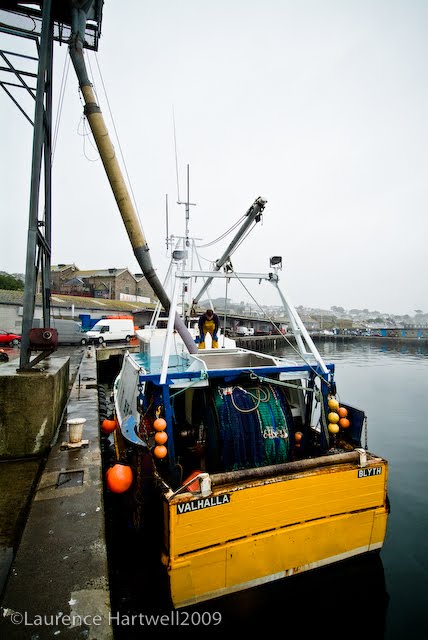
Valhalla taking ice in Newlyn
Dave Warwick on the Valhalla is one of the skippers looking for crew, and has to take the risk of skippering his boat solo until he can find some. He is limited to working the well-fished inshore waters until he can find men made of the right stuff.

Meanwhile, Malcolm Saunders is winding down after a long career at sea. Malcolm grew up when fish stocks were plentiful and he got his fill – and made a lot of money. But with the toll a lifetime away at sea took on his family, he is not sure he made the right decisions, and wonders whether the next generation of skippers will learn from his mistakes.

Episode 1 Cornwall: This Fishing Life Series 1 Episode 1 of 6

Monday, 16 December 2019

Memorial ride-out for Conor Mosely.


Floral tributes to young Conor Moseley were laid at the foot of the harbour Christmas tree...


before nearly 100 bikers rode out...


accompanied by family and friends in as vintage double-decker bus...


to Lands End in tribute to Conor.

Sunday, 15 December 2019

A Government and Fisheries.


The election of a Conservative government, with a solid majority, means that the passage of the Withdrawal Agreement through Parliament seems guaranteed; meaning that the UK will leave the EU on 31st January 2020. The provisions of the Withdrawal Agreement spell out that, from that date, the UK will be an independent coastal state, with regulatory autonomy over fishing within its exclusive economic zone, albeit subject to a transition period to the end of 2020, during which the UK would still be subject to the Common Fisheries Policy.


Fisheries Bill

The Government will also be in a position to reintroduce its Fisheries Bill to provide itself with powers to implement its programme on fisheries, including powers to control access over who is permitted to fish in UK waters, and to set its own quotas (accepting that for shared stocks, these will usually be set in cooperation with other coastal states.) The previous Bill was pulled after its provisions became at risk of the arithmetic in the previous Parliament.

Negotiations

Early next year, talks will begin between the UK and the EU on a framework fisheries agreement that will determine the shape of cooperation between the UK and EU, after the end of the transition period. A framework agreement could consist of very high-level statements, referencing cooperation on managing shared stocks, broad commitments to sustainable fishing, and compliance with the UN Law of the Sea. It is expected that a framework agreement could be concluded by the end of July. The current framework agreement between EU and Norway, is an obvious template.

Negotiations for an annual UK/EU fisheries agreement for 2021 would be expected to occupy the second half of 2020. There will also be tripartite and bilateral discussions with relevant coastal states such as Norway and Faeroes. The content of the annual fisheries agreement would include setting TACs, quota shares and exchanges, and access arrangements.

Both the EU and the UK accept, under the terms of the Withdrawal Agreement, that from the end of the transition period their fleets will have no automatic right to fish in each other’s waters. Access would be subject to negotiation, as would quota shares and quota exchanges.

The UK, in its White Paper, has made clear that some level of access could be granted to EU fleets to fish in UK waters, subject to the satisfactory negotiation of revised quota shares. The EU has made it equally clear that any free trade deal with the UK would be contingent on the status quo on access and quota shares.

In both the EU and the UK, fishing rights are a matter of high visibility and high political profile.

The stakes are therefore very high for all parties as we enter this next phase of negotiations with the EU. The UK fishing industry sees the UK’s departure from the EU as an opportunity to break free from a cumbersome and ineffective management system, and a chance to redress the asymmetrical access and quota arrangements which have worked to the UK’s disadvantage for 40 years. The EU will try to hang on to the current arrangements which work so well to its benefit.

Against this background, the NFFO will be working closely with UK Government to ensure that the commitments it has made on fisheries are delivered in full.

Saturday, 14 December 2019

New safety funding from Seafish for PFDs!

PFDs will save your life if you go overboard - fact.

Seafish is administering a new UK Government-funded scheme which allows owners of UK-registered commercial fishing vessels to recover £200 per item against the cost of purchasing type-approved Personal Flotation Devices (PFDs) fitted with integrated Personal Locator Beacons (PLBs) for their crew.


The scheme is being delivered in co-operation with the Maritime & Coastguard Agency (MCA) and Trinity House as part of the Fishing Industry Safety Group’s 10-year strategy to eliminate preventable deaths in the UK fishing industry. It is open to owners of active UK registered commercial fishing vessels who have not previously received support for purchasing PLBs. (You can apply for the cost of adding a PLB if you previously received funding to purchase PFDs).

To qualify for funding, owners must apply to Seafish for approval before purchasing their preferred PFDs/PLBs. They need to provide a specification of the equipment they want to buy, a quote from their preferred supplier and an indication of the number of items required to equip all the crew on their vessel.

Please note:

The deadline for applications to be received is 31 March 2020.

Funding will not be awarded retrospectively so owners must complete the application form and receive authorisation before purchasing equipment to be eligible for reimbursement.
PFDs purchased must comply with minimum standards – see MGN 588 for details.
Seafish will check with the MCA and the relevant Fisheries Department to check and confirm the accuracy of the information provided in an application – including personal details, vessel ownership, licensing and that it is currently active.

Download a PFD/PLB funding application form here
(N.B. the above link will download a word document)

Completed application forms should be returned by email to: training@seafish.co.uk

On receipt of an application, Seafish will check the details provided and then write to the applicant to confirm eligibility and provide a claim form if your application is successful.

Friday, 13 December 2019

Storms delay entire UK 2019 Election results!


Bathing Mounts Bay in an an early morning orange glow...


the sun rises over the fishing fleet in Newlyn harbour, one blue, one orange and one red - which of the three parties will win as the entire country waits for the final constituency of St Ives to be declared - it seems that storm force winds have prevented the ballot boxes from being shipped from the off islands of the Scillys!