and more bass just some of the superb fish being put ashore on Monday's market in Newlyyn...
though young Roger's smattering of John Dory is merely a taster for the summer when these fabulous eating fish will be in season congregating around the rocky approaches to the Scillys...
spot the difference? - these are not Dover sole but sand soles...
these are Dover soles...
mighty meaty ray wings...
and some huge plaice form the Sapphire II...
along with lemons form the Trevessa V...
and a handful of handline mackerel...
get whisked away pronto...
big boats catch big fish...
the truly tenacious cuttlefish...
leaves its mark on the market floor...
outside its 0° so Edwin moves fast...
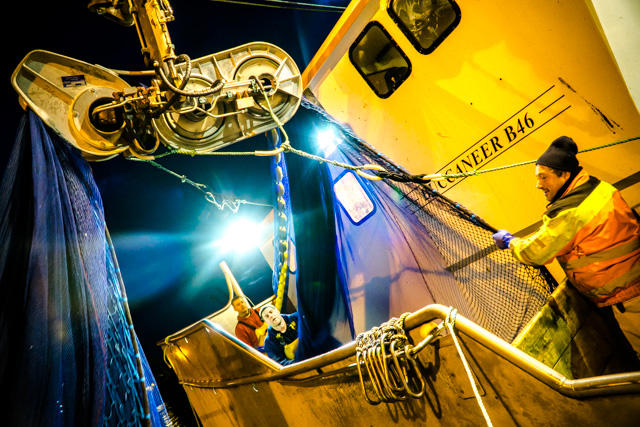
no light yet, the Vesta is still under wraps...
as the day breaks on a clear but chilly morning...
its time to take fuel for the big beamer, Sapphire II...
looking across the promenade to the Mount at first light...
The majority of fishermen voted to leave the EU having been promised that this government would "Take back control".
Crusading website Fishing for Leave fires a huge salvo of questions across the bows of Her Majesty's Government today. In an attempt to get some kind of clarification that, this government, despite the promises and the rhetoric so often bandied about under the emotional headline, 'We will take back control' will not be selling out the fishing industry on the way out of the EU as previous Tory Prime Minister Ted Heath's government did when we joined the EU!
"Take back control" Another reminder what Fisheries Minister George Eustace said on national TV ahead after the referendum and ahead of exit negotiations.
So, summing up in FFls post today:
Existential Threat to the Fishing Industry
"If we fail to break free from the CFP the EU will be free to implement policy changes to our detriment. We doubt the EU27 would feel charitable to their political prisoner who has no representation but abundant fishing waters. Continuation of the ill-conceived EU quota system and discard ban is the existential threat that could be used to finish what’s left of our Britain’s fishing fleet allowing the EU to claim the ‘surplus’ that Britain would no longer have the capacity to catch. Rather than address the cause of discards – quotas, the EU has banned the symptoms – discards. Now when a vessel exhausts its lowest quota it must cease fishing. ‘Choke species’ will see vessels tied up early and, according to official government Seafish statistics, 60% of the fleet will go bankrupt. If a sizeable portion of the UK fleet is lost international law under UNCLOS Article 62.2 which says; ‘Where a coastal State does not have the capacity to harvest the entire allowable catch, it shall… give other States access to the ‘surplus’. Between the EU having the opportunity to claim “continuity of rights” even if proved wrong they could drag out Britain being trapped in the CFP and its quota system and discard ban for enough time to fishing our fleet off. Once we have lost our industry there is no way back from this Catch 22– if we do not have the fleet we cannot catch the “surplus” and if we do not have the “surplus” we cannot maintain a fleet. With this we will also lose a generation and their skills which are irretrievable. The UK political establishment of all hues would not be forgiven for betraying coastal communities a second time. A transition destroys the opportunity of repatriating all Britain’s waters and resources worth between £6-8bn annually to national control. This would allow bespoke, environmentally fit-for-purpose UK policy that would benefit all fishermen to help rejuvenate our coastal communities. As Minister Eustice promised we could rebalance the shares of resources where we, have the EU fleet catching 60% of the fish in our waters but receive only 25% of the Total Allowable Catches even though we have 50% of the waters. This transition is the reverse of this and something exceptional that is within touching distance and what the public in constituencies across our land expect to see on this totemic and evocative issue. The government and MPs must refuse the “transition” terms and discontinue the CFP entirely on 29th March 2019 or we will consign another British industry to museum and memory. That Theresa May has known this all along means she, and her remain minded officials, are fully complicit in the embryonic stages of a second betrayal and sell out of Britain’s fishing industry. NOTE For too long people have bought the government rhetoric. The PM and Ministers have repeated; “We will be leaving the Common Fisheries Policy on March 29, 2019”. This spin has never been a commitment nor indication of a clean Brexit for fisheries. Those who kept citing these words have been either mendacious or naive to the reality of a Transition. The government has known all along what the transition meant. The PM always continues, that; “Leaving the CFP and leaving the CAP” wouldn’t give the opportunity until “post that implementation(transition) period – to actually introduce arrangements that work for the United Kingdom. The arrangement that pertains to fisheries during that implementation period will, of course, be part of the negotiations for that implementation period”. We may officially “leave” the CFP on 29th March 2019 but we’ll re-obey entire EU Acquis as part of the “transition” period after Article 50 officially terminates the UKs membership – we will have left in name only." Read the full post here written by Njordr AB
Reuters' writers, Nigel Hunt and Mark Hanrahan have produced an excellent overview of the British Brexit fishing position. A series of carefully annotated graphics, which help provide a little more clarity than is often used by some in the media wishing to make a point, focus on some of the key issues.
What fish went where.
LONDON (Reuters) – British fishermen hopeful of a post-Brexit boom may find life outside the European Union choppier than expected, a Reuters Graphic shows.
Changing sea temperatures, caused by climate change, have forced many of the fish most popular with British consumers, such as cod and haddock, to migrate north into cooler waters controlled by Norway and Iceland. (For a graphic on ‘Climate change and the North Sea’ click tmsnrt.rs/2Ea9y58) The graphic, drawn from the activities of tens of thousands of British and European fishing vessels, also highlights the importance of access to the European market to the industry – with Britain exporting around 75 percent of its catch to EU markets. (For a graphic on ‘British fish catch landings’ click tmsnrt.rs/2EpkyMc) Britain and its European Union neighbours currently enjoy equal access to EU waters, and can buy and sell fish freely inside the world’s largest trading bloc. That will change with Brexit, but how is still to be negotiated.
(For a graphic on ‘UK’s tangled trade’ click tmsnrt.rs/2DDFFsS) Britain’s waters have helped sustain fishing industries in neighbouring countries such as Denmark, France, Ireland and Spain while the European Union controlled access under its Common Fisheries Policy. But the British fishing industry is demanding a large share of the catch when control of the waters shifts from Brussels to London. (For a graphic on ‘UK’s fishing trade’ click tmsnrt.rs/2DBc1o1) However, any restriction on EU market access would be likely to take the form of tariffs which can be as high as 24 percent on seafood. (For an ‘Interactive graphic on Brexit and the fishing industry’ click tmsnrt.rs/2DKUKZD) Writing by Nigel Hunt and Mark Hanrahan; Editing by Robin Pomeroy - Full story here:
In 2017, the Guilvinist port confirmed its leading position on the Cornish territory.
In 2017, guilviniste port confirmed its leading position on the Cornish territory.
With 46.5% of the total tonnage of Cornish ports in 2017, the Port guilviniste consolidates its leadership in the area. For its part, Concarneau relies on coastal fishing. Despite a fall of 1.22% in tonnage compared to 2016, offset by values up 1%, Guilvinec the port remains the flagship of Cornwall with its deep sea fishing. With 15,043 tons, guilviniste auction alone represents 80% of the volume of offshore sales Cornish. Regularity and value The reasons for this confirmation? First, with 34 boats, 11 of which are owned by Bigouden Armament, 75% of the Cornish offshore fleet is based in Guilvinec. Loctudy has nine ships, against only one in Concarneau and Saint-Guénolé ... "The Guilvinec is today a high-end seafood market place with high volumes, a regularity in inputs and good values", explains Christophe Hamel, director of auctions in Cornwall at the Chamber of Commerce and Industry of Metropolitan France. West Brittany (CCIMBO). Read also: Pleasure in Guilvinec, the port is a territorial asset Not to mention the trawlers outside, from Concarneau, Lorient or Ireland for example, which alone accounted for 1,000 tons in 2017. "The courses are good in Guilvinec and the location of its port relative to the fishing grounds is also an advantage, " says Robert Bouguéon, former president of the local fisheries committee of Saint-Guénolé Penmarc'h. Offshore strike force of course, but also dynamic coastal with about forty boats for a result of 2650 tons in 2017. Guilvinec also offers reassuring sales capacities for shipowners. Evidenced by the presence of 205 buyers, including 144 registered in Guil. In a context where the share of distance selling is increasing: 58% in 2017 against 54% the previous year. To ensure a service at the height of this pole position, the Chamber of Commerce and Industry deploys 42% of these staff related to Cornish fishing ports, or about fifty employees. And a vast modernization of the port and fish market is recorded over the next eight years, for an amount of 10.5 million euros. As part of a global investment program of € 28.6 million at the scale of Cornish fishing ports. Find our section Sea economics Specializations The Guilvinec hub of the Cornish peach, okay. But this supremacy in no way alters the activity of other Cornish ports that develop, them through other fisheries. "The ports of the territory specialize," confirms Christophe Hamel. Like Concarneau who, in less than ten years, made a big change in his fleet to count today a single offshore and 120 coastal. "This port has become a popular coastal selling place including itinerant fishmongers," says the director of Cornish auctions. "A nice card to play" Loctudy, on the other hand, still has a mixed offshore-coastal fleet. A real difference with the port of Saint-Guénolé Penmarc'h now in a strong coastal dynamics coupled with a beautiful activity in blue fish. Douarnenez, port of landing, always ensures Bolinche side and Audierne remains faithful to its beautiful reputation in liners and gillnetters. "The coastal fishery has a nice playing card," says Christophe Hamel. In a context where the offshore world will, in the short term, face a problem of renewal of its flotilla, a massive number of retirements and the consequences of the worrying Brexit. Flotilla that could decrease by 5% over the next eight years. Find this article on Ouest-France.fr Ludovic The Signor.