Friday, 7 October 2016
The first #FishyFriday of October means it's the start of @seafoodweek!
There's no floundering about at the start of #SeaFoodWeek in Newlyn with top quality fish from two of the port's finest beam trawlers...
in Newlyn with top quality fish from two of the port's finest beam trawlers...
being sold by Mr Auction himself, Ian Oliver...
like these lovely lemons..
and monks from the Sapphire II who makes a habit of landing the very best fish...
while there are plenty of inshore wings to bring a little ray of sunshine to the port...
to cheers the soles of all concerned on this #fishpunday...
speaking of witch...
these eight-legged beasts make great eating in fish stews...
or you could shell out a few extra pennies for some succulent southwest scallops...
or see if your fishmonger can supply you with some Cornish MSC Certified hake...
from the Joy of Ladram , sister ship to the star of the Catch TV series Govenek of Ladram...
this fish always takes top plaice in any #fishpunday competition...
unlike the mackerel who proved popular with the handline boats yesterday...
outside the harbour was being treated to yet another stunning dawn spectacular...
as the sun began to throw light on the low cloud cover...
Nigel appeared to be fighting a losing battle with the ice-tube...
as he took ice on the Innisfallen...
laying to the market, one of the port's biggest beam trawlers, the St Georges was waiting for the arrival of skipper and crew...
while the Sapphire II prepared to take on fuel...
hopefully the Ivan Ellen will remain in her berth for a good while yet...
as the solitary figure of a crew member heads for his boat...
function over form for this fully sheltered crabber...
the William Samson Stevenson basks in the morning glow...
which extends right across the harbour...
and over the bay to the Mount...
ice taken, time for the last smoko before...
its time for Nigel to set sail...
and the Sapphire II completes her fuel stop...
even the gulls seem to enjoy mornings like these...
along with a brace of photographers who made the effort to be down the quays before the sun came up...
to capture the warming light...
that floods the harbour...
some things come in threes...
heading for a quay berth.
Herring Survey off Scotland 2016.
Take a look at how our fishers are at the forefront of marine science with this #herring survey video http://tinyurl.com/hdvh526
Thursday, 6 October 2016
A dark start for one of the biggest whitefish trawlers in England
Done and dusted by 6:30am...
with only a couple of dozen boxes of inshore fish on the market this morning...
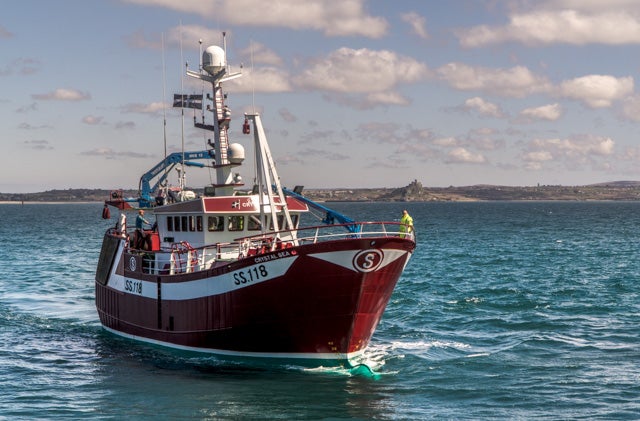
so the action was to be found down the quays where the Crystal Sea was ablaze with lights as she prepared to go to sea...
as usual, the boat often spends less than 24 hours in port as she makes a quick crew change and turnaround, her bit done again for the Fishing for Litter campaign...
due to land n Thursday morning, the beam trawler St Georges makes her way to the gaps...
back in the port again the Jersey workboat, Duke of Normandy...
with her deck lights showing off a big working deck and crane...
summer is over, well, as far as the Isles of Scilly Steamship Company are concerned as the Scillonian III has now taken up her winter residence berth...
and the Bay can look forward to some colder starts...
Fishermen lead the way in discarding old habits
![]() |
| "a way of life and a business" |
For coastal communities across Europe, fishing is both a way of life and a business. It’s an activity rich with tradition, spanning generations within families – but to be passed down from father to son, businesses need to be strong: fishing must stay profitable, and sustainable. Facing a changing policy landscape can challenge fishing businesses of all sizes, and the introduction of a ‘Landing Obligation’ (which requires fishermen to land and account for all of their catch rather than discarding unwanted fish) by the Common Fisheries Policy is certainly one of the biggest policy challenges the industry has had to adapt to.
Whilst many industry members are still reeling at the implications of landing 100% of catch – and worried about their bottom line in a ‘discard free’ future – a dedicated and growing core of active fishermen are seeking new solutions to implementing the Landing Obligation (LO). Their vision is of fishing businesses that waste little, deliver profits and remain sustainable in the long-term. But how can this be achieved?
“We just need to make use of the tools available. With the right combination of tools and policy measures we can create the right conditions for sustainability and strong business.” Peter Olsson, Swedish Fishermen’s Producer Organisation.
| Crystal Sea off Cornwall |
No need to reinvent the wheel:
With the LO in place, I believe constructive dialogue between policy makers and those working to practically apply their legislation is more important now than it ever has been. In recent years we have seen a step-change in how fisheries science and management is viewed: the start of a shift from top-down instructions to something more inclusive, which seeks answers and inspiration from the communities affected by legislative change. Using the knowledge already inherent in fishing communities, and giving them the space and correct incentives to experiment and deliver change, we can see existing tools to combat discards put to new uses.
This will have to be the basis upon which a successful Landing Obligation is delivered.
“The collaborative approach to implementation is truly worthwhile. When you give fishermen the ability and incentive to deal with the issues themselves, they are able to come up with the best solutions. Fishermen need the freedom to take control of their fisheries.” David Stevens, Crystal Sea Fishing
Highlighting the range of tools available to achieve low – or no – discards has been at the heart of EDF’s industry-led approach in Europe, with our Discard Reduction Manual offering methods which can be applied in different scenarios, combined, or used in isolation: all of which can play a role in delivering the LO. These tools include options for smart quota management and building accountability, but also look closely at ways to improve selectivity within fisheries.
Industry innovation highlighted at IIFET 2016 in Aberdeen:
Providing a crucial platform for the exchange of knowledge from within fishing communities and debate emerging new ideas, the International Institute for Fisheries Economics and Trade (IIFET) dedicated a day of its 18th biennial meeting solely to ‘industry and policy’. I was there to host an EDF panel session entitled: ‘Adapt, improvise and overcome: fishermen’s responses to the LO’.
Practical, optimistic approaches to the LO conundrum were at the heart of discussions, with both fishermen and the processing sector detailing their trial, error and triumphs with self-driven gear adaptation. Whilst there was a clear sense of ambition from those present, the vision of the future presented was not without some stark warnings from industry.
With that crucial aim of constructive and mutually respectful dialogue in mind, it’s clear that legislators need to listen and be sensitive to the testimonies of fishermen like Crystal Sea Fishing’s David Stevens. His participation in the Cefas and Marine Management Organisation (MMO)-supported “Catch Quota Trial” enabled him to achieve a 67% reduction in mortality and almost completely erase juvenile haddock discards. This was, however, done at a 19% economic loss. This cannot be ignored.
An important step forward:
I strongly believe that closely examining real life examples, such as David’s, and the others we heard during our panel conversation, is the first step on the path to discovering practical implementation solutions for policies that affect livelihoods as well as ecosystems. It allows us to assess and balance the on-the-water effectiveness of increased selectivity, different forms of smart quota management, and everything else in the toolbox. Such scenarios also let us see potential limitations of policies and the need for further innovation from the bottom-up – as well as increased flexibility from the top-down.
EDF will continue to find channels through which to encourage this kind of dialogue, and to champion the examples of ambitious fishermen generating best practice ahead of the curve. With old knowledge, new innovations and a varied toolbox at hand, Europe can deliver a sustainable future: for fish, fishermen and communities.
By: Dr. Erik Lindebo, Senior Consultant, EDF Oceans Europe
Tuesday, 4 October 2016
Bit fresh in Mount's Bay this morning.
Fresh breeze in the bay this morning...
as can be seen from the blown-out flag on the Ros Na Rioch...
the Crystal Sea is comfortably moored on the end of the New quay...
while the netter, Karen of Ladram heads out of the gaps...
and away to the Low Lee buoy on another hake netting trip...
compare two very different mornings in Newlyn, one in, one out.
Subscribe to:
Comments (Atom)