'>

Friday, 17 October 2014

Finding fish before #FishyFriday!


The St Georges put ashore a trip which included a few big pollack - the kind of fish that like to hang around wrecks...


while the net fish kept buyers happy...


while outside the fish auction the netter Ajax is about to make her last landing in Newlyn as she is being replaced by a new steel netter - which will be steaming down from McDuff next week...


hopefully the team working on Penzance's Promenade will get the huge granite stones in place before any big gales hit the Bay.

Thursday, 16 October 2014

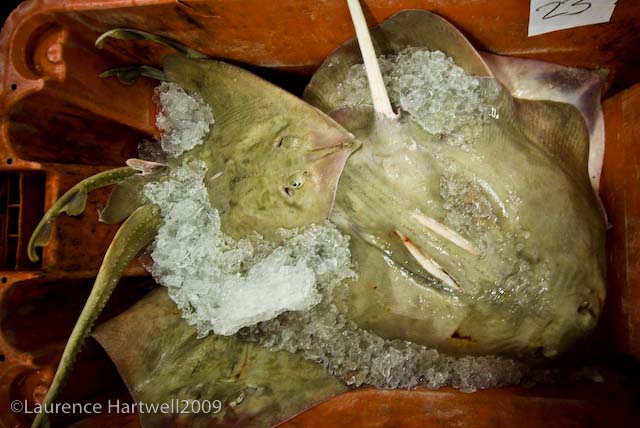
Ray and skate off the menu for many.

Skate & Ray ban - ICES Areas VI & VII shaded yellow

The full extent on the ray and skate ban which came into force last Friday is seen here - from the French coast in the South East all the way out to west of Rockall in the North West.  Ray is one of the fish likely to cause real problems for fishermen operating in mixed fisheries as a choke species.  Many skippers are waiting for further news and clarification from the MMO who introduced the end of ray and skate fishing in ICES areas VI and VII - rumour has it that the ban will be in place until the end of the year - which will mean many tons of ray and skate being discarded in these areas as the fish are found all over fishing grounds.

Two ray wings cut into four feed the family!

Rays are a great fish for kids and fussy eaters as the 'bones' are in fact just cartilage and the meat just comes away easily after lightly frying or poaching - check out the classic Breton ray in black butter dish 

Nathan Outlaw's latest book Fish Kitchen has some simple ray and skate dishes to try - if you can get some fresh ray or skate fished from the east coast!

Wednesday, 15 October 2014

Managing fish stocks - Discarding and the landing obligation

Landing obligation - and ban on discards of catches that it entails - is one of the key elements resulting from the reform of the Common Fisheries Policy (CFP). The Commission proposal paves way for a speedy implementation of the ban on discards. The PECH Committee will present the draft report on landing obligation at the next committee meeting on 16 October.


The film explains what discards are and describes different ways of improving selectivity, based on two langoustine fisheries, one in the Bay of Biscay (Brittany, France) and the other in Skagerrak (Gotland, Sweden). It also reveals the most important measures proposed by the European Commission to reduce by-catches and discards.

Discarding is the practice of returning unwanted catches to the sea, either dead or alive, either because they are too small, the fisherman has no quota, or because of certain catch composition rules. The new CFP does away with the wasteful practice of discarding through the introduction of a landing obligation. This change in regime serves as a driver for more selectivity, and provides more reliable catch data. 

To allow fishermen to adapt to the change, the landing obligation will be introduced gradually, between 2015 and 2019 for all commercial fisheries (species under TACs, or under minimum sizes) in European waters. Under the landing obligation all catches have to be kept on board, landed and counted against the quotas. Undersized fish cannot be marketed for human consumption purposes. The landing obligation will be applied fishery by fishery. 

Details of the implementation will be included in multiannual plans or in specific discard plans when no multiannual plan is in place. These details include the species covered, provisions on catch documentation, minimum conservation reference sizes, and exemptions (for fish that may survive after returning them to the sea, and a specific de minimis discard allowance under certain conditions). Quota management will also become more flexible in its application to facilitate the landing obligation.

TtGaps comment:
In the UK the most concerned fishermen are those that operate in what are referred to as 'mixed fisheries' - typically bottom or demersal trawling - where the boat is fishing for a broad range of fish that inhabit the sea bed and not just targeting a single species as many pelagic trawlers or netters might. In a mixed fishery the spectre of 'choke species' looms large - where are single species of fish for which there is a small or non-existent quota is being caught which then prevents the boat from fishing in that area. At certain times of the year and in many areas this will be a constant problem for many vessels - and, as yet, an answer to the problem has yet to be found!

There are many references to be found on the web relating to this thorny subject:

http://www.fishermensvoice.com/archives/0311GroundfishermenFaceEconomicDisaster.html  

http://en.fvm.dk/fileadmin/user_upload/ENGLISH_FVM.DK/Themes/Yield_of_fish/Calculating_effects_of_choked_species.pdf 

http://www.nature.com/news/2010/100602/full/465540a.html 

https://www.linkedin.com/groups/ON-CHOKE-SPECIES-3971738.S.106903949 

http://www.clientearth.org/reports/simply-mixed-fisheries.pdf 

Client Earth Paper 

http://onlinelibrary.wiley.com/doi/10.1111/faf.12079/abstract


Wednesday brings little ray of hope for the fleet as the MMO's ban on rays hits home


One for the record, possibly the last rays to be auctioned on Newlyn market this year...


much to the consternation of skipper Roger Nowell (L) seen her talking with fellow fisherman Dennis Pascoe about the shock ban on ALL ray and skate landings in Area VI & VII as of October 10th which many fishermen were unaware it seems...


the buyers are keen enough...


especially as ray is a popular fish in the south west...


and not one the boats can easily avoid catching - their size makes many technical measures to reduce catches unworkable and they can be found on many fishing grounds...


better stick to chasing the Dorys next time...


not seen too often,a box of scad...


while mackerel are still to be found around the coast...


as are these cracking big tub gurnards... 


it's that time of year when the cuttles literally 'paint it black' - look out for the Sapphire II landing a big trip of black gold on Friday...


maybe the Crystal Sea II will be tempted to try fishing for them this year...


today, the inshore fleet will be mainly staying in port owing to the strong winds off Cornwall.

Tuesday, 14 October 2014

From 12 October 2014 the skates and rays fishery in areas VI and VII (SRX/67AKXD) is closed to all fishing vessels administered by the MMO.


The closure, from 00.01 on Sunday 12 October, is due to stock exhaustion. It affects under 10 and over 10 metre vessels, both members of producer organisations and non-sector.


The fishery remains open for under 10 metre vessels administered by the Welsh government.The MMO hopes to re-open the fishery in the future once the flexibility underthe 2014 Quota Management Rules (PDF, page 5) has been realigned and all landing data reaches our systems.

Details of the closure were also issued on 10 October as a fishing vessel licence variation.

Fish as food in education today - will our kids know how and what to cook?

Diet and health
By the age of 7-9, children should:
  • be aware that we all need a balanced and varied diet to grow, be active and maintain health, and that we need to eat more of some foods than others e.g. we all need to eat at least 5 portions of fruit and vegetables every day.
  • recognise that food and water are basic requirements of life.
  • know that family and friends may eat or avoid certain foods.
  • be aware that being active and looking after yourself are important for health, e.g. brushing teeth twice a day.
By the age of 11-12, children should:
  • make food choices based on the understanding that a healthy diet is made up from a variety and balance of different food and drinks.
  • be aware of the importance of a healthy and balanced diet, good oral health and being physically active for health and wellbeing.
  • know that a variety of food is needed in the diet because different foods provide different substances for our health, namely nutrients, water and fibre.
  • be aware that food needs change and that some people eat or avoid certain foods, e.g. allergy or religious belief.
By the age of 14, pupils should:
  • use current healthy eating advice to choose a varied balanced diet for their needs, as well as being physically active.
  • know that food provides energy and nutrients in different amounts; that they have important functions in the body; and that people require different amounts during their life, e.g. pregnancy, infant feeding.
  • understand the importance of energy balance and the implications of dietary excess or deficiency, e.g. malnutrition, maintenance of a healthy weight.
By the age of 16+, students should:
  • be able to apply current healthy eating recommendations, and understanding of peoples' needs, to their own diet and others', e.g. before and during pregnancy.
  • be able to maintain a healthy weight throughout life, understanding the relationship between diet and physical activity, as well as taking into account other factors, e.g. advertising, food availability.


Cooking (Food preparation and handling skills)
By the age of 7-9, children should:
  • recognise and taste a range of familiar ingredients, e.g. fruit, vegetables, cereals, dairy, meat, eggs.
  • name and use a range of basic tools safely, e.g. small knife, chopping board, measuring spoon.
  • use a range of food preparation skills with supervision, e.g. peeling, slicing, mixing, scooping, grating, spreading.
  • with help prepare a range of healthy recipes safely and hygienically.
  • recycle food packaging and be careful not to waste food when preparing and cooking.
By the age of 11-12, children should:
  • name, taste and prepare a broader range of ingredients and healthy recipes, accounting for ethnic diversity.
  • select and use appropriate tools and equipment safely when preparing and cooking food.
  • demonstrate an increasing range of food preparation skills, e.g. accurate weighing and measuring, kneading.
  • know how to store, prepare and cook food safely and hygienically.
  • actively minimise food waste, compost fruit and vegetable peelings and recycle food packaging.
By the age of 14, pupils should:
  • use a broader range of preparation techniques and methods when cooking, e.g. stir-frying, steaming, blending.
  • use equipment safely, being aware of others' safety.
  • with guidance modify recipes and cook dishes that promote current healthy eating messages.
  • understand and use good food safety practices.
By the age of 16, students should:
  • apply skills and understanding competently to plan, prepare and safely cook dishes for a healthy, varied and balanced diet.
  • be able to change recipes and dishes to make them healthier by altering ingredients, and/or by using different cooking methods, e.g. using herbs instead of salt, using low fat yogurt, grilling instead of frying.
  • apply good food safety principles when buying, storing, preparing and cooking food.

Monday, 13 October 2014

Today's number one fish from Cornwall's number one port


Cynthia's mother says #eatmorefish, especially if it's bass...


signs that haddies are making an appearance again...


on anyone's favourite flatfish feast menu are...


 lovely lemons soles...


or mini monk tails or scampi tails as they are sometimes referred to...


talking of tall tails, which fish?...


a box of JDs keeps an eye on the auction...


tied up this morning, two the port's biggest crabbers - both will be subject to the new >14 metres 140 'days at sea' rule...


fishing effort targeting crabs in Area VII from 2001 - 2013...


the Cornishman would be happier if she was still at sea this morning.