|
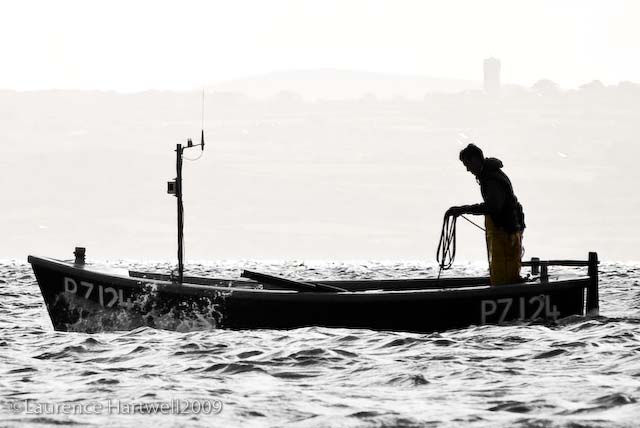
Single handed inshore fishermen like Dennis Pascoe above must feel entirely aggrieved at the decision to remove mackerel from the 'fish to eat' list - the amount of mackerel caught by fishermen in a year would not begin to amount to a single haul from one of the big boats who take 99.9% of the NE quota. |
It was ironic that I got the call that the Marine Conservation Society , had downgraded mackerel from its "eat with a happy heart" list, to "eat with caution", as I was putting a tin of mackerel into my shopping basket. Just last week, we were told that mackerel was plentiful and good for us. But, although this is news that hits and confuses consumers now, it's actually a story that started some years before.
First, let me tell you that the mackerel in question is from north-east Atlantic stocks (an area from Gibraltar to Russia). It is not endangered. Not yet. The scientists at the International Council for the Exploration of the Sea (ICES) are the ones that look at fish stocks and make recommendations as to what are the limits of any fish caught . This limit changes every year, is decided in December and becomes part of the common fisheries policy (CFP) which governs EU fisheries. These fishing quotas are reported in the press but most consumers quite understandably glaze over them. But if you had read the reports, you'd have seen that something was going on with mackerel.
What the ICES has said about mackerel is that its spawning stock biomass is currently at about 2.7 million tonnes. The safe biological figure is 2.3 million tonnes and it's not expected to fall below that figure at "current exploitation levels" until 2014; but that's only next year – hence why fish conservation organisations are concerned now. So the spawning biomass is currently above the levels required for a healthy stock, but, it's declining and there is a downward trend.
It's a sad story. Until recently mackerel fishing was well managed. The EU and Norway (which has allied itself closely with the EU in fishery terms) had a 90% quota of the total mackerel quota; the remaining 10% went to Iceland and the Faroe Islands. Until 2008, there were almost no catches reported in the Icelandic and Faroese waters, because there just weren't that many mackerel in the water to catch. But, in recent years, the mackerel have started to migrate, due to a myriad of factors such as rising sea temperature and to chase their food. These other coastal states wanted more than their 10%. In 2010 they started to increase their catches from 20% to 32% of the total allowed. Since 2009, Iceland and the Faroe Islands have unilaterally agreed their own quotas, which they are legally allowed to do as they are not governed by the common fisheries policy. Their own quota is about 150,000 tonnes over and above the recommended limits.
So you see, there is currently no international agreement which governs mackerel fishing limits, although there is hope of one this year. Understandably, EU fisherman are pissed off and everyone is confused.
On 31 March 2012, all seven mackerel fisheries in the UK that held the Marine Stewardship Council "tick" logo lost their accreditation. In other words any fresh mackerel they caught and that we buy, from that date on, could no longer be described as traceably sustainable. This suspension came after two years of catches above scientific advice and as a result too much mackerel catching by non-EU fleets.
There is hope. Next month there will be a meeting of scientists, representatives of the EU fisheries and also those from Norway, the Faroe Islands and Iceland to find a way forward. Various scientific data will be carried out this spring with results expected in September which will give up-to-date information on mackerel stocks.
The Marine Conservation Society reached its decision after looking at scientific advice, the Marine Stewardship Council's move to suspend mackerel certification, and the reasons behind that move. Its "fish to eat" list is updated annually, in February each year, hence the timing of this announcement. The advice may well change back again next year.
So, do you need to be carefully concerned? Yes. Alarmed? No. But the difficulty is that there is no obvious help for the consumer. You can ask where mackerel in a shop or restaurant has come from and how it's caught, but as no fresh mackerel currently holds the MSC tick logo, technically none is sustainable. So, time to look at other sources of omega 3s and treat yourself to the odd tin of mackerel occasionally. On these you will likely still find the MSC logo, as they would have been caught prior to 31March 2012. So you can breathe easily. For now.
Story courtesy of the Guarian.
In response to this news, the much publicised 'mac in a bap' campaign led Hughr Fearnely-Whittingstall is being toned down - though the chef has said they will continue to source ther mackerel from South West handline caught sources - good news for the likes of Dennis Pascoe and all other handliners in the region!
Mr Fearnley-Whittingstall said he would, in line with the MCS guidance, be dropping his call for mackerel to be more widely eaten. He was infuriated that mackerel stocks have been allowed to decline and urged countries involved in the mackerel war to reach an accord.“When we started the mac bap campaign 2 years ago, mackerel was certified as sustainable and part of a well managed fishery,” he said.“Unfortunately things have changed, and politics and greed are getting in the way of common sense. If the countries involved could agree sensible catch limits this could still be a certified sustainable fishery.“We hope that these so called mackerel wars can be laid to rest as soon as possible, so we can all go back to eating mackerel again with a clear conscience.”He promised to reduce the use of mackerel in his River Cottage restaurants in line with MCS advice and added: “MCS are advising that handline-caught mackerel from inshore boats is the best choice to make when eating mackerel.

See the full article here.“At our River Cottage cookery school and canteens we will continue to serve South West handline caught mackerel on an occasional basis, as we do not wish do withdraw our support from small scale local fishermen who are catching mackerel in the most sustainable way possible.”Raymond Blanc, the two Michelin-starred chef, described the plight of mackerel as “horrible” and said its decline “clearly is an example of the failure of politics”.Tim Glover, chief executive of Fish2fork, was equally appalled: “It is quite unacceptable that mackerel has become a political pawn. It is paying the price of irresponsible brinkmanship.”Just two years ago mackerel was being hailed as the sustainable alternative to cod but it is now being heavily overfished.
Sustainable alternative to mackerel - Cornish Sardines!
Of course there's an equally nutritious Cornish alternative to Omege3 rich mackerel - why not seek out plentiful Cornish Sardines at your local fresh fish shop - many supermarkets - like Waitrose sell these fish which are in top condition at this time of year.
1178 views on 23/01/13