'>

Thursday, 13 January 2011

Tuna tables - who's top?

Don't forget! - This summer, support the local fleet of tuna boats that use pole and line exclusively!

Pole and line tuna boats - Ben Loyal and Nova Spero.

With Sainsbury's at the top and John West at the bottom, here is the Greenpeace's Canned tuna league table's methodology:


The tuna retailers' league table has been compiled on the basis of data obtained from four sources:


•Retailer and brand supplier responses to a product survey issued by Greenpeace commencing in May of last year.

•Correspondence with retailers and brand suppliers arising from the survey.
•Information obtained from Greenpeace Active Supporters engaging in spot checks of their local supermarkets.

•Material that is publicly available on retailer and brand supplier websites.

The data obtained was evaluated by Greenpeace against a set of criteria broadly designed to test each company's commitment to sustainability in relation to their tinned tuna products.

The true cost of tuna


The biggest tuna fishery in terms of volume is skipjack - the tuna most likely to end up in cans. While skipjack is not yet overfished, if fishing continues at current rates it won't be able to sustain itself. What's more, the methods used to net skipjack all too often catch young yellowfin and bigeye, threatening these species further. Yellowfin, a much more commercially valuable species, makes up 35 per cent of the world's catch. Today the majestic bluefin only represents 1.5 per cent of the landed volume of tuna, but its dollar value is astronomical. In 2001, a single bluefin tuna set an all time record when it sold for US$173,600 in Japan.


Numerous other marine species are hooked and netted in the global tuna fisheries. Around 100 million sharks, plus tens of thousands of turtles, are killed every year - causing devastation to the entire marine ecosystems.

Information courtesy of Greenpeace 2011.

Another point of view from the world of commerce.

"Sometimes you just have to consume less" says James in his businessgreen blog.

Taking the Fish Fight forwards - public support is growing!

Kudos to Channel 4 - viewing figures for Hugh's new series FishFight jumped above a new CSI on Channel 5 and almost beat a new series of Taggart on ITV - seems the folks at home are as interested in murdering fish as they are in another 'murrda'!.......


By Wednesday morning the number of online FishFight supporters joining the campaign to end discards had jumped from the 52,000 on Monday.......


to hit 90,000 by Thursday morning - at this rate the 100,000 mark should be reached by around 8pm Thursday evening.

In tonight's episode at 9pm on Channel 4, Hugh's fish fight takes him to Scotland, to the largest farmed salmon company in the world, then to Brussels and Westminster to try to and make some waves.


In order to add some urgency to his campaign, Hugh launches a website http://www.fishfight.net/, which goes viral, and picks up 24 000 supporters in just 24 hours. Fishermen from all over the country descend on Westminster to add their voices to the protest, which ends with a rallying cry to all of us to try to help sort out the mess our fisheries are in.


Hugh believes we all need to try and eat different types of fish, to relieve some of the pressure on cod, tuna and salmon, and we need to add OUR voices to the campaign to stop discards.

By 5pm on Thursday!.......

and by half five!
they just keep signing up!

FishFight - round 2.

Last night was tuna's turn to taste the tousled chef and good food guru Hugh Fearnley-Whittinstall's FishFight and his campaign to increase the diversity of fish consumed in the UK by highlighting the problems associated with satisfying the huge consumer demand for just three species, cod, tuna and salmon. 


With an 'own-brand' tin in hand, a simple search on Google for the company that processed the tuna using the ID code used on the side saw Hugh's team heading off to Ghanian waters. At the same time, he heads off to the Maldives where purse seining has been banned in their waters to see how a tuna fishery is carried out by pole and line boats - as opposed to the huge pursers that fish in the Indian Ocean and supply much of the tuna eaten from tins in the UK. Archive footage taken on a purser shows turtles, manta ray and sharks being caught, with the sharks being stripped of their fins before being thrown back over the side.


Before chancing his luck on one of the local tuna boats he takes the opportunity to dive alongside the local manta ray fish - an almost magical experience. Once aboard the tuna boat he investigates the floating feeding stations set by the purser companies that are set to attract the tuna shoals which saves them having to chase the shoals over the ocean.


His attempts to speak with Tesco and Princes Foods about their labelling on camera prove almost as elusive as the tuna. As the programmes are hitting our screens, some of the supermarkets are taking action to reduce the heat over labelling their products - it seems that Hugh's FishFight is not without impact.

Wednesday, 12 January 2011

Slack - 20 boxes.

Work in line for Penzance Dock today as Ross Bridge shuts.......
solitary tally on a slack morning.......
notable mainly for a very fresh sou'westerly breeze.......
and a mere 20 boxes of fish from the Resurgam on the market.

Hugh's Fishfight campaign on Channel 4.

Hugh Fearnley-Whittinstall's hard-hitting film documenting the 'mad' EU regulated quota system (which came about in the wake of the Common Fisheries Policy) hit the screens last night.  Hugh learnt just how bad what are known as 'discards' - the fish that fishermen catch but then have to throw back, dead, into the sea as they do not have quota to catch them. With fish consumption of cod, salmon and tuna around 50% of total the UK fish sales the series' targets these fisheries in particular, both here and around the world.


His first trip aboard the Seagull from Scrabster NE Scotland skippered by Gary Much saw him witness haul after haul of cod and coley going back over the side of the trawler as she worked off the Shetlands. After one haul, Hugh asks for all the fish that should be discarded to be kept in baskets - the fish represent around £30,000 worth of fish for the course of a single trip!


"I canna put a sign up on ma nets saying, 'no cod today'" says skipper Gary Much, resigned to work in a "mad" system out of his control.


Hugh then moves to the South coast of England and the beach boats of Hastings where skipper Paul Joy has seen the local fleet dwindle from 44 boats to 11. These beach boats are typical of the under 10m sector that make up the bulk of the UK's fleet yet only have 10% of the national quota. The local fleet fish primarily for cod, plaice and sole with a total daily quota of 13kg - obviously unsustainable. They have been given a huge pollack quota but, as skipper Paul points out, totally pointless as the last time he saw a pollack in his nets was five years ago!

In an attempt to show the people of Hastings just how much fish is dumped as discards by the local fleet, Paul and the other skippers left throwing back over-quota cod from their day's fishing until they were just off the beach - thereby allowing Hugh and the assembled crowd to wade in and pick up the discarded fish - Grimmy Mike in Newlyn would have been proud as he long argued that, as it was illegeal to dump anything at sea, fishermen forced to dump ocer-quota fish at sea were "damned if they did and damned if they didn't"!
Staunch anti-CFP activist, Newlyn's Mike Mahon who long campaigned for the right to retain on board fish that were caught rather than senslessley dump over-quota fish at sea.
You can catch the programme again on 4OD here.


Tonight's episode sees Hugh in warmer waters looking at tuna.

Falmouth Coastguard co-ordinates yet another international rescue off the isalnd of Sri Lanka.

Overnight, Falmouth Coastguard are co-ordinating the rescue of two British yachtsman aboard their 14m yacht Bacchus as they are caught in storm conditions off the island of Sri Lanka. This is the second time in a week that the service has been directly involved in co-ordinating the response to sailors in international waters far from the coast of the UK. Jeanne Socrates aboard her dismasted yacht off Cape Horn is now safely round Cape Horn thanks to Falmouth.  Below is a story from nearer home involving the team at Falmouth.

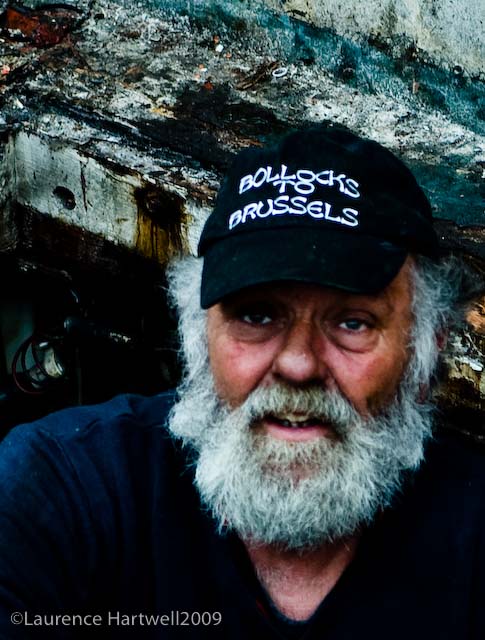
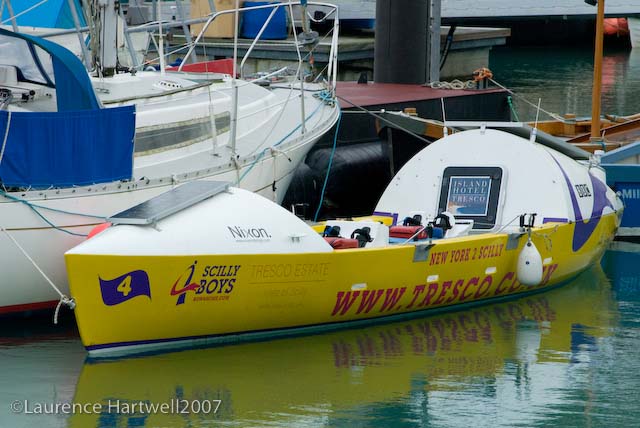
Wayne Davey and the Scilly Boys' boat, Gulf Grace in Newlyn in 2008 prior to her attempt to break the 100 year old trans-Atlantic record. 
In the summer of 2008, Tim Garratt, Joby Newton, Chris Jenkins and Wayne Davey, christened The Scilly Boys, had hoped to beat the current Atlantic crossing record of 55 days 13 hours.  But the Scilly Boys' vessel capsized 13 days after leaving New York ending their bid to break the 100 year old record.

Here is Wayne Davey's recollection of that event and, in particular, the crucial role that Falmouth Coastguard played in their rescue:

"On the 13th June 2008 at approximately midnight BST I, along with 3 Scillonians was sat inside my capsized rowing boat the 'ScillyBoys' some 800 miles east of New York, to the east of the treacherous Georges Bank, in 40kts of wind and 20-30ft seas. I managed to contact Falmouth CG via Satellite phone, and spoke with Jimmy Miller, who was over 2000 miles away at Falmouth CG. I explained to Jimmy who I was and what had happened to us and that our cabins were flooding. He reassured me that help was on the way, as he had alerted the US CG, and gave me advice. I was then passed to Watch Manager James Instance. The reassurance and advice that was given was what I needed, and the immediate co-ordination with the US CG meant that we were picked up from our liferaft by a 290 metre oil tanker the Gulf Grace approximately 8-9 hours later. 

Without doubt, if it wasn't for Jimmy Miller and James Instance and the rest of the team working through the night at Falmouth CG, then myself and the other 3 men would have drowned in the North Atlantic.


As a crew member aboard the Penlee lifeboat I have experienced the professionalism and knowledge of the Watch Team at Falmouth CG on numerous occasions, this time from the right side of the rescue, and the skills and organisation of the men at Falmouth are second to none. I think that it is ridiculous to day-man the station, especially with the TSS off Lands End and the Lizard.
"


Doubtless, there are hundreds, perhaps thousands of other seafarers who owe their lives to the truly international role that Falmouth Coastguard plays in maintaining a watch over the world's oceans. Sailors Jeanne Socrates and Wayne Davey are two of many who are eternally grateful that FCG were there when they needed them.