'>

Monday, 20 February 2017

Monday morning - biggest market this year.


A tad misleading with the netters Britannia V, Ajax, Lamorna, Little Pearl  and  New Harmony missing off the landing board...


as Monday's market is by far the biggest for the year...


top quality inshore fish from the Lizard...


numero uno megrim soles from the beamers...


along with monk - megs and monk make up the bulk of any beam trawl trip...


along with smatterings of Dover sole - the boats would land many more of these fish but under the present rigid quota system the boats are forced to dump tons of Dovers almost every trip - and it is not a fish easily avoided...


every ray has a unique, QCode like mark...


plaice come with orange and red spots
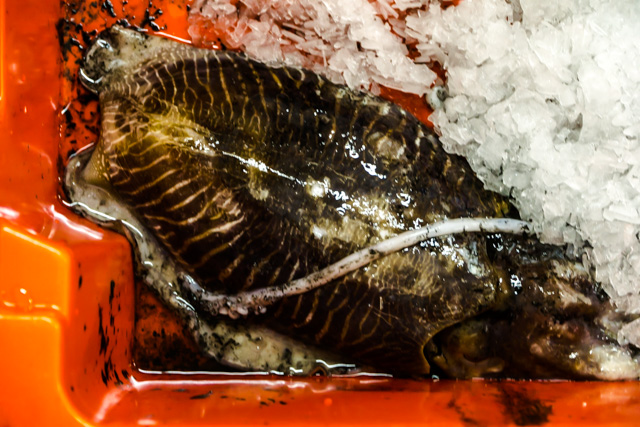


none of your £40,000 landings of cuttles in Newlyn needed to break port records, all eyes will be on the St Georges when she lands to see if Billy can wrestle the record back from relief skipper, Juicy, no pressure Bill ;-) ...


the frilly brill...


the not so frilly thornback ray's tail...


ahead by a short nose...


what to look for in fresh fish, bright, shiny eyes and blood-red gills...


black bream beauty...


Roger must have been smiling when these guys dropped out of the cod end on to the deck...


along with these cracking red mullet...


the other end of the market with nearly 1,500 boxes of big white fish...


so much fish that some of Ajax's trip was squeezed between the two market ends...


and the rest helped fill the rest...


and a good run of larger sizes was evident...


even the fridge was packed...


 with mainly handline mackerel...


cod is often referred to as 'green', not hard to see why when it is this fresh...


and added bonus for the beam trawlers are big prime flat fish like these turbot...


not a breath over the harbour this morning...


and, apart from the sad and sorry Excellent,  the only boats in port are those between trips...


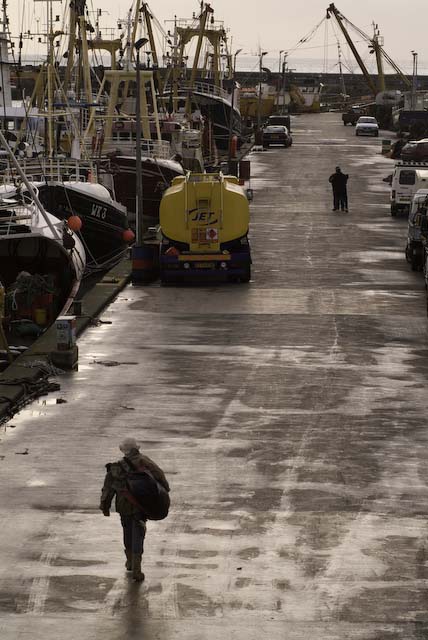
as one of the shore crew make their way down the quay...


signs of an industry with enough faith to invest in new builds for the future, with the port's largest sardine boat nearing completion in the foreground for Stefan Glinski and Rowse's latest big crabber being fitted out and all lit up...


Newlyn is one of the port's who pioneered recycling old fishing nets - though a new startup company, @FishyFilaments is developing some amazing technology to convert these old nets into the raw materials used by 3D printers - you can do your own bit to help the environment by supporting the venture via their crowdfunding page - a great cause championed by a local business with the support of the fleet...


a step nearer the bus pass for Rose!

BTW this was fishing news from the far west of Cornwall post 6,500!

Sunday, 19 February 2017

Friday, 17 February 2017

#FishyFriday in Newlyn and the market is full of the finest fish


The boats they came 4X4, four beam trawlers and four inshore trawlers...


filled the market this morning...


with the ever-present haddock...


and even a good dose of pouts...


but it was megrim soles that made up the biggest part of the beam trawler trips...


along with monk tails of course...


with plenty of rays on Newlyn fish market this #FishyFriday morning...


the biggest of the beamers landed the biggest of the fish including these huge turbot...


along with a trio of brill...


some very fine ling, which, by the way make perfect fish for fish cakes and fish pie...


along with several boxes of big ray wings from the inshore trawler, Millennium...


a fishy tail, but which one?...


sometimes conger eels just look plain mean...


it is hard to imagine how these 'claspers' at the base of the tail on a male ray with their razor sharp hooks buried within the folds of skin figure in more intimate moments of a ray's love life, but they do...


red mullet, a favourite fish for BBQs found throughout the Mediterranean...


what about a scallop or two dozen...


plenty of mackerel on both coasts...


never mind Norwegian Skrei - here is some top quality Cornish cod to match our Scandinavian cousins' any day...


another fishy tail, but which one?..


still no sign of any real quantities of squid on the grounds...


the beast that is the tub gurnard - a must-do-dish when baked in salt...


Keith Floyd's 'King of Fish', the bass...


looks like Roger on the Imogen III needn't get his JD trawl on the net drum just yet, early days as this beautiful fish prefers the summer months before it comes close inshore - presumably to bask in warmer waters...


hardly a ripple this morning...


as the gulls head off in search of breakfast...


another day roping up new pots for the Rowse boys...


as the latest sardine boat, Pelagic Marksman to join the fleet nears completion of her fitting out and begins to see her deck gear and nets put aboard...


the old pilot's office is quiet enough...


as skipper Don on the Filadelfia takes on fuel...


not quite as busy as in the late 1970s and 80s but the harbour is still home to a considerable number of small inshore boats, punts and toshers...


who fish in the most sustainable and environmentally friendly way for high quality fish like crab and lobster...


having shot the net a few hours ago, @Cornish_lobster picks out enough mackerel which when salted down will provide enough bait for his pots in the coming lobster season...


but a few of the bigger boys will just have to go home for supper!

What Brexit might really mean for the UK’s fishing industry?

Two posts on what Brexit might really mean for the UK’s fishing industry.  The first post comes from Bryce Steward and Griffin Carpenter:


What would Brexit really mean for the UK’s fishing industry?

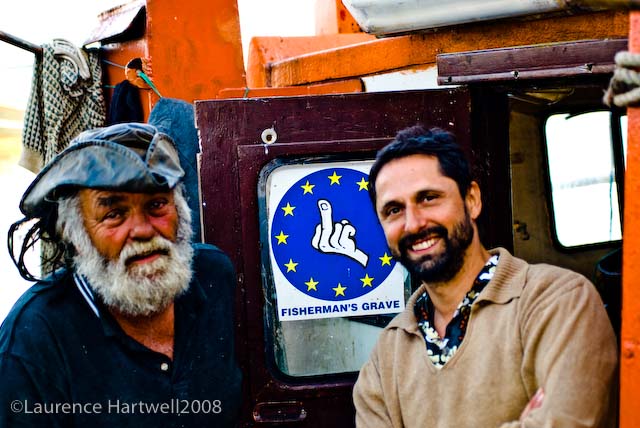
Trawler skipper and UKIP member, Mike Mahon  with Phil Stebbing who made the film, "The Deadline" 


Fish is as tasty and popular as ever, but no one seems to like the policies that regulate the industry behind it. For decades, European management of fisheries has been lambasted by fishers, conservationists and scientists, including us.

The centrepiece of this system, the EU’s Common Fisheries Policy, is particularly unpopular. Some scientists even argue it is designed to fail. Opponents blame it for not only mismanaging Europe’s highly productive seas, but also for giving away “our fish”, with the subject recently taking centre stage in an unlikely viral Brexit campaign video.

You might think that the chance to take back control of the fish in UK seas would be one of the most solid reasons to vote “Out” in June’s referendum on EU membership. So what’s the catch?

First, the idea that fish in British waters have been fished into near-extinction by pesky foreign boats simply doesn’t match up with reality. At least not anymore.

Yes, fish numbers aren’t what they were in the time of Moby Dick. However, a recent analysis of 118 years of statistics revealed the vast majority of the decline occurred prior to the Common Fisheries Policy’s implementation in 1983. In fact, the policy is now overall helping, not harming, the country’s fisheries.

Since EU policy was reformed in 2002, the health of many fish stocks has improved. By 2011 the majority of assessed fisheries were considered to be sustainably fished. Take the case of North Sea cod: once the “poster child” for overfishing and all that was wrong with European policy, it is now recovering strongly and likely to be certified as sustainable next year.

The EU is now phasing out the discarding of unwanted fish and setting quotas more in line with scientific advice. The aim is to ensure maximum sustainable yield of all stocks by 2020.

Who actually owns “our” fish?

Ownership of UK fishing quotas is controversial and often misunderstood. After total EU fishing limits are decided by the Council of fisheries ministers, it is up to each member state to distribute its share among its own fleet.

This is not an EU decision. The fact that a single giant Dutch-owned vessel nets a quarter of the English quota (6% of the UK total) might be shocking, especially considering the UK’s quota is in theory shared between more than 6,000 vessels, but the UK government could easily change how it allocates fish. In fact, the alternative allocation systems suggested by some pro-Brexit groups are already in place elsewhere in Europe.

Your plaice or mine?

Another common argument for Brexit is that it would give the UK sole control of the fish in its waters. However, these fish are not “British”; they don’t respect national boundaries. Mackerel, herring, cod and other commercial species are all highly mobile, and move easily across borders, especially in places such as the North, Celtic and Irish Seas, where “exclusive economic zones” are jammed together like sardines in a can.

So unlike more isolated countries such as Iceland and Norway, the UK was always going to have to share its fish with its neighbours, especially as we moved into an era of global maritime regulation.

Fencing out foreign fishermen

A post-Brexit UK might still have to agree quotas with its neighbours, but could it prevent foreign boats from fishing in its waters? Maybe. But only with huge investment in monitoring and control public bodies such as the Marine Management Organisation (MMO) – organisations which are being cut at present.

Whether the UK would want this sort of escalation is a different question, as it would also mean British boats could no longer fish in the waters of other European nations. This is a major concern in the fishing industry as 20% of the fish caught by the UK fleet is landed elsewhere in the EU.

The reality is that a Brexit would require a complete re-negotiation of fishing rights, with uncertain outcomes. Some of these rights extend back to the Middle Ages and banning foreign vessels from UK waters may well be incompatible with international law.

Such negotiations may harm trading relationships with Europe. At present the UK exports around 80% of its wild-caught seafood, with four of the top five destinations being European countries.

Remaining in the EU also has big benefits for the marine ecosystems that the fishing industry ultimately relies on. The Habitats Directive protects key habitats and species such as reefs and Atlantic salmon, while the Water Framework Directive and Marine Strategy Framework Directive commit EU members to restore and protect the environment. It seems unlikely that the UK’s current Conservative government, at least, would continue similarly progressive measures after a Brexit.

It’s no surprise the “In” campaign is gaining support from a range of environmental groups – the weight of evidence is on their side. In contrast, many fishermen have strong feelings about the EU, but the main industry organisations and decision makers are remaining neutral.

We’ve come a long way since the bad old days of excessive quotas and widespread illegal fishing. As things become more sustainable, fish numbers are rebounding, leading to increasing UK fishing quotas and growing profits (now the highest in the EU).

The history of the EU’s fishing policy is one of criticism and improvement. It is therefore unclear why the UK would want to abandon ship at this point.

This piece was written by Dr Bryce Stewart, lecturer at the University of York and Griffin Carpenter, Economic Modeller at the New Economic Foundation. Published on the, UK and a Changing Europe website.

Ref: House of Lords - Brexit Fisheries


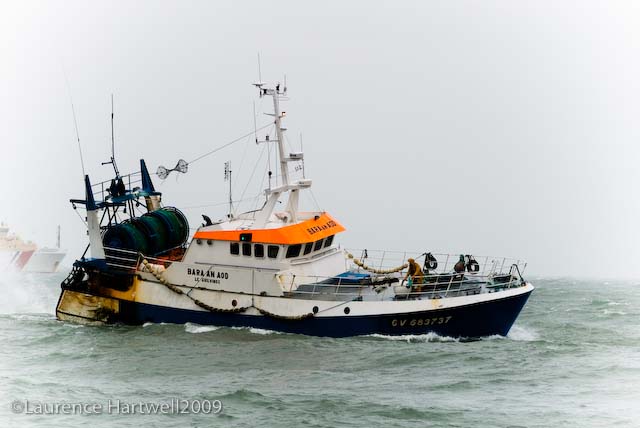
Stormy waters - French trawler heading for the sanctuary of Newlyn


The second take on the future comes from Paul Reynolds writing on the Con4Lib.com website:

Will the Government betray British Fishermen yet again?

The Common Fisheries Policy devastated the British fishing industry. The Government must now begin the process of repairing the damage by leaving the CFP as we leave the EU.

One of the most striking images of the EU Referendum was the sight of multi-millionaire Bob Geldof aboard a luxury yacht (which some alleged as being sponsored by Goldman Sachs) giving two fingers to a flotilla of fishing boats campaigning for a Leave vote.

Bethany Pickering, a young Labour member aboard Geldof’s yacht was less than impressed: “we didn’t expect it would be a millionaire being condescending to fishermen” … “It was very patronising, very much mocking the issue they had, jeering at them, using his ability and his money to drown out what they had to say.” Interestingly, she eventually switched from supporting Remain to Leave on the eve of the Referendum– albeit citing the EU’s inability to reform rather than the fishing protest.

Geldof’s actions seemed to epitomise a rich metropolitan elite completely out of touch with the lives of ordinary, working-class people. And if any group of workers have grounds for grievance over the UK’s membership of the EU, it is surely British Fishermen.

History of Betrayal

The UK has some of the richest fishing grounds in the world. But these have been surrendered by successive UK governments as outlined in John Ashworth’s booklet “The Betrayal of Britain’s Fishing”. I’ve summarised some of the key points in the history:

Pre-dating the UK’s accession to the EEC, the 1964 London Convention granted fishing rights to 31 areas within the UK’s 6-12 mile zone: France (15), West Germany (6), Belgium (5), Holland (3) and Ireland (2). In return, the UK obtained rights in 5 areas: France(1), West Germany (1), Holland (1) and Ireland (2). This is clearly an unfair deal which is especially favourable to France – the most plausibly explanation is the UK Government attempting to placate General De Gaulle’s hostility to the UK’s application to join the EEC.

EEC Fisheries Regulation 2141/70 designated all member states fishing waters a “common resource” and was signed only hours before the UK’s formal application was submitted in 1970. Thus, the UK’s accession meant sacrificing sovereignty over fishing waters. Prime Minister Edward Heath proceeded with accession talks and misled the House of Commons into believing that the United Kingdom had obtained a derogation which would permanently protect UK fishing interests.

Norway had also applied to join the EEC at the same time as the UK. Edward Heath wrote to the Norwegian Prime Minister asking him to keep quiet about the accession arrangements for fisheries, but the Norwegian Fisheries Minister let the cat out of the bag, which helped persuade Norwegians to reject the EEC in the 1972 referendum. Fisheries was again a key issue when Norwegians rejected the EU in the 1994 referendum.

In 1973, the Third United Nations Conference on the Law of the Sea (UNCLOS) commenced, which led a number of countries to establish 200-mile Exclusive Economic Zones (EEZs) around their coastlines. In 1976 all EEC members states created 200-mile EEZ’s (UK passed the Fishery Limits Act 1976). The UK’s EEZ contained approximately 80% of all Western Europe’s fish, but these waters were by now “Community waters” .

In 1976, the Commission proposed to manage fishing in “community waters”, divided into fishing areas within which a fixed “Total Allowable Catch” (TAC) would be set by species and allocated between member states based on a quota system. After much argument, the policy was finally implemented in 1983 – with the UK the biggest loser in the quota system.

Worse was to follow with the accession of Spain and Portugal. Spain had one of the world’s largest fishing fleets but very little marine resource in its own territory. Spain could fish in “Community waters” and took full advantage in exploiting access to the UK’s territorial waters. The UK Government tried to protect UK fishermen via the Merchant Shipping Act 1995. But in a famous case, the European Court of Justice upheld a complaint by the Spanish fishing firm Factortame Ltd and levied damages of £100m against the UK Government.

To add insult to injury, EU supporters claim “you need a CFP because fish know no boundaries” and conservation cannot be managed by individual nation states. In fact, the CFP is a classic Brussels cumbersome, bureaucratic, “one-size-fits-all” policy which cannot cope with fish movements and leads to widescale cheating and forces fishermen to discard prime marketable fish (up to 50% of a fisherman's catch). The CFP has been an environmental disaster for UK territorial waters. By contrast, Nordic nations such as Norway, Iceland, Greenland & the Faeroe Islands who have been wise enough to avoid the CFP all have thriving fishing industries.

The figures reflecting the impact on the Common Fisheries Policy on UK fishing are stark. Under “equal access” rules, 70% of UK fisheries resources worth approximately £1.6 billion are in foreign hands. 60% of the UK fishing fleet has been scrapped and employment in UK fishing has halved.

UK Government & Fisheries Policy

Given the tale of woe described above, it is not surprising that Fishing has long been a totemic issue for euro-scepticism. Under William Hague and Michael Howard, it was Conservative Party policy to withdraw from the CFP. In 2005, Shadow Fisheries minister Owen Patterson published a Green Paper outlining how the UK would take back control of its Fishing Waters. However, David Cameron – having posed as a euro-sceptic during his Conservative leadership campaign – dropped the policy upon becoming leader. So now that we are leaving the European Union, how does the current Conservative Government intentions match up ? The recent Brexit white paper does not provide grounds for optimism.

Para 1.1 “To provide legal certainty over our exit from the EU, we will introduce the Great Repeal Bill to remove the European Communities Act 1972 from the statute book and convert the ‘acquis’ – the body of existing EU law – into domestic law. This means that, wherever practical and appropriate, the same rules and laws will apply on the day after we leave the EU as they did before.”

Para 8.16 “In 2015, EU vessels caught 683,000 tonnes (£484 million revenue) in UK waters and UK vessels caught 111,000 tonnes (£114 million revenue) in Member States’ waters. Given the heavy reliance on UK waters of the EU fishing industry and the importance of EU waters to the UK, it is in both our interests to reach a mutually beneficial deal that works for the UK and the EU’s fishing communities. Following EU exit, we will want to ensure a sustainable and profitable seafood sector and deliver a cleaner, healthier and more productive marine environment.”

This suggests that the Common Fisheries Policy will be converted into domestic law. Worryingly, there is no commitment to restoring UK sovereignty up to the 200 mile limit or rejecting the Common Fisheries Policy. A post-Brexit revival of British fishing needs 2 key policies from the UK Government:

Firstly, the CFP must be repealed and not simply adopted into into UK law. As a Fishing for Leave spokesman explains “When the CFP (Common Fisheries Policy) ceases to apply on EU withdrawal, the UK can automatically repatriate exclusive competency over our 200-mile exclusive economic zone (EEZ) and all fishing resources within. The EU fleet will be automatically excluded from this area, unless the government adopts the disastrous CFP as proposed in the Great Repeal Bill.”

The CFP and its system of quotas is disastrous for fish stock and the fishing industry. It incentivises cheating & discarding of marketable fish. A system based on “days at sea” would incentivise transparency, accurate reporting, innovation and productivity. John Ashworth recommends the Faroese system as a good fit for the UK – this is a “days at sea” system and the waters around the Faroes Islands have a diverse fish stock (like UK waters).

Secondly, the UK must reclaim sovereignty over all fishing waters within the 200 mile limit, including the historic “acquired rights” inside the UK’s 12 mile limit granted to European nations under the 1964 London Convention. As a Fishing for Leave spokesman explains this offers a “back door access to the six-12 nautical mile band around the UK. … It would allow EU vessels access and, therefore, the ability to claim they had acquired rights under UK law.”

The London Convention, which came into force in 1966, allows any contracting party to renounce the agreement after 20 years (i.e. 1986). Two years notice is required to activate Article 15 of the London Convention. So to avoid an overlap period and the risk of the EU fleet acquiring rights under UK law, the UK Government must activate Article 15 of the London Convention at the same time as triggering Article 50 of the Lisbon treaty.

What UK Government must do now

There are elements in the Fishing industry who have invested heavily in the current CFP Quota system. It seems possible that the Governments attention has been captured by these vested interests. The Government may wish to recompense or provide equivalent access – but the Government must unambiguously reject any idea to adopt the CFP and its disastrous quota system.

The Government also seems to be reluctant to renounce historical access rights granted under the London Convention for fear of upsetting EU member states during the Brexit negotiations – depressingly repeating past failed attempts to curry continental favour via the sacrifice of British sovereignty over its territorial waters. Moreover it would be foolish to give up important negotiating leverage. The UK fishing fleet will take some time to recover capacity, and the UK could choose to grant temporary licenses to foreign fleets under UNCLOS 3 – but this power to choose only exists if historical access rights have been renounced. The Government must trigger Article 15 of the London Convention at the same time as Article 50 of the Lisbon Treaty.

Yet again, there is the distressing possibility of British Fishermen being “sold down the river” by our own Government. Edward Heath betrayed British Fishing and it has lived long in the memory and been a symbolic rallying point for euro-sceptic dissent. Brexit must mean Brexit for British Fishing. Be in no doubt –British fishing will be an acid test for Prime Minister May. If Theresa May delivers on Fishing, she will gain an enormous level of trust in all parts of the UK (notably Scottish Fishermen who are less than impressed with Nicola Sturgeon’s stance). If she fails, she could lose the trust of the nation in her ability to deliver any aspect of Brexit.

Posted by Paul Reynolds February 15, 2017 at 21:58

Thursday, 16 February 2017

Disruptive Technology Workshop - Hi-tech meets seafood.


In Oxford, UK, in May 2016, 17 international experts came together at FAI Farms to try to reinvent commercial fishing with a special 'Disruptive technology workshop on seafood harvesting'. 

The event was an initiative from Espersen, Icelandic Seachill and Nomad/Iglo and funded by the Seafish Strategic Investment Programme. This fascinating project brought together the worlds of high technology and seafood, offering radical and creative concepts for the future of the fishing industry.

For more information on this project go to http://www.faifarms.com/

And for more information on the Seafish SIP go to http://bit.ly/2ktnGjw

Newlyn's great tradition of artistic endeavour continues.

Newlyn copperwork boys with J.D McKenzie by Stanhope Forbes 1932
Following in the footsteps of artists like Stanhope Forbes, Newlyn's great tradition of artistic endeavour today still continues to draw inspiration from those that work in the port...


Close up of  Coppersmith, Michael Jordan by Henrietta Graham - maybe the copper dish in the background is the same one McKenzie has in his hand!
like coppersmith, Michael Johnson who re-introduced the art of copper beating started in 1890 by John Drew Mackenzie, an artist who settled at Newlyn. He was the key figure in setting up the Newlyn Industrial Class, assisted by the benefactor and local M.P., Thomas Bedford Bolitho.  


The Bolitho family have been lifelong supporters of the fishing industry in Newlyn; Nora Bolitho made it possible for the Fishermen's Mission to bu built in 1911, in more recent times, Major Simon Bolitho was chair of Newlyn Harbour Commissioners in the 1970s and today Edward Bolitho and Elizabeth Bolitho are still active within the community...


the 'new quay', Mary Williams Pier”, was opened by HM The Queen on 28 November, 1980, and is more properly known as the Mary Williams Pier after the daughter of T.E Bolitho, prominent local banker - Mrs. Mary Frances Williams of Trewidden who was locally known as Mrs. Charles Williams and who served on the Board of the Newlyn Harbour Commissioners in the 1970s when the proposal to build the new quay was being discussed....


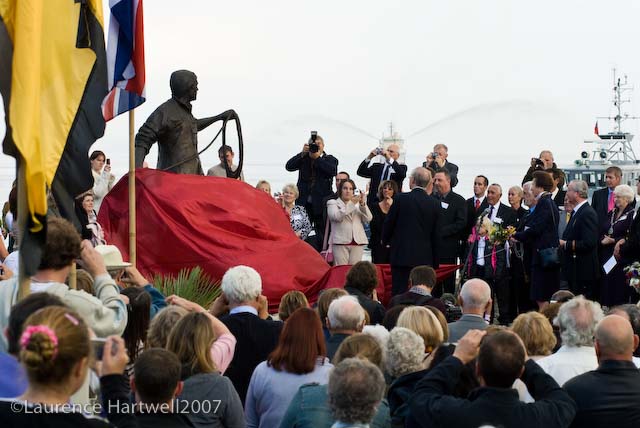
again with Royal support, Princess Anne did the honours in 2007 when she officially unveiled the fishermen's memorial sculpted by local artist Tome Leaper and partly funded by the Bolitho Trust ...


Henrietta Graham's Michael Jordan portrait alongside the second Newlyn fish auction oil sketch.
so it is no surprise that when portrait artist Henrietta Graham and marine artist husband Tim Hall move into their new studio behind Trelawney's fish merchant the working lives of those in the port continue to inspire and provide the opportunity to capture the life and soul of the port on canvas. 


Ken Howard OBE  working on an early morning study of the Old Harbour

So, if the thought of a harbourside studio setting or painting plein air on a secluded beach or cliff or capturing your own piece of history from Newlyn's historic 12th century historic old harbour or on its bustling fishmarket fills you with inspiration there are plenty of painting holiday opportunities available.