The online game, Pirate Fishing, casts you, the player, in the role of an investigative journalist who has to expose the multi-million dollar illegal fishing trade in West Africa.Juliana Ruhfus of People and Power spoke to us about what inspired her to #gamify current affairs.Click here to try the interactive game investigating Sierra Leone's illegal fishing trade: http://aje.io/dsrx The precious marine resources of some of the world's poorest people are being targeted by industrial-scale pirate fishing operations, to feed the seafood hungry markets of Europe and Asia. The problem is particularly acute in West African waters where fish is a vital - and often the only - protein source for millions of people. In a special two-part investigation, People & Power set out in 2012, to identify and expose some of those involved in the multi-million dollar trade and to look in particular at its consequences for the impoverished West African nation of Sierra Leone. More than two years later, in 2014, the problems are still the same, and now Al Jazeera is re-airing the investigations. In part one of Pirate Fishing , reporter Juliana Ruhfus and producer Orlando von Einsiedel take to the seas off Sierra Leone with an NGO, the Environmental Justice Foundation (EJF), which has been trying to raise awareness about the issue. In a dramatic opening sequence they manage to catch two South Korean trawlers in the act of fishing illegally inside a coastal exclusion zone. But contrary to international maritime regulations, the trawlers have covered up ship-board markings making it impossible to determine their names and ports of origin. The vessels refuse all their requests to stop and eventually make good their escape. What follows is a remarkable piece of forensic journalism as the Al Jazeera team strives to track down and identify the vessels. Along the way they investigate disturbing allegations that the trade is flourishing because of rampant local corruption, in which officials are paid to turn a blind eye to the activities of foreign trawlers. With their time in Sierra Leone fast running out and the authorities seemingly reluctant to help, it looks as though the two vessels might evade justice. But then the team gets a vital clue that cracks the mystery wide open. In part two of Pirate Fishing , the identity of one of the trawlers is revealed and in a nail biting climax, the captain and crew are confronted with the evidence of their crimes. Taken together the two films are akin to a dramatic detective story, but the issue they address is deadly serious. Sierra Leone is one of the poorest countries in the world - currently ranked 180th out of 187 countries on the Human Development Index. After coming out of a brutal civil war that lasted 11 years, the country has struggled to rebuild its devastated infrastructure. Its waters contain some of the richest fish stocks in the world and could, if sustainably developed and managed, one day provide the country with much-needed income. Even as things stand, fishing currently represents 10 percent of Sierra Leone’s GDP and is a crucial component in its food security (contributing 64 percent of the total animal protein eaten in the country). But the pirate fishing activities of foreign trawlers are stripping these fishing grounds so quickly that unless the practice is stopped there will soon be nothing left to develop. And most important of all, local people will be deprived of a crucial food source - just to satisfy the appetites of seafood lovers in Europe and Asia.
*Have something to say about Al Jazeera's news, shows and web coverage?
Jazeera’s most viewed news coverage, the week’s most popular documentaries, the inside story on how we get our stories, all available at the click of a button on:
FILMMAKER'S VIEW By producer/director Orlando von Einsiedel Right from the start of this project, our ambition was always to do more than just show that pirate fishing was taking place in West African waters. We wanted to see justice being done, to witness and film an illegally operating trawler being apprehended by the authorities at sea. But as a quick glance at a map will show, that was going to be easier to wish for than to achieve. Our chosen location, Sierra Leone, had many hundreds of miles of coastline - a huge area for us to cover - yet only a handful of small boats in private hands with the range and speed to do the job effectively. We also realised, early into the shoot, that our presence was not universally welcomed and that there were plenty of people with an interest in allowing pirate fishing to continue unhindered. Fortunately the NGO we were working with, the Environmental Justice Foundation , gave us access to their small but fast new patrol boat. With a ministry of fisheries representative, Victor Kargbo, on board (he had the authority to stop and board an illegal vessel if we found one), we were all set to go. As viewers of part one of our film will have seen, we got lucky. On our first day out at sea we received a tip off about two trawlers fishing illegally within the Inshore Exclusion Zone a few miles away. When we actually came across them, one of the things that really struck me was just how brazen they were. I could not believe how little respect they had for the rule of law or for the livelihoods of the local fishing communities they were destroying. They had deliberately covered over their shipboard markings (name, number and port of origin) to make identifying them very difficult and they ignored all of Kargbo's radio attempts to get them to stop. In fact, the crew members we could see on board just laughed at him. Their disdain was obvious and they clearly felt confident that they would get away with it. Such a level of ambivalence towards a country's laws only comes about when you are certain that there will be no consequences. But of course, in the concluding episode, you will see exactly how mistaken that belief was. Through good solid detective work we were able to identify one of the vessels and take the evidence to the authorities. What followed … well, you will just have to watch and see. On a professional level this was a very intense shoot. The only time we stopped moving was to sleep. When filming an investigation like this you always feel there is one more interview you could be filming or one more lead you should follow, so you only ever stop when you are completely exhausted. And filming at sea in a small boat has its particular challenges - we got caught in a huge storm on one occasion - and everything gets very wet, but our cameras (a Sony EX1 for the more action led sequences and then a Canon 7D HDSRL for the prettier shots) stood up well. They even survived climbing in and out of a deep freeze in the depths of one trawler we boarded, which, I have to say, at one point was more than I thought we would. Ultimately, this is a project I am very proud to have worked on. From a personal point of view I hope that the films will assist in moving the issue forward in Sierra Leone and internationally and that they will help to highlight to consumers in Europe and Asia the fact that the fish they are eating could be unethically sourced. I also hope that in a small way, the story of how a few very brave and determined Sierra Leoneans are prepared to take risks to help better their country, will inspire others to follow suit. It certainly inspired me. WHAT HAPPENED NEXT? Ocean 3: Following the end of filming, the Ocean 3 was fined $90,000 for breaking four Sierra Leonean fishing laws. In addition, it was charged the local value of its catch, a further $65,000. The vessel's owners struggled to pay the fine, eventually handing over only $125,129. The vessel was released from port to undertake further fishing in order to pay the rest of the fine. Its current location is unclear. More Investigations by Juliana Ruhfus The Nigerian Connection Exposing the plight of African women caught up in a web of organised crime, prostitution and human trafficking. The Brazil's River of Mud We investigate the events leading up to the Fundao dam disaster. Is enough being done to avoid future recurrences? Sri Lanka: War Crimes Is the establishment of truth key to reconciliation in Sri Lanka? Haiti: Seismic Election Revisiting Haiti ten months after the devastating earthquake Crude amnesty A look at the conflict between militants and the Nigerian military in the Niger Delta Marampa: The second vessel viewed by Al Jazeera and Victor Kargbo was documented fishing illegally by EJF again on January 8, 2012. The following week, the vessel was finally firmly identified as the Marampa 803 using photographs belatedly provided by the vessel's agent, the Sierra Fishing Company. It was arrested on the night of January 18, 2012 and now faces multiple charges. The complicity of Sierra Fishing Company, which is part-owned by a donor-funded ethical venture capitalist company, is currently under investigation. Five Star: The Five Star - the vessel photographed by Juliana Rufus in Freetown harbour and found not to be one of the trawlers viewed by Al Jazeera on October 22, 2011 near Bonthe - has been repeatedly accused of fishing within the Inshore Exclusion Zone by fishermen in the Bonthe area. Fishermen in Liberia also allege that it fished without a license in that country's Inshore Exclusion Zone several times in November and December 2011. The vessel is also under investigation by EJF for transhipping illegally on the night of January 18, 2012.Kum Myeong 2: On December 9, 2011 the Kum Myeong 2 was documented by the EJF boat fishing illegally at the entrance of the Sherbro River. The government of Sierra Leone reacted swiftly to EJF's evidence and called the vessel to port. Instead of coming into Freetown to be fined, however, the vessel fled Sierra Leonean waters. It is believed to now be on the run in Guinea. Victor Kargbo: Victor continues to investigate pirate fishing vessels breaking Sierra Leonean law. On the night of January 18, 2012, Victor travelled with colleagues from the Ministry of Fisheries and Marine Resources and the Sierra Leonean navy in a chartered vessel to arrest the Marampa 803 over 70 miles from the coast. Victor and his colleagues next attempted to arrest a refrigerated cargo vessel that the Marampa was believed to have been planning to transfer its catch to. Victor's vessel ran into difficulty, however, and was lost at sea, out of contact for 36 hours, before being spotted by a UN helicopter scrambled in a massive search and rescue effort. Vessel monitoring systems: The Minister of Fisheries and Marine Resources has ordered a significant tightening of controls on fishing vessels operating in Sierra Leone. Vessels are now liable for sanctions if they turn their vessel monitoring systems off for longer than one hour instead of the previous 72 hours. In addition, Sierra Leone's cabinet is currently considering a draft Fisheries Act that will increase fines on vessels operating illegally and strengthen the role of fisheries observers on board vessels. Under the act, fishing vessels that hide their markings will face much stiffer penalties. The navy and Ministry of Fisheries and Marine Resources (MFMR) recently undertook a joint fisheries patrol on board the EJF boat. The team travelled to Sulima, a hard to reach area near the Liberian border with high levels of illegal fishing activity. This area is now reachable in the EJF boat and illegal trawler incursions are reported to have declined since the team's visit.
FOR MORE INFORMATION ON THE ILLEGAL FISHING TRADE
Click here to find out more about the work of the Environmental Justice Foundation (EJF).
Do you know this ship? Click here for a list of all the vessels that have been blacklisted by any of the eight Regional Management Organisations that currently operate lists of vessels that have been involved in illegal fishing. The list is published in cooperation with Stop Illegal Fishing, a working group of the NEPAD Agency's Partnership for African Fisheries Programme . The NEPAD is the implementing arm of the African Union. The list is continuously updated as the vessels change name, flag and/or call sign. Where they are available, pictures of the vessels are also included.
With the majority of boats back at sea after storm Doris and her siblings paid a visit there were only a handful of boats who made it in to land for the mid-week market...
with the bulk of the fish coming form the big gill netter, Joy of Ladram...
who landed a mostly hake...
and a few of these controversial fish...
and the odd cod...
meanwhile, here fellow fleet member, Goveenk of Ladram was making...
an ealry morning landing before taking ice and heading straight back to sea again.,..
handliners from St Ives continue to fill the middle fridge with mackerel...
though it looks like there were some weighing exercises to be had on the market...
these stunning fish will be gracing Mousehole Fish's counter later today...
not long after the market is cleared and all set for tomorrow's auction...
away on the slip, Rowse's next crabber glows in the dark...
as the sun begins to push its way towards the horizon...
the new pots on the left have been roped ready for action, just a few hundred more to get through.
The first in a series of six documentaries about the people and places of West Cornwall. Made in 1982 my Yorkshire TV. Directed by Barry Cockcroft. Transferred from VHS to digital tape January 2017.
INTRODUCTION In this manual we describe the different stages of the fish capture process, highlight how different parts of the gear may influence selection and identify possible design changes which can alter the selectivity of the gear. The intention is to make fishermen, net makers and fisheries managers more aware of the possible modifications that can be made to their gears so that they can design and develop gears with a selective performance suitable for their particular fishery. We have also assembled a catalogue of fact sheets which provide brief descriptions of many of the catch comparison and selectivity trials that have taken place in the North Atlantic and adjacent seas. This is again to highlight the potential gear modifications that can be made and to provide an indication of their likely effect. It is important to bring together this type of information and to disseminate it as broadly as possible. Not only will the preferred selective performance differ at a fishery by fishery level, it may also vary at a vessel by vessel level, as individual fishermen may wish to tailor their gears to the specific catch and quota restrictions they may face and/or to optimise their response to the prevailing market forces. The catalogue of factsheets is by no means exhaustive, indeed, it is just a starting point, and it is anticipated that the web version will be added to and built upon. www.discardless.eu
Marine Scotland is the directorate of the Scottish Government responsible for the integrated management of Scotland’s seas. Marine Scotland Science (formerly Fisheries Research Services) provides expert scientific and technical advice on marine and fisheries issues. Scottish Marine and Freshwater Science is a series of reports that publishes results of research and monitoring carried out by Marine Scotland Science.
The plastics contained in fishing nets have a value as a raw material, unfortunately the economics of the global recycling industry works against establishing a local-scale solution, and as a result we see the value of those nets exiting the county, or worse; going to landfill or being added to waste-to-energy streams.
Fishy Filaments wants to provide a local, commercial route to intercept and recycle marine plastics and by doing so capture the value of those materials for the local economy after their first life as fishing gear.
To this point the project has been self-financed, but has been working with the support of Fishing for Litter (South West) and The Newlyn Pier and Harbour Commissioners, with the aim of taking both caught marine litter (sometimes known as ghost gear) and end-of-life fishing nets, processing them locally and producing a valuable hi-tech material for the fast-growing 3D printing sector.
The project has already produced a world first; we made a 3D printed form made entirely from recycled fishing nets that were used by the Newlyn fleet and in the longer term we have plans to take other locally-arising wastes, produced by boat and board-building, to add further products to the portfolio.
The ultimate aim is to go into commercial production, securing supplies of used fishing gear from around the county, and maybe further, making local hires and selling the 3D printing filament to a national or possibly global market. For Fishy Filaments a sustainable business is one that is self-supporting as well as being socially and environmentally responsible.
However before we can get to that full commercial roll-out, there remains a phase of up-scaling and product testing that needs to be done. It is this advanced feasibility study that we are asking for help with.
To this point our Research and Development has been a well-thought through, but manual process able to produce only limited lengths of filament at a time. To get our product consistency high enough to justify sending the product to external testers, the R&D kit used so far needs to be replaced by lab grade production machinery.
The £5000 target is sufficient to buy the professional-quality equipment necessary to produce a testable product and construct demo pieces from that product. This feasibility study will also provide the numbers upon which a final business plan will be built before we enter a final round of ‘go live’ funding.
Technically we’ve proven the process. Now we need to prove that a business can be built on it.
Rewards
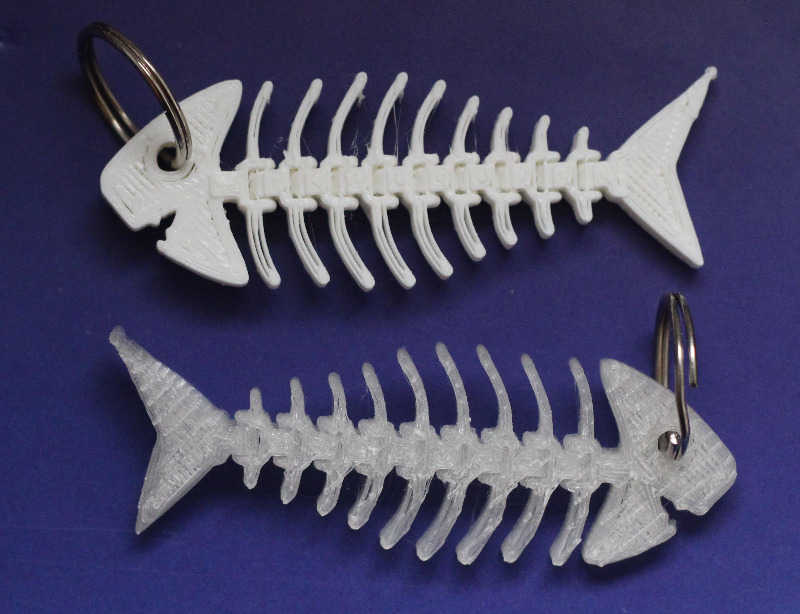
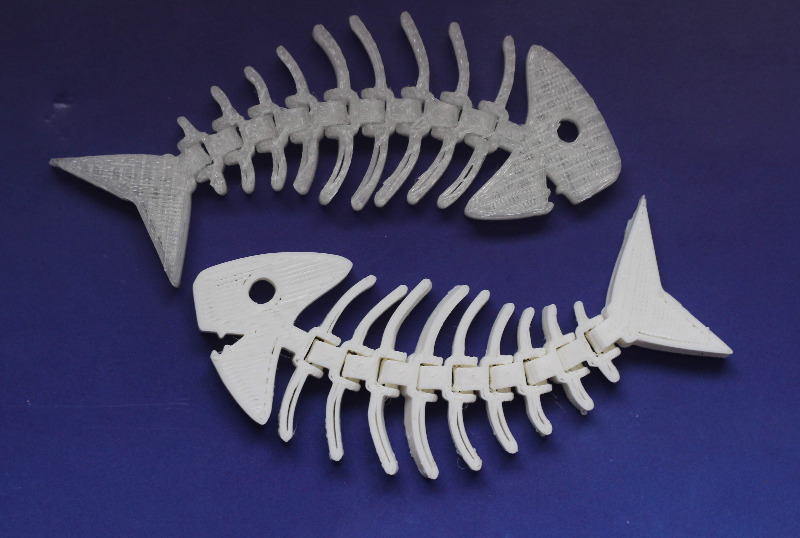
It is customary to offer rewards for funding pledges. Fishy Filaments is offering a range of pledge options, some of which include 3D printed plastic items. These items were produced by Fishy Filaments in Cornwall using an open source design posted on Thingiverse by StevenDuval (http://www.thingiverse.com/thing:1360291) and are made from PLA, a biodegradable plastic whose raw materials are cornstarch or milk. We have conducted independent tests to confirm that the PLA used does degrade over time.Given the nature of the issues surrounding marine plastics we have also given pledgees the option to NOT recieve a plastic item, even one that we feel is appropriate, and we respect that choice.
On Sunday evening, over 140 works of art were projected on to the wall of the clock tower in Porthleven - exactly 3 years to the day a huge storm smashed the 12"x12" timber baulks to pieces that protect the inner harbour from huge seas - ten boats sank and thousands of pounds worth of fishing gear were lost or damaged - the Fishermen's Mission were there to help.
Next month, on the 16th of March, all the works of art will be auctioned by local Penzance auction house, David Lays - online and live from the Atlantic Inn in Porthleven. A big thank you to Impact Sound & Light for the projected lightshow.